
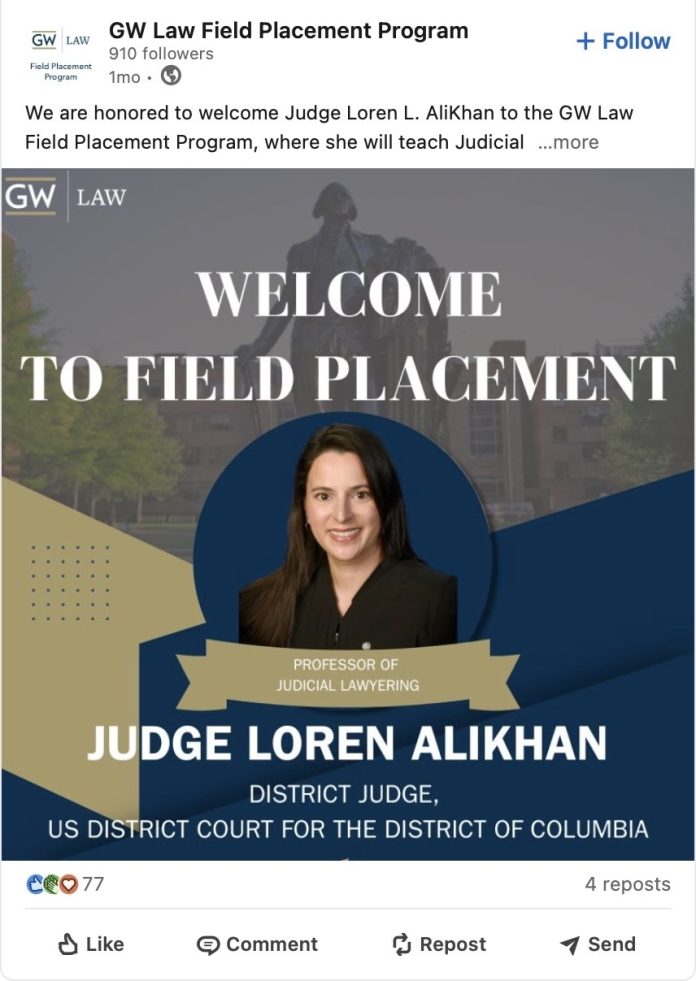
The Washington Free Beacon showed that George Washington University hired a federal judge who is presiding a lawsuit accusing GW Law of “pervasive antisemitic harassing” to teach a GW Law class on “ethics, discretionary judgment and social media posts.” The judge, Biden’s appointee Loren AlKhan, is yet to recuse from the case. Legal experts have criticized her for not doing so.
GW Law School Field Placement Program has announced that AliKhan is teaching a course co-requisite on “judicial lawyering.” The class covers topics such as “protocol,” “professionalism,” “judicial decision-making,” and “an attorney’s ethical duties and discretionary judgement.” According to the course bulletin that states the class is part the Spring 2026 term, the class will also cover “equality, discrimination and racism in law,” and “an attorney’s role in creating an equal access legal system.” This semester began on January 12. AliKhan’s hiring was therefore before the announcement.
AliKhan, who was nominated by then-president Joe Biden to the court in may 2023 noting she would be “the First South Asian Woman to Serve on United States District Court for District of Columbia”, needed a tiebreaking vote by then-vice-president Kamala Harris in December 2023 to secure Senate confirmation. She has not recused from the antisemitism suit against her new employer. AliKhan did not acknowledge a possible conflict of interest until several weeks after the announcement. She issued on March 30, a 10-day stay “to assess if she has a situation that warrants disqualification, disclosure to parties, or any other appropriate action.” She then scheduled a “status meeting” for April 20, despite the fact that she had been aware of a potential conflict.
According to law professors, the Free Beacon reported that AliKhan’s suspension should have been immediate because federal laws and rules clearly state that she should not have been allowed to continue.
Keith Fisher, associate Professor of St. Thomas University College of Law, who wrote legal briefs for the American Bar Association in a Supreme Court case regarding a judge’s refusal recuse himself, said AliKhan’s decision to not immediately “disqualify” herself shows “an abysmal failure of judgment.”
This is a simple decision. You should not allow even a smidgen of suspicion that you may not be impartial,” said he to the free Beacon. “The moment she accepted this position with GW she should have disqualified herself to short circuit this whole thing.”
Fisher said AliKhan’s conduct “falls within a literal interpretation” of the code for federal judges. The code requires judges to disqualify if they have an “interest that could reasonably be questioned,” such as a financial interest in a subject matter or party in the proceeding or any other interest.
Seth Oranburg is a law professor from the Franklin Pierce School of Law at the University of New Hampshire. He agreed with Fisher’s assessment.
“A judge can’t pause a conflict: judges on the payroll of a litigant should recuse themselves immediately. Judge AliKhan’s’staying’ of the Soffer V. Gwu case in order to ‘assess her conflict of interest’ unfairly harms plaintiff by delaying inevitable. He told the Free Beacon that her complete recusal was the only ethical solution.
Requests for comment from either AliKhan or GW were not answered.
The antisemitism suit AliKhan oversees alleges that GW has violated Title VI by allowing a hostile educational environment to flourish without check. The lawsuit includes a litany incidents against Jewish students including physical assaults and vandalism. University administrators are alleged to have turned a blind-eye.
Sabrina Soffer is one of the plaintiffs that graduated last spring. She told the Free Beacon she and her legal team did not know AliKhan had a new job until the judge stopped the case.
“This is a serious case, and nothing should be done to diminish its importance.” Soffer said, “I hope that the circumstances that led to this appointment are transparent and that this case will be treated fairly.”
Jason Torchinsky – Soffer’s lawyer and a former official of the Justice Department’s Civil Rights Division – lamented that GW’s decision to hire AliKhan “delays justice”.
“We believe the judge should recuse herself due to her apparent employment with GW’s Law School.” Torchinsky, a lawyer for the Free Beacon, said that his clients were upset by the incident. “The need to send the case to another judge will delay justice and the reckoning necessary with antisemitism on GW’s Campus,” he added.
AliKhan was criticized during her Senate confirmation hearing for arguments she made while serving as solicitor general of District of Columbia. These arguments were centered around religious liberty. In one instance she argued religious services posed “a greater risk” of COVID-19 than people gathered for anti-police demonstrations, but presented no proof, prompting criticism by Republicans.
AliKhan, since the beginning of the second Trump Administration, has issued a number of rulings which have halted and constrained executive action. These include blocking a federal funds freeze, enjoining the executive orders targeting law firm, which she called “abuses of power,” as well as limiting the efforts of the administration to remove officials from Federal Trade Commission, by ordering their restoration.
She was the president of Georgetown University’s chapter of the ACS while she attended law school there. She has consistently spoken at ACS events, including those held by the Vanderbilt Law School. She was the president of Georgetown University’s chapter of ACS during her law school years and has consistently delivered speeches since 2018..
The post George Washington University hires federal judge overseeing antisemitism lawsuit against it to teach ‘Ethics’ and ‘Discretionary Judgement’ first appeared on.