
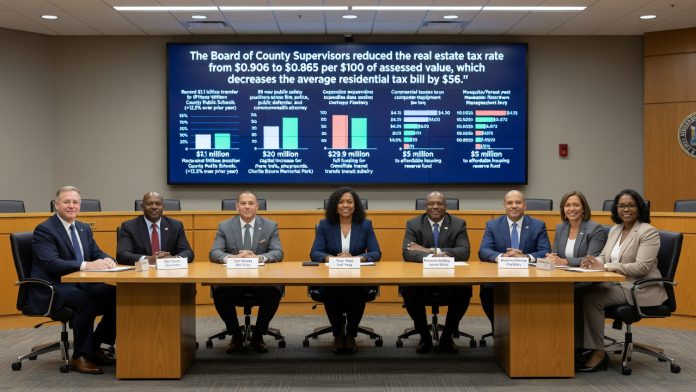
The Prince William County Board of County Supervisors recently approved a fiscal year budget that reduces the real estate tax rate while simultaneously expanding funding for local schools and public safety. Following extensive public hearings, the board voted to lower the real estate tax rate from $0.906 to $0.865 per $100 of assessed value for the upcoming fiscal cycle. This reduction of just over four cents translates to an estimated average decrease of $56 on residential tax bills across the county. Local leaders indicated that the budget aims to balance the financial realities of taxpayers with the growing infrastructure needs of the expanding region.
Board Members Navigate Fiscal Adjustments
The current Prince William County Board of County Supervisors consists of Chair Deshandra Jefferson, Tom Gordy, Yesli Vega, Bob Weir, Victor Angry, Kenny Boddye, Andrea Bailey, and Margaret Franklin. These elected officials deliberated extensively over several weeks to craft a financial plan that addresses both regional inflation and rapid population expansion. Over the last six years, the board has overseen a cumulative real estate tax rate decrease of $0.25, dropping from a high of $1.115 in fiscal year 2022 to the newly adopted $0.865. The latest budget adoption reflects ongoing local government efforts to mitigate the impact of rising property assessments on individual homeowners.
While residential property owners will see a slight reduction in their real estate tax bills, the board implemented targeted increases in commercial areas to offset the revenue difference. Specifically, the personal property tax rate on computer equipment and peripherals was increased from $4.15 to $4.50 per $100 of valuation. This strategic adjustment is explicitly designed to shift a larger portion of the county tax burden off of local residents and onto the rapidly expanding data center industry. By increasing the levy on computer equipment, the county can generate necessary operational revenue without heavily taxing local households.
In addition to the primary real estate tax adjustment, the board approved minor reductions in specialized local levies affecting property owners. The countywide fire levy rate was reduced from $0.072 to $0.070 per $100 of assessed value. Furthermore, the mosquito and forest pest management levy rate saw a modest decrease from $0.0025 to $0.0020. These incremental reductions provide additional, albeit small, measures of financial relief for property owners navigating the current economic climate and rising costs of living.
Record Investments in Education and Public Services
Despite the reduction in the residential real estate tax rate, the newly adopted budget includes significant funding increases for the Prince William County Public Schools system. The school division will receive a record transfer of $1.1 billion, representing a substantial 12.5 percent increase over the previous fiscal year. This additional $123.5 million allocation is intended to maintain the existing revenue-sharing agreement, reduce classroom sizes, and enhance comprehensive school security measures. Local officials believe these educational investments are critical for maintaining the high standards expected by community residents. Chair Deshandra Jefferson noted that education remains a paramount priority, emphasizing that this historic funding transfer is designed to ensure a successful future for local children.
Public safety and environmental sustainability initiatives also received substantial financial backing in the newly adopted fiscal plan. The budget allocates funding for 85 new public safety positions spread across the fire and rescue, police, public defender, and commonwealth attorney departments. An additional $1 million was specifically earmarked to expand comprehensive physical examinations for county firefighters to ensure occupational health. Meanwhile, the Office of Environmental Sustainability secured funding for a new staff position, local watershed restoration projects, and vital solid waste infrastructure improvements.
Enhancing Local Parks and Transportation Networks
The approved budget directs considerable resources toward community amenities and regional transportation services that benefit the growing population. The Parks and Recreation department received a $20 million increase in capital investment funding for immediate and long-term projects. This financial boost will directly support the development of new trails, modern playgrounds, community spaces, and the future Charlie Boone Memorial Park. Additionally, the local transit system, OmniRide, received full funding for its local subsidy request, totaling $29.9 million to maintain essential public transportation routes throughout the region.
Addressing the growing need for accessible living options, the board also approved a $5 million contribution to the county affordable housing reserve fund. Chair Deshandra Jefferson stated that the budget reflects a steady commitment to community safety, wellbeing, affordability, and overall economic prosperity. Supervisor Kenny Boddye echoed these sentiments following the budget adoption, noting that days of deliberation and public engagement helped craft a financial plan that delivers more services to local residents. Boddye acknowledged that while the final budget might not be flawless, it represents meaningful legislative progress for the rapidly developing county.
Email the Prince William Board of Supervisors At:
Chair At-Large (Deshundra Jefferson) – djefferson@pwcgov.org,
Brentsville (Tom Gordy): tgordy@pwcgov.org,
Coles (Yesli Vega): yvega@pwcgov.org,
Occoquan (Kenny Boddye): kboddye@pwcgov.org,
Potomac (Andrea Bailey): abailey@pwcgov.org,
Woodbridge (Jeannie LaCroix): jlacroix@pwcgov.org,
General Board: bocs@pwcgov.org,