
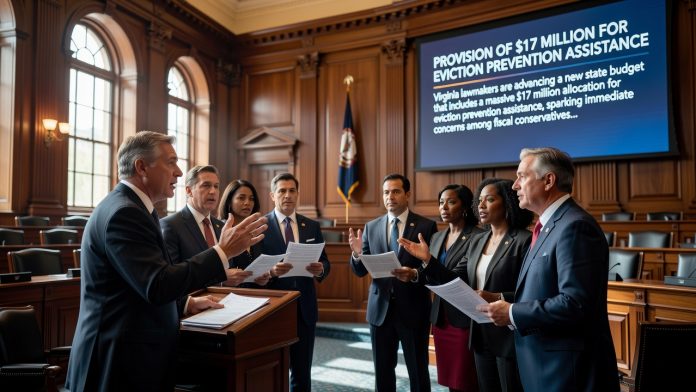
Virginia lawmakers are advancing a new state budget that includes a massive $17 million allocation for eviction prevention assistance, sparking immediate concerns among fiscal conservatives. This hefty provision is tucked inside House Bill 30, which proponents are calling the Affordable Virginia Budget for the upcoming fiscal years. While advocates claim the funding is necessary to help struggling families, critics argue this represents a dangerous expansion of the welfare state. Hardworking taxpayers are now being asked to shoulder the financial burden of individual housing obligations, raising serious questions about government overreach and fiscal responsibility.
The $17 million appropriation is explicitly designed to backfill recent federal funding cuts to various safety net programs across the Commonwealth. In previous budget cycles, base state funding for the Eviction Prevention and Diversion Pilot Program typically hovered around $3.3 million to $3.45 million annually. This new allocation represents a staggering multi-million dollar expansion that drastically increases the long-term financial liabilities of the state. Fiscal watchdogs warn that replacing temporary federal emergency funds with permanent state tax dollars is a proven recipe for structural budget deficits.
This ballooning funding will directly affect the Virginia Department of Housing and Community Development by heavily expanding the Virginia Eviction Reduction Program. Bureaucratic agencies historically struggle to manage such rapid influxes of cash without falling victim to administrative waste and highly inefficient spending practices. Expanding these diversion programs at this unprecedented scale requires increased overhead, meaning a significant portion of taxpayer money could be lost to government bureaucracy rather than helping citizens. Conservatives argue that state agencies should be thoroughly audited and streamlined before receiving massive budget increases that inevitably grow the size of government.
Questioning the Fiscal Responsibility of Expanding Welfare
The proposed eviction prevention funds are merely one piece of a much larger housing package that significantly expands overall state spending. Lawmakers have also earmarked over $187.5 million for the Virginia Housing Trust Fund and an additional $17.6 million for rapid rehousing efforts. When combined, these initiatives represent hundreds of millions of taxpayer dollars flowing directly into government-managed housing interventions. Critics maintain that these massive expenditures do little to address the root causes of economic instability, choosing instead to apply costly taxpayer-funded bandages that fail to lower inflation.
Democratic leadership continues to defend the massive spending increases as a necessary response to current economic conditions and housing challenges. House Appropriations Chair Luke Torian justified the budget by stating that it is not just about filling gaps, but rather about addressing an affordability crisis touching nearly every household across the Commonwealth. Speaker Don Scott, along with lawmakers Charniele Herring and Kathy Tran, released a joint statement claiming this fiscally responsible budget prioritizes the areas where families are hurting the most. However, conservatives point out that true fiscal responsibility involves cutting taxes and reducing government waste rather than expanding dependency programs that ultimately burden the working class.
Protecting the Taxpayer and Promoting Accountability
The push to dramatically increase eviction prevention funding ignores the fundamental conservative principle of personal financial responsibility. When the government routinely steps in to pay private rent obligations, it disrupts the free market and removes incentives for individual financial independence. Landlords and property owners also face increased uncertainty when the state becomes heavily involved in private lease agreements through government-mandated diversion programs. Free market advocates argue that reducing burdensome local zoning regulations and lowering property taxes would do far more to create affordable housing than expanding bureaucratic welfare initiatives.
Whenever government programs experience a sudden and massive influx of funding, the risk of fraud and financial abuse skyrockets exponentially. The Virginia Eviction Reduction Program will now be responsible for distributing $17 million without adequate new safeguards to ensure the money reaches those in genuine, temporary need. Taxpayers have a fundamental right to demand strict oversight and rigorous means-testing to prevent this program from becoming a permanent entitlement scheme. Without stringent auditing measures firmly in place, millions of taxpayer dollars could easily be wasted on fraudulent claims or unnecessary administrative bloat.
As the debate over House Bill 30 continues, fiscal conservatives are urging lawmakers to strongly reconsider this massive expansion of state spending. Slashing unnecessary programs and returning surplus funds to the taxpayers should be the primary focus of the upcoming legislative session in Richmond. Virginia simply cannot afford to replace expiring federal dollars with permanent state-funded welfare expansions that will inevitably drive up taxes for everyone. Lawmakers must prioritize budget reductions and strict fiscal restraint to protect the long-term economic health and prosperity of the Commonwealth.