




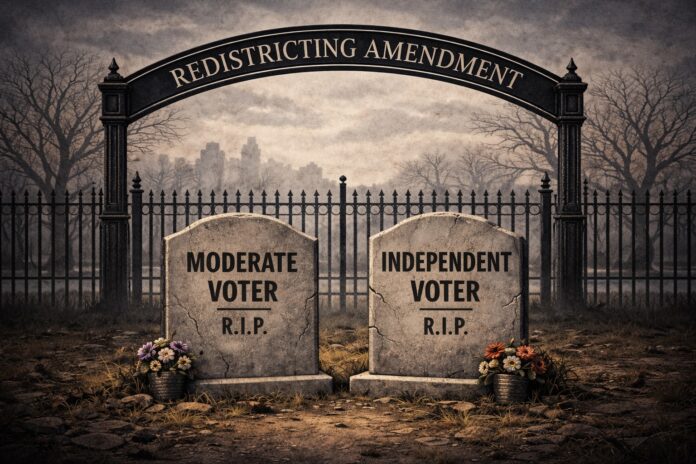
Elections With Predetermined Outcomes
Gerrymandering deliberately manipulates political districts to give one party an unfair structural advantage. By “packing” (concentrating certain voters) and “cracking” (diluting others), the outcome of elections can be effectively decided before a single vote is cast.
Heavily engineered districts don’t just shape who wins—they shape whose voices count. The voters most often pushed to the margins are moderates and independents, the very citizens who tend to favor balance over ideology.
When Primaries Matter More Than People
The mechanism is simple: draw districts so politically safe that the general election becomes little more than a formality. Candidates no longer need to persuade abroad cross-section of citizens. Their only task is surviving a low-turnout primary dominated by the most partisan and ideologically motivated voters.
Elections are no longer decided by the reasonable middle, but by the loudest political edges. The incentive shifts from solving problems to proving ideological loyalty.
Moderates Become Politically Invisible
For party moderates, this creates a political Catch-22. Their numbers may be large, but they are scattered across districts in ways that prevent them from forming a decisive bloc. Their preference for pragmatism, compromise, and practical governance is structurally drowned out by voters demanding ideological rigidity.
Moderates are still there. They still vote. But under gerrymandered maps, they become present—yet politically invisible.
Independents face an even steeper climb. Because they do not reliably participate in party primaries, they are largely excluded from the stage where elections are actually decided. By November, their choices have already been filtered through a process designed without them in mind, reducing their role to little more than rubber-stamping predetermined outcomes.
A Legislature Pulled Away From the Center
Lawmakers from gerrymandered districts are not rewarded for listening to the center—they are rewarded for avoiding it. Their greatest political threat is not the opposing party, but a primary challenger who claims to be more ideologically pure.
The result is a governing environment that discourages cooperation, penalizes moderation, and deepens division.
Gerrymandering doesn’t cancel elections—it empties them of meaning.
The ballot remains. The process remains. But when districts are designed to protect parties instead of represent communities, moderates and independents don’t just lose influence—they lose their voice in the system altogether.
In April, moderates and independents will have the opportunity to decide whether their voice should remain relevant in future elections.
To stay relevant, vote No on the “Virginia Use of Legislative Congressional Redistricting Map Amendment.”
NEWSLETTER SIGNUP
Subscribe to our newsletter! Get updates on all the latest news in Virginia.