


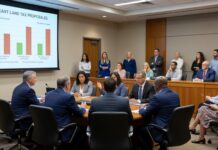


RICHMOND, Va. – The Virginia Senate gave final legislative approval to House Bill 1 on March 4, 2026, passing the measure by a narrow 21-19 vote and sending it to Governor Glenn Youngkin for consideration. The bill, which incrementally raises the state’s minimum wage to $15 per hour by January 1, 2028, codifies the current adjusted rate of $12.77 per hour effective January 1, 2026, before increasing it to $13.75 per hour on January 1, 2027. Starting January 1, 2029, the minimum wage will adjust annually based on changes in the consumer price index, aligning future rates with inflation trends.
Sponsored by Delegate Jeion Ward of District 87, HB1 originated in the House of Delegates, where it passed on February 3, 2026, with a 64-34 tally. The legislation moved swiftly through committees, first clearing the House Labor and Commerce Committee on January 20 by a 15-7 vote, then the Appropriations Committee on January 28 by 15-7. In the Senate, it advanced from the Commerce and Labor Committee on February 23 with an 8-5 vote and from Finance and Appropriations on March 3 by 9-5 before the full chamber vote.
The bill’s progression reflects the structured timeline of increases, providing two years from the current $12.77 rate to reach $15. This gradual approach builds on Virginia’s existing minimum wage law, which automatically adjusted upward from $12.41 to $12.77 for 2026 based on prior statutory formulas. Proponents note the CPI linkage ensures the wage keeps pace with rising living costs without exceeding economic realities.
Fiscal analyses from the Department of Planning and Budget indicate a modest impact on state expenditures, estimating an increase of $757,203 in general fund expenses alongside $489,371 in other funds. This limited budgetary effect underscores the bill’s targeted scope on wage floors rather than broad spending mandates.
House passage drew 34 dissenting votes, while the Senate’s 19 no votes highlight sustained scrutiny over potential effects on employment sectors reliant on entry-level labor. Virginia’s economy, marked by robust small business presence, has seen similar proposals face resistance in past sessions. Governor Youngkin vetoed comparable minimum wage legislation in 2024, including prior versions of HB1 and SB1, citing concerns for job creators. The National Federation of Independent Business praised those actions, emphasizing protection for small employers.
HB1 mirrors its Senate counterpart, SB1, ensuring identical policy across chambers. Ward, serving District 87 encompassing parts of Newport News and Hampton, introduced the measure prefiled on November 17, 2025, positioning it as a priority early in the 2026 Regular Session.
As the bill awaits gubernatorial action, stakeholders monitor its path. Virginia’s current minimum wage structure, decoupled from the federal $7.25 rate since 2021, has risen steadily through inflation-tied adjustments. The proposed $15 threshold positions the commonwealth competitively with neighboring states while the incremental steps afford businesses adaptation periods amid ongoing economic recovery.
The close committee and floor margins—consistently around two-thirds support—demonstrate deliberate legislative vetting. Appropriations panels in both chambers approved referral with majorities exceeding 60 percent, balancing wage updates against fiscal prudence. With the General Assembly’s 2026 session advancing, HB1 stands as a key labor measure now in executive review.
Virginia’s minimum wage history traces to 2020 reforms establishing annual CPI adjustments post-2025, which HB1 extends and accelerates modestly. The bill’s text amends Section 40.1-28.10 of the Code of Virginia, embedding the phased hikes into statute for stability.
Governor Youngkin, emphasizing economic growth in prior addresses, holds the deciding authority. His office has not commented on HB1 as of March 5, 2026, but past vetoes of wage mandates signal rigorous evaluation of business impacts.
NEWSLETTER SIGNUP
Subscribe to our newsletter! Get updates on all the latest news in Virginia.