
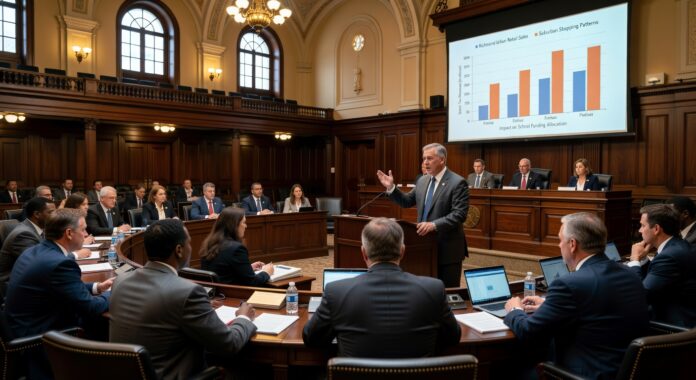
Under Virginia law, localities collect a 1% share of the 6% sales tax on transactions occurring within their borders. This money supports general funds, including K-12 schools, which derive about 45-55% of operating costs from local sources. In the Richmond region, the city has long faced challenges attracting major retailers. Residents often travel to Henrico County or Chesterfield County for groceries, household goods, and other purchases at stores like supermarkets and Walmart locations.
This ‘sales tax leakage’ means Richmond forgoes significant revenue—estimated in millions annually—while bolstering suburban school districts. During the hearing, Delegate Garrett addressed concerns raised about this disparity. He noted the absence of adequate retail in Richmond, questioning why neighboring counties should compensate. ‘No supermarket, let alone a Walmart,’ he observed, attributing the issue to local conditions.
The Madam Chair responded by affirming consumer choice: residents select where to shop, directing taxes accordingly. The exchange occurred amid discussions on potential legislative adjustments, such as revising allocation formulas to better reflect residency or economic needs.
Richmond Public Schools have struggled with funding shortfalls, lower test scores, and infrastructure needs, partly linked to a narrow tax base. Property taxes provide steady income but yield less in the city due to valuation differences. Sales tax, more volatile, amplifies inequities when retail flight occurs.
Henrico and Chesterfield, conversely, benefit from commercial vibrancy. Strategic development has positioned them as retail destinations, generating surplus for schools and services. Officials there defend the status quo, arguing it rewards investment.
Proposals to reform the system vary: some seek state grants to offset losses, others proportional allocation based on population. Past efforts, like those in other states, have mixed results, sometimes sparking business relocations.
Stakeholders await further action as the session nears its close. Economists note Virginia’s system promotes competition among localities, fostering growth. Critics argue it penalizes core cities recovering from deindustrialization.
The debate encapsulates Virginia’s diverse needs: urban revitalization versus suburban prosperity. Resolution could influence budgets across the commonwealth.
Source: Field reports and eyewitness accounts.
NEWSLETTER SIGNUP
Subscribe to our newsletter! Get updates on all the latest news in Virginia.