
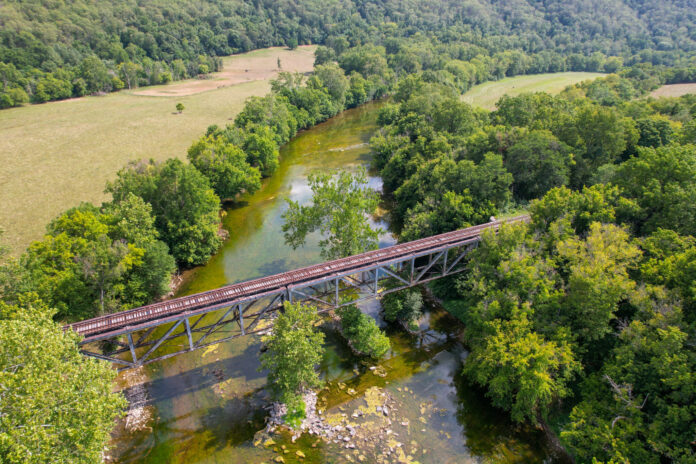
The Shenandoah Valley Battlefields Foundation, known for preserving the Civil War and historic sites, is facing legal action from one of its own members over plans to restore an inactive Manassas Gap rail line in the Shenandoah Valley.
Frank Cihlar, a foundation member, filed a lawsuit Friday in Shenandoah County Circuit Court, alleging the organization has “no legal authority” to restore commercial freight service on the rail corridor owned by Norfolk Southern Corporation. Cihlar argues the foundation’s involvement strays far from its mission and threatens its federal tax-exempt status.
“What the hell is a tax-exempt foundation that gets deductible contributions … getting involved in this issue that has nothing to do with the Civil War,” Cihlar said in an interview.
Last year, the foundation partnered with the Shenandoah Rail Corridor Coalition to negotiate a $23 million letter of intent with Norfolk Southern to purchase the nearly 50-mile corridor, which stretches from Front Royal to Rockingham County.
Cihlar’s lawsuit seeks to block the foundation from proceeding with efforts to restore commercial freight service, arguing the project contradicts the organization’s charter and management plan. He asked the court to intervene and halt what he considers a misuse of the foundation’s resources and mission.
Mark Perreault, a retired in-house counsel for Norfolk Southern Corporation, chairs the foundation’s Board of Trustees, while foundation CEO Keven Walker serves as both the organization’s spokesman and a representative for the foundation and of the Shenandoah Rail Corridor Coalition.
In a statement, the foundation defended its efforts to preserve the Manassas Gap Railroad, a site designated as historic by the U.S. Secretary of the Interior over 25 years ago.
“Our discussions regarding the preservation of the railroad have been undertaken in close consultation with governing authorities and in a manner consistent with our bylaws and mission,” the foundation stated. “We look forward to sharing the merits of our position and advancing public dialogue regarding an important opportunity to preserve a significant piece of our shared history.”
But Cihlar’s complaint argues that the Shenandoah Valley Battlefield Foundation is acting beyond its legal authority by pursuing its railway restoration plans. He contends that neither the foundation’s Articles of Incorporation or the federal statute under which it operates permits such activities.
“You don’t have to be a tax lawyer to know that the operation of a commercial freight railroad is not charitable by definition, it isn’t educational and it isn’t scientific,” Cihlar said.
If the court rules in his favor, Cihlar said, the foundation would be required to recover all funds allegedly spent on studies and related efforts to restore the rail line, and any additional contracts would be nullified.
In 2020, Virginia began studying the feasibility of converting the inactive Norfolk Southern rail segment in the Shenandoah Valley into a multi-use recreational trail. Four years later, with the study complete, the community remains divided over how to best use the nearly 50-mile corridor.
The state allocated up to $35 million to “buy land for the proposed rail, trail and conduct in initial planning in site development.” Some community organizers advocate for developing a public trail for pedestrians and cyclists, citing its potential for recreational use and tourism.
Meanwhile, the Shenandoah Valley Battlefields Foundation and the Shenandoah Rail Corridor Coalition struck a deal with Norfolk Southern to create a 450-acre linear park featuring an excursion and freight railway.
Critics argue that restoring the rail line while building a parallel trail could become prohibitively expensive.
Last June, Walker, the foundation CEO, said the coalition solicited bids to revive the rail line and suggested that applicants could use the $35 million in state funds to make the necessary repairs. However, language in the state budget specified that any land acquisition for the trail “shall not preclude the consideration of options to maintain rail transportation in the corridor.”
Virginia Secretary of Transportation Shep Miller said the state is now conducting a second study to examine a “broad variety of potential options” for the corridor. The study remains under development, and VDOT anticipates the release of the Phase 1 Report and a public input process in spring 2025.