
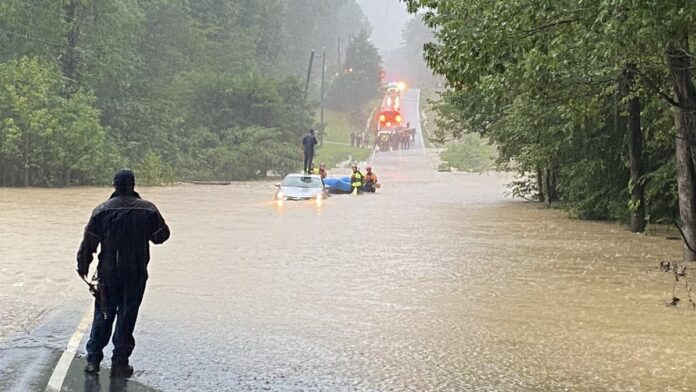
After tragic flooding in Texas claimed dozens of lives and wreaked havoc in several communities, Virginia weather and emergency officials are pitching in to the Lone Star State’s recovery efforts and sharing how they prepare for major weather events here at home..
Gov. Glenn Youngkin on Sunday announced two of the state’s swift water rescue teams have been deployed to assist with rescue operations in Texas, as the state braces for more rain after flash flooding devastated its central region. The rescue teams are equipped with gear that is meant for traversing treacherous waters.
“Our hearts go out to the families and communities in Texas who have been devastated by these historic floods,” Youngkin said in a statement. “We stand in solidarity with the people of Texas, and we are committed to offering any and all support requested during this critical time.”
Before a weather event occurs, meteorologists from the National Weather Service’s regional offices provide critical forecasts. They are able, in most situations, to project how a weather system could move through the area and the best and worst case scenarios for storms. That information is relayed to state and local agencies who determine how to warn the public, stage supplies or possibly enact evacuation plans.
“Giving them that information so they can prepare and get assets to where they need to be situated is critical, well ahead of the storm,” said Michael Dutter, science and operations officers for the National Weather Service in Wakefield, one of three NWS offices in Virginia. “And then giving them frequent updates and any changes.”
The General Assembly invested over $102 million into the Department of Emergency Management for the current fiscal year. Those funds go towards emergency preparedness initiatives, recovery efforts, information systems and other related expenses.
Dutter said with some weather systems it can be hard to predict the exact rainfall amounts or a gauge of how the waterways will react to certain storms. For example, Tropical Storm Chantal, which developed off the coast of the Carolinas over the weekend, was disorganized last week, leading to a more challenging forecast for NWS scientists. In those cases, they have to work closely with agencies to give updates when their models update.
“We can give some good ideas about what could happen and other times we can’t. So I think that’s one of the harder things to really convey. People need to know information as soon as we know so they can make decisions. But sometimes we don’t know either, until the event gets closer,” Dutter said.
The Virginia Department of Emergency Management prompts the Virginia Emergency Support Team (VEST) to communicate with municipalities and first responders in disaster situations. Since the state is no stranger to severe water events, VDEM has a flood intel unit that focuses on flood impacts and makes risk-based decisions. They also use data from the gauge system to help predict how a storm may impact communities downstream.
“Our gauge network is important because it affords us to observe near real-time data to influence better prediction of downstream effects. These predictions and early warnings help keep Virginians safe – especially in underserved communities that may lack observational data to support residents and public safety officials,” a VDEM spokesperson said.
The department provides numerous resources to help communities plan for flood events and be able to monitor the rain gauges themselves so businesses can make informed decisions during a weather event.
Virginia has diverse geography that creates unique challenges in weather events. VDEM maps out its focus areas for each region of the commonwealth.
“In the western regions of Virginia, steep terrain and deep valleys alternate to produce numerous micro-climates, each potentially different from the broader regional picture. The central Virginia urban corridor encompasses higher population density which can make a small shift of location in a forecasted rainfall event affect a significant amount of people and higher amounts of critical infrastructure,” the agency stated. Eastern and coastal Virginia possess thousands of miles of coastline and numerous small towns, all uniquely at risk of tidal flooding, flash flooding, and storm surge.”































