
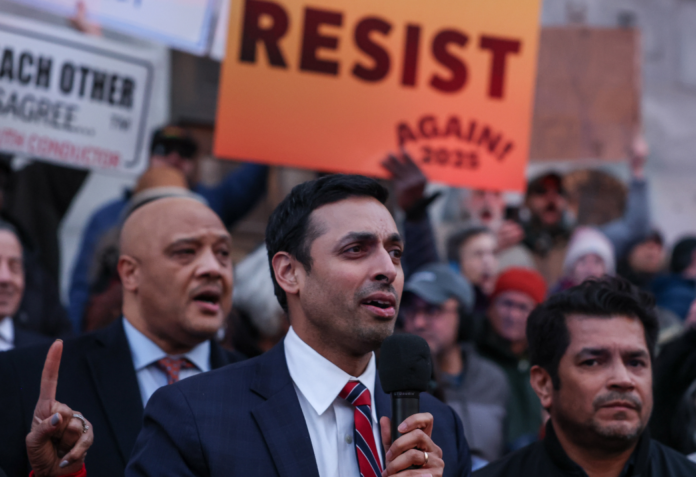
The Department of Government Efficiency, commonly referred to as DOGE, has a storied history that began under President Barack Obama as an initiative to enhance government operations. Over time, its mission shifted, and today it finds itself at the center of political contention. Notably, Representative Suhas Subramanyam, who once worked under the Obama administration alongside Joe Biden, is now holding town halls to oppose DOGE—an agency with roots tied to his former boss. This article traces DOGE’s origins, its transformation, and the irony of Subramanyam’s current stance against it.
Obama’s Creation of the U.S. Digital Service
In 2014, Barack Obama launched the U.S. Digital Service (USDS), the precursor to what is now known as DOGE. The USDS emerged in response to the disastrous rollout of HealthCare.gov, aiming to modernize the federal government’s outdated technology systems. Obama recruited top talent from the private sector—engineers and innovators from companies like Google and Amazon—to overhaul government IT infrastructure. The primary goal was to make services more efficient and user-friendly, though this modernization naturally paved the way for cost savings by streamlining operations.
The USDS operated as a small, agile team tasked with fixing critical tech issues across federal agencies. While its mission wasn’t explicitly about cutting budgets, the efficiency it fostered often reduced wasteful spending indirectly. Obama championed the initiative as a way to bring “change-makers” into government, emphasizing the need for top-level support to ensure its success.
Joe Biden’s Role in Cutting Waste
While the USDS focused on technology, another cost-saving effort took shape under Obama’s administration. In 2011, Obama appointed Vice President Joe Biden to lead the “Campaign to Cut Waste,” an initiative designed to identify and eliminate unnecessary government expenditures. Biden’s task was to scrutinize federal budgets and pinpoint areas where taxpayer dollars were being squandered. Obama stressed the importance of eliminating “pointless waste and stupid spending that doesn’t benefit anybody,” framing it as a priority regardless of the federal deficit.
Though distinct from the USDS, Biden’s campaign shared a common thread with later iterations of DOGE: a focus on fiscal responsibility. The initiative identified billions in potential savings, though its scope remained narrower than the sweeping reforms DOGE would eventually pursue. Biden’s leadership in this effort positioned him as a key figure in Obama’s broader push for government efficiency.
The Transformation Under Trump
When Donald Trump assumed the presidency, he rebranded the U.S. Digital Service as the U.S. DOGE Service (Department of Government Efficiency) through an executive order. More than a name change, this marked a significant shift in mission. Trump tasked DOGE with cutting $2 trillion in wasteful federal spending, appointing tech mogul Elon Musk to lead the charge. Under Musk, DOGE expanded its focus from technology modernization to aggressive cost-cutting across all government sectors.
Musk’s team, composed of young private-sector technologists, tackled inefficiencies head-on. They terminated leases for unused office spaces, eliminated positions deemed redundant, and slashed programs like diversity, equity, and inclusion (DEI) initiatives. These actions, while effective in reducing costs, drew sharp criticism for their breadth and speed, with opponents arguing they undermined essential services.
Suhas Subramanyam’s Connection and Opposition
Suhas Subramanyam, now a Democratic Representative from Virginia’s 10th District, entered this narrative through his work in the Obama administration. As a policy advisor, Subramanyam contributed to technology and innovation efforts, likely intersecting with the USDS’s mission. While there’s no direct evidence he worked under Biden on the “Campaign to Cut Waste,” his role in the administration tied him to its efficiency-driven ethos. After leaving federal service, Subramanyam served in the Virginia General Assembly before winning a congressional seat.
Today, Subramanyam is a vocal critic of DOGE, organizing town halls to rally opposition. He accuses the agency of overreach, arguing that its unilateral cuts—made without congressional approval—threaten critical government functions. Attended by federal workers and constituents, these town halls highlight concerns over job losses and program eliminations. Subramanyam has even proposed legislation to rein in DOGE, demanding greater transparency and oversight.
The Irony of the Situation
Subramanyam’s opposition to DOGE is striking given its lineage. The agency traces back to Obama’s USDS, and its current cost-cutting mission echoes Biden’s “Campaign to Cut Waste”—both initiatives Subramanyam was indirectly linked to through his Obama-era service. Yet, he now stands against it, a stance that seems at odds with his past.
This shift can be understood through context. Biden’s campaign was a targeted, measured effort, while DOGE under Trump has taken a more radical approach, often bypassing traditional checks and balances. As a Democrat representing a district with many federal workers, Subramanyam may also feel compelled to challenge a Republican-led initiative that directly affects his constituents. His opposition likely reflects both principled objections to DOGE’s methods and political pressures from his base.
Conclusion
The journey of DOGE—from Obama’s tech-focused USDS to Trump’s cost-cutting powerhouse—illustrates how government initiatives can morph under different leaders. Suhas Subramanyam’s current crusade against DOGE, despite his ties to its progenitors, underscores the nuanced nature of political allegiance and reform. What began as a bipartisan push for efficiency has become a partisan flashpoint, proving that in government, the line between saving money and overstepping bounds is often a matter of perspective. As DOGE’s future unfolds, it will remain a symbol of both ambition and contention in the quest for a leaner federal system.