
University of Richmond’s “Electing the President” digital map allows public to see historic election results

The University of Richmond’s Digital Scholarship Lab (DSL) has published a unique interactive map of voting history in the U.S. Presidential elections dating back to 1840 before the Republican party existed.  

The Electing the President map went live Sept. 30 and is a free online tool which researchers, historians, students and those with an interest in political demographics and trends over time are sure to find valuable. It shows the results of both the electoral college and popular vote from 1840 to 2020.
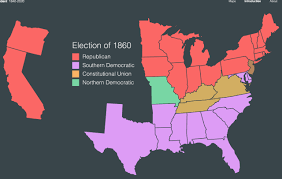
A map from the “Electing the President” collection at the University of Richmond’s Digital Scholarship Lab.

The map shows shifting voter patterns over time in the United States and gives a detailed explanation of cultural, geographical and political fluctuations among voters, which impacted presidential elections.

“These are merely examples of how maps and space can be used to analyze presidential elections and voting behavior. Electing the President aims not to advance claims about the “Solid South,” the “southern strategy,” a Republican suburban strategy, or any other historical interpretation. Instead, we hope it can serve as a versatile tool for exploration,” wrote Dr. Robert Nelson, director of the Digital Scholarship Lab. 

“By offering different ways to visualize the electoral college and the popular vote for 46 elections stretching back to William Henry Harrison’s contest with Martin Van Buren in 1840, our goal is to help users deepen their understanding of the complex factors that have shaped presidential elections over nearly two centuries,” he said.

Electing the President is part of the American Panorama project, an historical atlas of the United States. “It combines cutting-edge research with innovative interactive mapping techniques, designed to appeal to anyone with an interest in American history or a love of maps,” described Dr. Nelson, the editor for American Panorama.

Some of the fascinating maps include: foreign born population from 1850-2020, the forced migration of enslaved people between 1810-1860, family displacements through urban renewal from 1950-1966, and redlining in a New Deal America from 1935-1940.

Additional American Panorama projects include the award-winning Mapping Inequality, which maps the practice of redlining and the history of racial and ethnic discrimination in housing policy across the country, and Photogrammar, which provides tools to explore a rich archive of photographs taken between 1935 and 1944.
Dr. Nelson is the Director of the DSL and Head of Digital Engagement in Boatwright Library. He teaches courses related to antislavery and slavery in the United States and about the digital humanities. Dr. Nelson can be reached at: rnelson2@richmond.edu

Audrey Carpenter is the Loudoun County Bureau Chief for All Virginia News. She can be reached at: audreycarpenter@allvirginia.news


At this dangerous time for journalism in Virginia

We hope you appreciated this article. Before you close this tab, we want to ask if you could support All Virginia News at this challenging time for independent journalism in the Commonwealth.

Virginia is currently governed by a Democratic trifecta—Governor Abigail Spanberger in the Executive Mansion, Democrats holding majorities in both the House of Delegates and the Senate, along with key leadership positions held by figures such as Lt. Governor Ghazala Hashmi, Attorney General Jay Jones, House Speaker Don Scott, and others. In any period of one-party dominance, the risk of reduced transparency and accountability grows. A strong, independent press is essential to scrutinize those in power, regardless of party affiliation.

Across the nation and here in Virginia, press freedom faces real pressures: from political threats and regulatory actions to corporate influence and economic challenges that can compromise editorial independence. When government officials—whether in Richmond or Washington—attempt to shape coverage through pressure, investigations, funding decisions, or favoritism, it undermines public trust and democratic health.

All Virginia News exists to serve Virginia readers first. We are not owned by billionaires or large corporations with political agendas. Our commitment is straightforward: deliver factual, thorough reporting that holds every elected official accountable—Democrat, Republican, or independent—without fear or favor. We believe democracy functions best with a robust, independent press that provides Virginians the full picture, free from partisan spin.

What sustains us through these challenges is the direct support of our readers. A majority of our funding comes from individuals like you who value trustworthy, paywall-free journalism. Your contributions preserve our editorial independence and allow us to continue aggressive, non-partisan oversight of state government, policies, and their impact on Virginia families.

We know these requests are never as welcome as the reporting itself, but without reader support, this work simply could not continue. Of course, we understand that not everyone is in a position to contribute financially, and we remain grateful for your readership either way.

If you are able, please support All Virginia News today. All gifts matter, but recurring contributions are especially valuable as they help us plan and sustain our coverage long-term (and reduce the frequency of these appeals). It takes just a moment to give. Thank you for standing with independent journalism and helping protect a free press that serves all Virginians.

0 0 votes
Article Rating
Subscribe
Notify of
guest

0 Comments
Most Voted
Newest Oldest
Inline Feedbacks
View all comments

Check out our other content

Check out other tags:

Most Popular Articles