
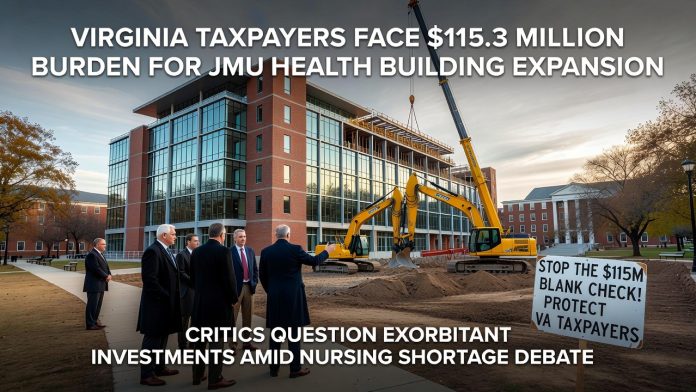
Virginia taxpayers are facing a massive financial burden as the upcoming FY2027 state budget includes a staggering $115.3 million allocation for a single building expansion at James Madison University. This nine-figure appropriation from the General Fund is earmarked for the College of Health and Behavioral Studies, representing a significant capital expenditure during a time of economic uncertainty. When combined with other university requests, the total healthcare expansion package at the institution approaches nearly $150 million in state funding. Conservative lawmakers and fiscal watchdogs are raising serious concerns about this level of spending, questioning whether such exorbitant investments in higher education infrastructure are truly respectful of the hard-working taxpayer.
The proposed project centers on constructing a lavish five-story, 125,367-square-foot wing that will feature new classrooms, laboratories, and clinic spaces. This massive construction budget follows a previous allocation in the FY2025 budget, which already provided $7.87 million just for the planning phase of the expansion. That initial planning cost was split evenly between the General Fund and Non-General Fund sources, but the actual construction costs are now falling heavily on state revenues. Critics argue that pouring over $115 million into a single university facility exemplifies the unchecked growth of higher education budgets that routinely demand more taxpayer dollars.
Justifying the Price Tag Amidst a Workforce Crisis
Proponents of the massive spending package point to a legitimate crisis, noting that Virginia currently faces a severe shortage of more than 20,000 registered nurses. University officials argue that physical limits on faculty availability, clinical placements, and classroom space have previously restricted the growth of critical healthcare programs. While addressing the nursing shortage is undeniably important for the health and safety of the Commonwealth, fiscal conservatives question if a sprawling, nine-figure building is the most cost-effective solution. Taxpayers are left wondering if the university could achieve similar educational outcomes by optimizing existing campus spaces or partnering with private healthcare providers rather than demanding new construction.
James Madison University President Jim Schmidt has heavily advocated for the project, stating that the state funding will transform the campus and directly address critical workforce needs across the Commonwealth. Furthermore, Sharon Lovell, Dean of the College of Health and Behavioral Studies, justified the expenditure by claiming it will enable the university to increase its annual number of undergraduate nursing graduates. She also noted that the new space will eventually allow for the expanded enrollment in their specialized nursing programs. However, while university administrators celebrate the influx of state cash, conservative advocates warn that transforming a campus should not come at the expense of runaway government spending and inflated state budgets.
The Danger of Recurring Budget Obligations
Beyond the massive one-time construction costs, the FY2027 budget also introduces concerning permanent financial obligations related to the university’s Fast Flex Bachelor of Science in Nursing program. Previous state budgets awarded the university one-time appropriations of $1 million to assist with the nursing program expansion. Unfortunately, the new budget shifts this funding structure to a recurring $1 million annual appropriation designed to support ongoing nursing faculty salaries and program viability. Committing the state to permanent, recurring expenses reduces future legislative flexibility and creates a continuous drain on the General Fund that taxpayers will have to sustain indefinitely.
The financial demands from James Madison University do not end with the new College of Health and Behavioral Studies wing and the recurring faculty salaries. The FY2027 budget also includes an additional $30.5 million specifically designated for the renovation of Johnston Hall. When adding this renovation to the $115.3 million expansion and the recurring program funds, the total healthcare expansion package balloons to an astonishing $146.8 million in central capital outlay. This staggering sum highlights a broader trend of endless university expansion that continuously looks to state lawmakers to foot the bill for their ambitious campus development plans.
Protecting the Virginia Taxpayer from Higher Education Bloat
Fiscal responsibility requires that every dollar extracted from Virginia citizens be spent with maximum efficiency and strict oversight. Higher education institutions have a well-documented history of administrative bloat and unnecessary facility upgrades that drive up both tuition costs and state tax burdens. Instead of relying on the General Fund to finance massive 125,367-square-foot additions, universities must be pushed to adopt leaner operational models and seek private endowments. Lawmakers must demand strict audits of these central capital outlay requests to ensure that not a single dollar is wasted on architectural vanity rather than practical educational needs.
As the General Assembly debates the final details of the FY2027 budget, conservative leaders must stand firm against excessive government spending. While solving the shortage of registered nurses is a valid policy goal, it does not justify writing a $115.3 million blank check for university construction projects. Protecting the taxpayer means demanding rigorous financial justification, exploring cheaper alternatives, and refusing to expand permanent state obligations. Virginia can successfully train the next generation of healthcare professionals while still maintaining strict fiscal discipline and honoring conservative economic principles.