
Last month, staff presented the proposal to the Board of Education to continue the state’s plan to raise academic benchmarks for students in reading and math. The plan followed an initiative to address Virginia students’ significant declines in these subjects in grades 3 through 8, which the coronavirus pandemic exacerbated.
Holly Coy, the agency’s chief of staff, said shortly after the June 24 presentation that the proposed changes would have impacted both the statewide Standards of Learning benchmarks, or cut scores, and Virginia’s system for school accountability.
These metrics are “highly interrelated,” Coy said, because schools are largely measured on SOL test score results.
Staff’s proposal included a single increase in cut scores by the 2028-2029 school year rather than the year-by-year shift over four years that the board voted on last year and that the Joint Legislative Audit and Review Commission (JLARC) analyzed.
“JLARC specifically noted that the VDOE should account for how changing different factors, including cut scores, would impact other aspects of the system,” Coy said in a statement.
Coy also said this spring, stakeholders expressed “confusion and concern about multiple changes to testing and accountability happening in isolation of one another”
In April, House Education Committee Chair Sam Rasoul, D-Roanoke, successfully carried a bill that required Virginia to reevaluate accountability and testing, in response to the JLARC recommendations.
Coy said the state could not reevaluate the plan when the board voted on the phase-in plan in the fall of 2025.
She said the commonwealth would have reached full implementation of higher cut scores a year faster and completed modeling, regulatory changes, and a full preview year for a revised accountability system across three school years.
The move would have given education leaders time to prepare for a single transition year and eliminated the disruption of changing cut scores in every subject and grade for multiple years, which “risks significant confusion and a lack of clarity about what the new expectations are for students,” she said.
“While the June proposal changed the phase-in process, it continued with the shared goal of higher expectations for students through higher cut scores and a strong accountability system that drives school improvement,” Coy said.
Board blocked plan to delay
The proposal to delay the implementation of the cut scores was rejected in a surprise 7-0-1 vote at the June 25 business meeting, considering the board was only scheduled to review the plan to modify the proposed accountability framework.
Board members said delaying implementation of the accountability system would have negatively affected student outcomes. The vote keeps the original plan in place, with cut scores gradually increasing over a four-year period starting this year, as scheduled.
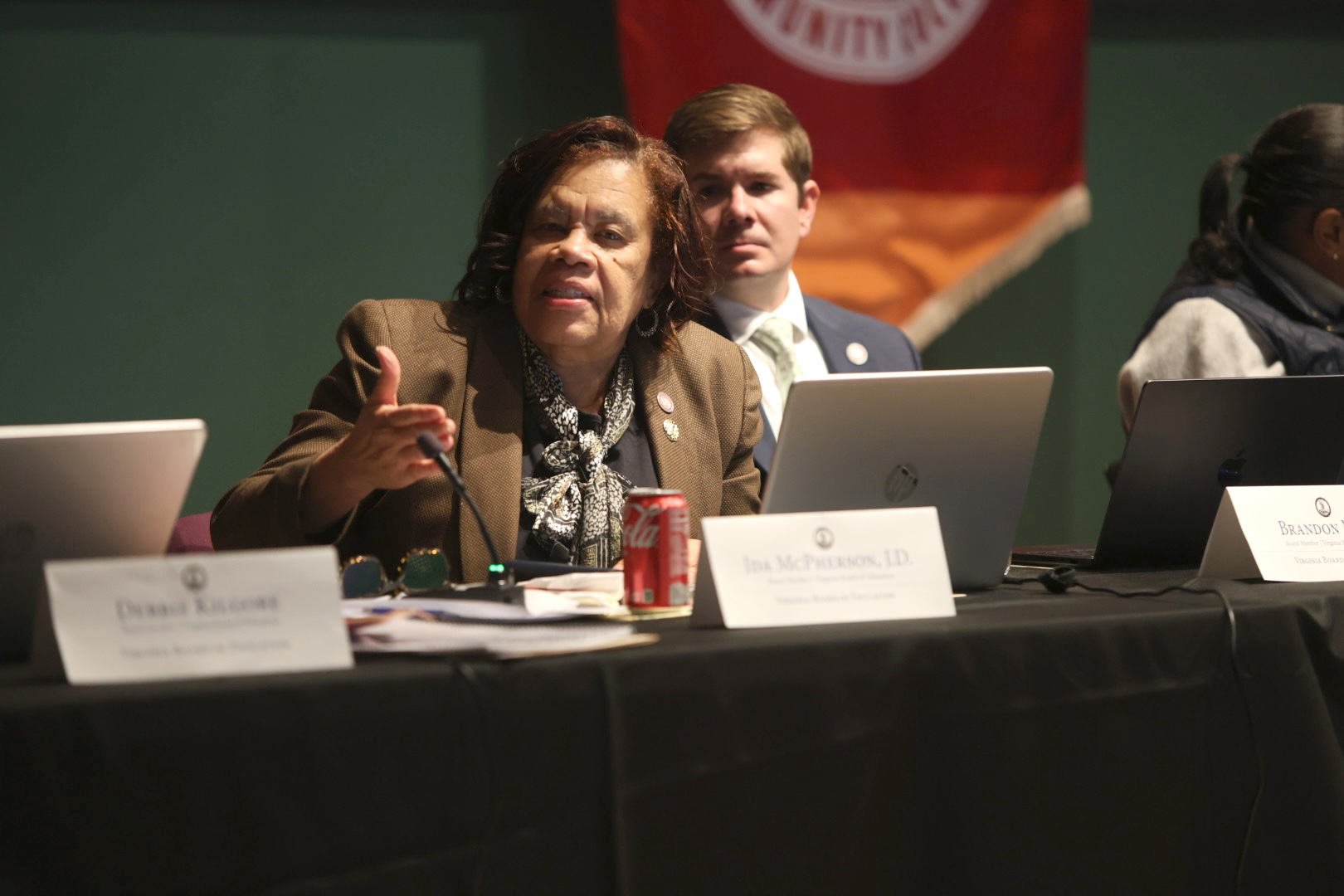
Board Member Ida Outlaw McPherson, an appointee of Gov. Glenn Youngkin, supported raising expectations as soon as possible, noting that educators requested a phased-in approach at the June 25 business meeting.
“If you think that Nvidia, Amazon, and all these big companies are gonna wait for us to continue to teach students, and they’re reading at less than a fourth grade level at this point, I mean, what are we talking about?” McPherson said. “We don’t have any more time.”
Board Member Kimberly Bridges, an appointee of Gov. Abigail Spanberger, abstained after expressing her opposition to voting immediately on the proposal.
To stay within the law, the board will continue to re-evaluate the K-12 accountability system in August.
One of the changes they will consider is changing schools’ academic progress labels from “off track” to “approaching expectations,” and from “on track” to “meets expectations.”
Board members will also consider revising the School Performance and Support Framework, including exempting students who have recently moved to the U.S. and are still learning English from the reading assessment in their first year (2026-2027).
The possible accountability system changes would also adjust high school ratings to rely on current achievement data rather than longer-term cohort results. They would also ensure that Virginia elementary and middle schools won’t be penalized for having too few English Learner students to receive a fair evaluation.
Annual benchmark data
Seven months after approving major K–12 accountability changes, the board received a document at its June 25 business meeting detailing year-by-year increases in proficiency benchmarks, something division leaders had sought over the past year.
During the June 24 work session, Superintendent Jenna Conway said that while the board had clearly approved the final proficiency targets and a four-year implementation plan, there was “not a publicly available document from last fall” that outlined the annual implementation benchmarks.
But at the June 25 business meeting, staff provided the board, at members’ request, a document comparing the previously approved implementation plan with the proposed transition timeline.
Board President Mashea Ashton, a Youngkin appointee, has not responded to questions about which information was available to the board as it approved the four-year implementation plan.
This month, the board switched to a 5-4 majority in favor of the Spanberger administration.
The board is expected to continue its work on the accountability system at its Aug. 26-27 work session and business meeting.