
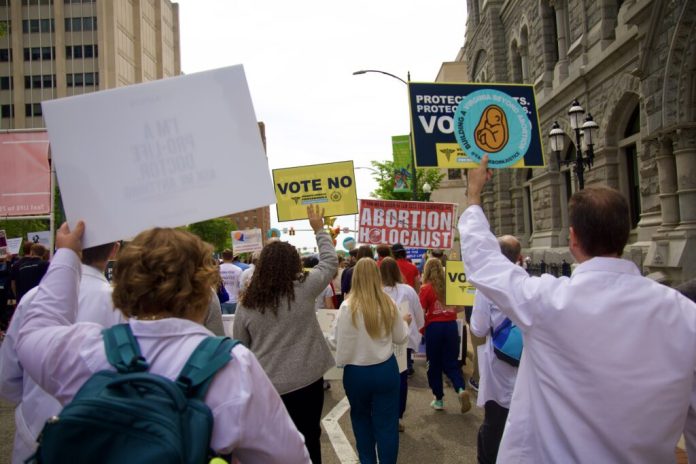
At the center of Bansley v. Nardo is an argument that the clerk of the House of Delegates, Paul Nardo, failed to send copies of the amendment to circuit court clerks across the state — a longtime requirement in Virginia’s multi-year constitutional amendment process.
The requirement was intended to increase public awareness of pending referendums by prompting clerks to post amendment language outside courthouses. In modern times, lawmakers argued that information is readily available online and through news organizations, which is why they removed the requirement earlier this year through House Bill 1384.
Gov. Abigail Spanberger signed the measure in February when she advanced the constitutional amendments.
Before appearing on statewide ballots, the amendments had to pass the legislature in two separate sessions with a House election in between. The clerk postings would have been an additional procedural step.
Because HB 1384 was signed after Virginia’s pending constitutional amendments initially passed and after they passed a second time, Bedford County Supervisor Charla Bansley argues the process should be invalidated.
Nardo, the lead defendant in the case, otherwise would have been required to send copies to all 133 circuit court clerks in Virginia.
Court filings from Bansley’s attorneys with Liberty Counsel argue she has standing to sue because of ”flagrant violations of the processes in place at the time the proposed constitutional amendment was considered and approved by the General Assembly.”
“Virginia citizens have the right to a transparent, orderly constitutional change, and any misstep undermines the integrity of the amendment process and can interfere with the will of the voters,” Liberty Counsel founder Matt Staver said in a statement.
At a hearing later this month in Bedford County, a judge could determine whether the case should proceed, whether Nardo’s request to move the case to Richmond should be granted and whether a group called Virginians For Reproductive Freedom can join as co-defendants.
An after-the-fact test
Legal historian Lauren MacIvor Thompson said the case reminds her of how the Comstock Act has resurfaced in anti-abortion debates in recent years.
The “zombie law,” as she described it, dates to the 19th century and prohibited the mailing of pornography and abortifacients.
The federal law was largely dormant until local governments in Virginia and elsewhere began citing it in ordinances aimed at banning the mailing of abortion medication. It is also central to a Louisiana case that could lead to a national ban on mailing abortion pills if the U.S. Supreme Court revisits the issue later this year.
“We have these laws on books that are relics from a completely different time and a completely different historic context,” Thompson said.
In Bansley v. Nardo, the now-repealed Virginia statute is not nearly as old as the Comstock Act. It dates to 1971, the last time Virginia broadly rewrote its constitution.
Defending the repeal earlier this year, Del. Marcus Simon, D-Fairfax, called the requirement a “holdover.”
House Minority Leader Terry Kilgore, R-Scott, disagreed, saying “passing a post-facto law, I think, is wrong on its face.”
If a court sides with Bansley and strikes down the amendment on a procedural technicality, Thompson said the “cascading effects” could be significant.
For example, she noted that “people can be pro-contraception but still anti-abortion,” referring to the amendment’s protections for contraception, fertility treatments and abortion access.
If one falls, do the others?
Virginia also has pending constitutional amendments to restore voting rights for people with felony convictions who have completed their sentences and to protect same-sex marriage.
Thompson said a voter planning to oppose the reproductive rights amendment could still support one or both of the others.
Virginians for Reproductive Freedom campaign manager Han Jones said lawmakers ultimately advanced the amendments so voters — not courts — could decide them.
Although the other amendments advanced alongside the reproductive rights proposal, their fate is not necessarily tied together. Still, a ruling in Bansley’s favor could open the door to similar challenges.
Randolph-Macon College political science professor Lauren Bell said judges typically rule on a case-by-case basis, limiting decisions to the dispute before them.
If the reproductive amendment were struck down and someone sought to challenge the other two, Bell said they could file separate lawsuits citing the Bansley case. A judge could also choose to rule more broadly in the Bansley case.
“Judges do sometimes issue decisions that go beyond the scope of the issues in the case,” she said.
A matter of words
While the next steps in the effort to strike down the amendment may become clearer soon, a separate legal challenge is also moving forward.
A Bluefield Town Council member and a child psychologist are being represented by the legal arm of the Family Foundation, a conservative advocacy group that hosts Virginia’s annual March For Life rally.
Josh Hetzler, the plaintiffs’ attorney, said his clients are not seeking to block the amendment. Instead, they argue the ballot language is “deceptive” unless it is rewritten before early voting begins Sep. 18.
After an early June hearing in Tazewell — where the case originated, along with the lawsuit that ultimately struck down Virginia’s redistricting amendment earlier this year — Jones said Virginians For Reproductive Freedom is waiting to hear if they can intervene as a defendant in that case as well.
Requests for comment from the Family Foundation were not returned before publication.
Ohio faced a similar dispute ahead of its 2023 reproductive rights amendment, and the ballot language was ultimately changed. Voters still approved the amendment.
“It is not surprising that voters have turned out to vote for these things, even in purple or redder states,” Jones said.
Outside the courtroom, campaigns supporting or opposing the amendment are expected to ramp up.
Jones’ organization sponsored an advertising campaign last year highlighting the amendment’s long path to the ballot and had identified lawmakers who supported it during the 2025 House of Delegates elections.
Meanwhile, Women Speak Out Virginia — a partner organization of national anti-abortion group SBA Pro-Life — organized door-knocking efforts in swing districts last year centered on the amendment.
“We know what these groups are, we know what they want,” Jones said of groups opposing the amendment. “We’re confident these cases will not stand and that voters are going to be able to make their voices heard this November.”































