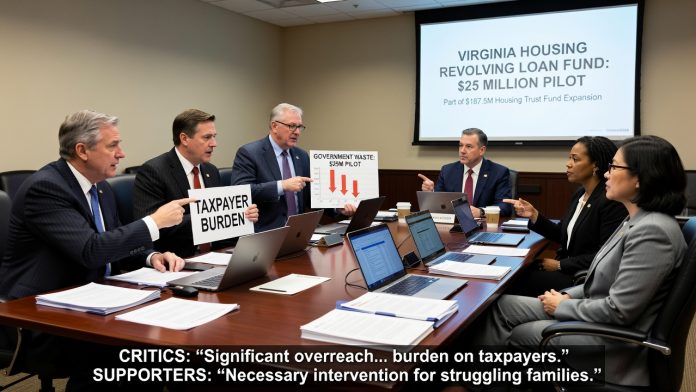
The Virginia state government is aggressively expanding its footprint in the real estate market with the creation of a massive revolving loan fund pilot program for mixed-income housing. Lawmakers have pushed forward with this costly initiative, aiming to funnel millions of taxpayer dollars into the acquisition, construction, and improvement of various housing projects. Critics of this exorbitant spending plan argue that it represents a significant overreach of state authority and an entirely unnecessary burden on hardworking taxpayers. By directly subsidizing housing developments, the government is stepping into territory that is historically best managed by the free market.
The legislative subcommittee initially pushed for a hefty $25 million allocation to capitalize this brand-new housing fund. During the final conference report negotiations, the broader housing initiatives were adjusted to include $60 million from the general fund, with $20 million specifically carved out for the mixed-income housing pilot. This massive allocation is part of a broader legislative push that brings the Virginia Housing Trust Fund to a staggering $187.5 million over the current biennium. This represents the absolute highest funding level to date for the trust fund, raising serious alarms among fiscal conservatives about unchecked state spending.
Expanding Bureaucracy and Waste
The daily administration of these substantial funds will involve multiple layers of government bureaucracy, specifically utilizing the Department of Housing and Community Development and the Virginia Housing Development Authority. Managing a complex revolving loan fund requires extensive administrative overhead, which inevitably eats into the actual funds meant for community development. Taxpayers are rightfully concerned that a significant portion of this multi-million dollar allocation will be lost to bureaucratic waste, endless red tape, and state-level inefficiencies. Expanding state agencies to oversee private housing construction is a proven recipe for fiscal waste and prolonged project delays that harm local economies.
Established under the legislative framework of House Bill 820, the Virginia Housing Revolving Loan Fund represents a fundamental shift away from conservative free-market principles. When the state government uses taxpayer money to issue high-risk loans for mixed-income housing, it inherently picks winners and losers within the private real estate sector. This type of heavy-handed government interference artificially manipulates local housing markets and often discourages private investment in the very communities the state claims to help. Fiscal conservatives strongly argue that reducing local zoning regulations and cutting property taxes would do far more to spur housing development than handing out state-funded loans.
Questionable Fiscal Responsibility
Democratic leaders have heavily praised this massive spending package, framing it as a necessary and urgent intervention for struggling Virginia families. Speaker Don Scott, Leader Charniele Herring, and Chair Kathy Tran recently released a joint statement claiming they successfully delivered on a promise to build an affordable Virginia. They boldly described the budget as fiscally responsible, asserting that it prioritizes areas where families are hurting the most, such as housing, healthcare, and childcare costs. However, branding a state budget with record-high spending as fiscally responsible completely contradicts the basic economic reality that massive government expenditures inevitably fall on the shoulders of taxpayers.
The Commerce, Agriculture and Natural Resources Subcommittee report attempted to justify these staggering costs by describing a multifaceted approach to solving the statewide housing affordability crisis. Their expensive strategy includes throwing taxpayer resources at new construction projects, eviction prevention programs, and various homelessness response efforts across the commonwealth. While these may sound like noble causes to some voters, relying on a $25 million state-capitalized fund to solve complex economic issues rarely yields long-term success or sustainability. Government-funded pilot programs have a long, predictable history of ballooning into permanent, budget-draining fixtures that completely fail to address the root causes of economic distress.
Protecting the Virginia Taxpayer
State-managed revolving loan funds carry inherent financial risks that ultimately place everyday Virginia taxpayers on the hook for potential project defaults. If private developers fail to repay these state-issued loans, the resulting financial loss will directly impact the general fund and severely limit future state budgets. Taxpayers should never be forced to act as a financial backstop for mixed-income housing projects that traditional financial institutions deem too risky to finance independently. Protecting the integrity of the state budget requires lawmakers to unequivocally reject these risky financial ventures and demand strict accountability for every single dollar spent.
As Virginia looks ahead to fiscal year 2027 and beyond, the long-term financial implications of these massive housing initiatives remain deeply troubling for fiscal conservatives. True housing affordability will never be achieved by expanding government programs or funneling millions of tax dollars through state-run loan funds. Lawmakers must immediately pivot toward cutting wasteful spending, rolling back burdensome zoning regulations, and allowing private enterprise to meet housing demands efficiently. Only by firmly reining in this runaway spending can Virginia protect its taxpayers and ensure a truly prosperous, fiscally sound future for the entire commonwealth.
Email the House of Delegates at:
Jessica Anderson: DelJAnderson@house.virginia.gov,
Bonita Anthony: DelBAnthony@house.virginia.gov,
Alex Askew: DelAAskew@house.virginia.gov,
Terry Austin: DelTAustin@house.virginia.gov,
Jason Ballard: DelJBallard@house.virginia.gov,
Robert Bloxom, Jr.: DelRBloxom@house.virginia.gov,
Gretchen Bulova: DelGBulova@house.virginia.gov,
Katrina Callsen: DelKCallsen@house.virginia.gov,
Karen Carnegie: DelKCarnegie@house.virginia.gov,
Betsy Carr: DelBCarr@house.virginia.gov,
Stacey Carroll: DelSCarroll@house.virginia.gov,
Mike Cherry: DelMCherry@house.virginia.gov,
Nadarius Clark: DelNClark@house.virginia.gov,
Laura Cohen: DelLJCohen@house.virginia.gov,
Joshua Cole: DelJCole@house.virginia.gov,
Nicole Cole: DelNCole@house.virginia.gov,
Kelly Convirs-Fowler: DelKConvirs-Fowler@house.virginia.gov,
Mitchell Cornett: DelMCornett@house.virginia.gov,
Rae Cousins: DelRCousins@house.virginia.gov,
Will Davis: DelWDavis@house.virginia.gov,
Karrie Delaney: DelKDelaney@house.virginia.gov,
Lindsey Dougherty: DelLDougherty@house.virginia.gov,
Mark Downey: DelMDowney@house.virginia.gov,
Michael Feggans: DelMFeggans@house.virginia.gov,
Hyland Fowler, Jr.: DelBFowler@house.virginia.gov,
Lily Franklin: DelLFranklin@house.virginia.gov,
Margaret Franklin: DelMFranklin@house.virginia.gov,
Debra Gardner: DelDGardner@house.virginia.gov,
Thomas Garrett, Jr.: DelTGarrett@house.virginia.gov,
Jackie Glass: DelJGlass@house.virginia.gov,
Timothy Griffin: DelTGriffin@house.virginia.gov,
Elizabeth Guzman: DelEGuzman@house.virginia.gov,
Karen Hamilton: DelKHamilton@house.virginia.gov,
Cliff Hayes, Jr.: DelCHayes@house.virginia.gov,
Dan Helmer: DelDHelmer@house.virginia.gov,
Rozia Henson, Jr.: DelRHenson@house.virginia.gov,
Phil Hernandez: DelPHernandez@house.virginia.gov,
Charniele Herring: DelCHerring@house.virginia.gov,
Keith Hodges: DelKHodges@house.virginia.gov,
Patrick Hope: DelPHope@house.virginia.gov,
Hillary Kent: DelHKent@house.virginia.gov,
Karen Keys-Gamarra: DelKKeys-Gamarra@house.virginia.gov,
Terry Kilgore: DelTKilgore@house.virginia.gov,
Paul Krizek: DelPKrizek@house.virginia.gov,
Amy Laufer: DelALaufer@house.virginia.gov,
Destiny LeVere Bolling: DelDLeVereBolling@house.virginia.gov,
Jay Leftwich, Jr.: DelJLeftwich@house.virginia.gov,
Alfonso Lopez: DelALopez@house.virginia.gov,
Fernando Martinez: DelMMartinez@house.virginia.gov,
John McAuliff: DelJMcAuliff@house.virginia.gov,
Adele McClure: DelAMcClure@house.virginia.gov,
Garrett McGuire: DelGMcGuire@house.virginia.gov,
Ellen McLaughlin: DelEMcLaughlin@house.virginia.gov,
Joseph McNamara: DelJMcNamara@house.virginia.gov,
Kirk McPike: DelKMcPike@house.virginia.gov,
Delores McQuinn: DelDMcQuinn@house.virginia.gov,
Leslie Mehta: DelLMehta@house.virginia.gov,
Will Morefield: DelJMorefield@house.virginia.gov,
May Nivar: DelMNivar@house.virginia.gov,
Israel O’Quinn: DeliOquinn@house.virginia.gov,
Delores Oates: DelDOates@house.virginia.gov,
Justin Pence: DelJPence@house.virginia.gov,
Eric Phillips: DelEPhillips@house.virginia.gov,
Kimberly Pope Adams: DelKPopeAdams@house.virginia.gov,
Cia Price: DelMPrice@house.virginia.gov,
Sam Rasoul: DelSRasoul@house.virginia.gov,
Atoosa Reaser: DelAReaser@house.virginia.gov,
David Reid: DelDReid@house.virginia.gov,
Andrew Rice: DelARice@house.virginia.gov,
Chris Runion: DelCRunion@house.virginia.gov,
Charles Schmidt, Jr.: DelCSchmidt@house.virginia.gov,
Don Scott: DelDScott@house.virginia.gov,
Phillip Scott: DelPScott@house.virginia.gov,
Holly Seibold: DelHSeibold@house.virginia.gov,
Briana Sewell: DelBSewell@house.virginia.gov,
Irene Shin: DelIShin@house.virginia.gov,
Marcus Simon: DelMSimon@house.virginia.gov,
Shelly Simonds: DelSSimonds@house.virginia.gov,
JJ Singh: DelJSingh@house.virginia.gov,
Rip Sullivan, Jr.: DelRSullivan@house.virginia.gov,
Anne Tata: DelAFTata@house.virginia.gov,
Josh Thomas: DelJThomas@house.virginia.gov,
Virgil Thornton, Sr.: DelVThornton@house.virginia.gov,
Luke Torian: DelLTorian@house.virginia.gov,
Kathy Tran: DelKTran@house.virginia.gov,
Howard Wachsmann, Jr.: DelOWachsmann@house.virginia.gov,
Wendell Walker: DelWWalker@house.virginia.gov,
Jeion Ward: DelJWard@house.virginia.gov,
Lee Ware: DelLWare@house.virginia.gov,
Vivian Watts: DelVWatts@house.virginia.gov,
Michael Webert: DelMWebert@house.virginia.gov,
Madison Whittle: DelMWhittle@house.virginia.gov,
Bill Wiley: DelBWiley@house.virginia.gov,
Rodney Willett: DelRWillett@house.virginia.gov,
Wren Williams: DelWWilliams@house.virginia.gov,
Tony Wilt: DelTWilt@house.virginia.gov,
Thomas Wright, Jr.: DelTWright@house.virginia.gov,
Scott Wyatt: DelSWyatt@house.virginia.gov,
Eric Zehr: DelEZehr@house.virginia.gov,