
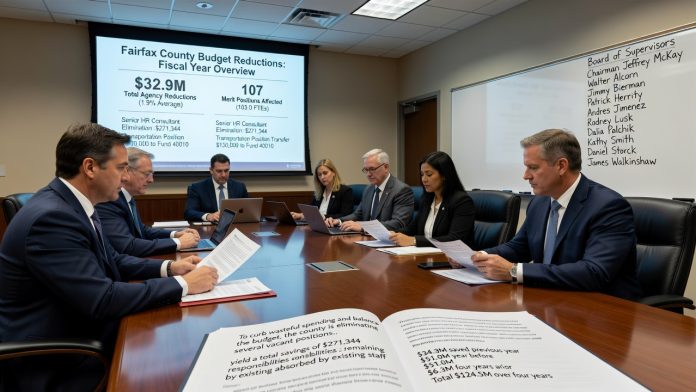
Fairfax County officials are implementing targeted budget reductions for the upcoming fiscal year to curb municipal spending and balance the local budget. The county is eliminating several vacant positions across multiple departments, which will generate significant savings for the General Fund. These strategic cuts are part of a broader financial plan designed to minimize the tax burden on residents while maintaining essential public services. The current Fairfax County Board of Supervisors, which must approve these measures, includes Chairman Jeffrey McKay, Walter Alcorn, Jimmy Bierman, Patrick Herrity, Andres Jimenez, Rodney Lusk, Dalia Palchik, Kathy Smith, Daniel Storck, and James Walkinshaw.
Among the most notable personnel adjustments is the elimination of a vacant Senior Human Resources Consultant position within the Department of Human Resources. This specific reduction in the Human Resources General Services unit will yield a total savings of $271,344 for the county. Officials justified this elimination by citing a recent redesign of the general human resources inquiry process that significantly reduced the workload associated with the role. The remaining responsibilities previously handled by this consultant position will now be absorbed by existing staff members to ensure continuity of operations.
In addition to the human resources adjustment, the county is transferring a transportation position to generate further financial relief. This role, previously funded through the General Fund, is being moved to Fund 40010, which oversees County and Regional Transportation Projects. By shifting this position, the county achieves a direct savings of $130,000 to the General Fund while increasing budgeted cost recovery for capital projects. The salary and benefit expenses associated with this transferred transportation position will now be supported entirely by Commercial and Industrial Tax revenues.
Broad Agency Reductions and Historical Context
These individual position changes represent a small fraction of a much larger fiscal consolidation strategy across local government agencies. The overall budget plan includes a total of $32.9 million in agency reductions, which equates to an average agency reduction of 1.9 percent. This comprehensive cost-saving initiative will affect a total of 107 merit positions, representing 103.0 full-time equivalents across the municipal workforce. County Executive Bryan Hill noted in his budget message that these cuts were necessary to offset rising operational costs and limit overall financial pressure on local taxpayers.
County Executive Bryan Hill outlined the reasoning behind these financial maneuvers in his proposed budget message to the board. He stated that over several years of constrained budgets, the county has consistently prioritized its workforce in acknowledgment of the essential services employees provide to residents each day. At the same time, he emphasized that local leaders have made difficult decisions, including implementing millions of dollars in reductions, to help balance the municipal ledger. These strategic fiscal adjustments aim to protect core community services without placing undue strain on the local tax base.
The current round of budget reductions adds to a multi-year trend of targeted agency spending cuts within Fairfax County. The $32.9 million in upcoming reductions joins $34.3 million saved in the previous fiscal year, $51.0 million saved the year before that, and $6.3 million saved four years prior. Altogether, these continuous fiscal tightening measures have resulted in over $124.5 million in total spending cuts over a four-year period. This sustained trajectory of financial consolidation reflects an ongoing administrative commitment to finding operational efficiencies across all county departments.
Revenue Changes and Taxpayer Impact
While spending cuts address one side of the budget, local officials have also implemented new revenue streams to stabilize county finances. Board Chairman Jeffrey McKay noted during a recent meeting that a new four percent meals tax provided an alternative revenue stream for the county. This new tax, which took effect on January 1, 2026, successfully offset the immediate need to hold the real estate tax rate steady. Consequently, the board was able to authorize a reduction in the real estate tax rate from $1.1225 to $1.12 per $100 of assessed value.
Despite the marginal decrease in the baseline real estate tax rate, many local property owners will still experience higher out-of-pocket costs. The average homeowner’s tax bill is projected to increase by approximately $337 compared to the previous calendar year. This overall increase in tax liability is driven directly by a 3.77 percent average increase in residential property assessments across the county. Therefore, while the governing board lowered the actual tax rate, the rising value of real estate continues to push the average tax burden upward.
The combination of targeted personnel eliminations and new revenue generation highlights the complex balancing act facing municipal financial planners. By eliminating vacant roles like the Senior Human Resources Consultant and shifting funding sources for transportation positions, the county is actively reducing its reliance on the General Fund. These focused administrative actions ensure that local government can continue operating efficiently amidst fluctuating economic conditions and rising property valuations. The ongoing fiscal strategies ultimately aim to deliver essential community services while demonstrating responsible stewardship of public tax dollars.
Email Fairfax County Supervisors At:
Jeff McKay – chairman@fairfaxcounty.gov,
Kathy Smith (Sully District) sully@fairfaxcounty.gov,
Rachna Heizer (Braddock District) braddock@fairfaxcounty.gov,
James Bierman (Dranesville District) dranesville@fairfaxcounty.gov,
Rodney Lusk (Franconia District) franconia@fairfaxcounty.gov,
Walter Alcorn (Hunter Mill District) huntermill@fairfaxcounty.gov,
Andres Jimenez (Mason District) mason@fairfaxcounty.gov,
Daniel Storck (Mount Vernon District) mtvernon@fairfaxcounty.gov,
Dalia Palchik (Providence District) providence@fairfaxcounty.gov,
Pat Herrity (Springfield District) springfield@fairfaxcounty.gov,