
We did the math. Here are the receipts.
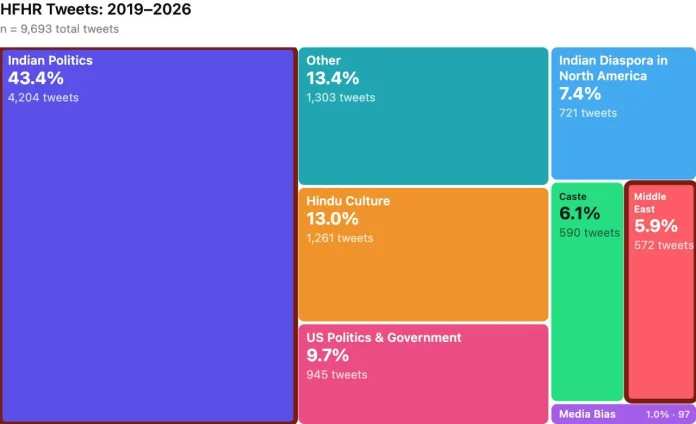
In the last six years, Hindus for Human Rights has posted 4,204 posts about Indian politics. This compares to 1,261 posts on Hindu culture and only 721 posts about the Indian diaspora living in North America.
1. HfHR’s presence on social media:
CoHNA analyzed 9,693 HfHR posts published on the microblogging site X (formerly Twitter), between 2019 and 2026. The posts were sorted according to their primary subject. Indian politics was by far the largest category, with 43.4 percent. The posts categorized as ‘Hindu Culture’ only accounted for 13 percent. Next came US politics and government, at 9.7 percent; the Indian diaspora, at 7.4 percent; ‘caste,’ at 6.1 per cent; the conflict in the Middle East, at 5.9 per cent, and media bias, at 1.1percent.
Why did we do the sort and count? It’s important to determine if the label given to an organisation matches the work it does or its agenda. It seems that they are all confused right now!
See how HfHR has been described in the media. In July 2026, the news coverage of HfHR campaigns regarding the latest Indian political issue referred to it as a “US based Hindu rights group,” a “Indian diaspora in the US,” or a “US based advocacy group.”
These labels – ‘Hindu’, Indian’, “South Asian”, and ‘Diaspora” – may overlap in some instances, but are not interchangeable. When these distinctions are removed, an organization that is heavily focused on Indian politics may be interpreted as representing American Hindus just because it operates in the United States or has “Hindu” written in its name.
2. How HfHR presents themselves:
HfHR actively pursues a similar role in American public affairs. HfHR, in 2024, described itself as a “major Hindu civil rights organization” while opposing a Congressional Resolution concerning Hinduism and anti-Hindu Bigotry.
3. Who advises HfHR?
The advisory board of HfHR is closely connected to Indian public affairs. 15 of the 20 members are located in India. Several of them held senior positions in the Indian state, including HarshMander, who was on the Prime Minister’s National Advisory Council between 2010 and 2012, and as Special Commission to the Supreme Court of India between 2005 and 2017. SyedaHameed served as a member of India’s Planning Commission from 2004 to 2014, and the National Commission for Women, from 1997 to 2000. Mallika Sarabhai is a government appointed chancellor of Kerala Kalamandalam.
How HfHR harms American Hindus
1. Forcing a political agenda indian on the community
American Hindus are an extremely diverse group. Many Hindus in the US are from India. Others come from Bangladesh, Nepal and Pakistan, Sri Lanka and other countries. Many were born and raised in the west. Their religious identity is not necessarily linked to India.
When an India-centered framework is applied to American Hinduism, it can result in civic and religious activities here being recast into a foreign struggle. A temple event is recast as a question of Indian influences. Hindu community groups that engage with their policymakers are often accused of being agents of Indian government. As seen in HfHR’s treatment of Tulsi Gabriel and Shri Thanedar, an American entering public office can be assessed based on alleged ties with Indian governments or political party–as shown by HfHR’s treatment of Tulsi Gabriel and Shri Thanedar. HfHR’s India Lens for American Issues reinforces the trope that American Hindus are forced to contend with: that our temples and organizations, as well as our political participation, are extensions of a foreign nation, or that pride in religious identity makes us “less American.”
But that’s not it.
2. Suppression and justification of anti-Hindu violence by the US
Since 2023, more than 10 Hindu temples have been attacked in the US. These attacks range from vandalism committed by Khalistani extremists to gunshots in one instance. A Hindu human rights group would be expected to take this issue very seriously. HfHR, however, reframed the incidents and downplayed them as a result of disenchantment towards the Indian government. This was despite the fact that the temples attacked were run by Hindus in Fiji, Utah, and other places.
This is more important than ideological preferences. A dismissal from an organization that has “Hindus”, in its name, can have unusual authority when a police department or school board, civil-rights office or newsroom evaluates the complaint of a Hindu community. American Hindus must fight twice as hard to get their experiences taken seriously. HfHR knows this and could be the reason it chose to include Hindu in its name.
The same pattern is evident in the expression of religion. HfHR uses Hindu festivals like Diwali and Holi to spread political messages in India. It has promoted the false claim that Holi commemorates a Bahujan women’s burning and is a major supporter of “Holi Against Hindutva”. In its Diwali programming, it has also emphasized caste, Hindutva and political bickering over stories about Hindu deities.
Hindu traditions are not immune to criticism. However, there is a distinction between engaging with them critically and turning ancient festivals into platforms for current political sloganeering. It forces non-Indian Hindus and apolitical Hindus to take positions on Indian politics instead of focusing on their spiritual observances.
HfHR has tried to justify its non American focus by stating that it cannot ignore human right violations and oppression in other places, especially “South Asia”, which is part its mandate. The record of its advocacy should be compared to that claim.
Hindus in Bangladesh face unrelenting, constant persecution. This is punctuated with violent spikes, such as during Navratri 2021 and 2024 or the wave of violence that occurred from December 2025 until January 2026. Over the past eight decades, the percentage of Hindus has decreased from 22% to only 8%. HfHR has tried to silence those who have raised the concerns of Bangladeshi Hindus, labeling them as agents of Hindutva.
The case of Bipin Joshuai shows a similar pattern. Joshi, a Nepali Hindu college student, was taken hostage in the terror attack on October 7, 2023 and killed later. HfHR published 572 posts about the conflict in the Middle East. However, CoHNA’s review did not find any post about Joshi. This raises a question: which Hindu victims are given attention by an organization that claims to represent Hindu values and advocate human rights in South Asia?
CoHNA is not the voice of every American Hindu. It is precisely for this reason that distinctions are important. HfHR should be described accurately by journalists, legislators, universities, interfaith groups, and other institutions. It is a group with a focus on India that represents, at most, one political and ideological preference among Hindus living in the US. Like its Advisory Board the majority of their work is focused on Indian and non Hindu issues.
The religious and cultural concerns of Hindus in America are an obvious afterthought. Their input on our lives and representation is also treated as such.
Methodology
CoHNA reviewed 9693 posts by Hindus for Human Rights published on X from Dec 2019 to May 2026. Grok AI and Claude was used to analyze and categorize posts on X based upon their primary subject, into mutually-exclusive categories.