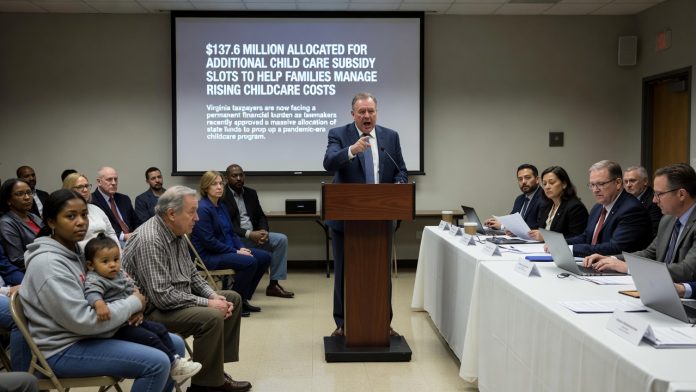
Virginia taxpayers are now facing a permanent financial burden as lawmakers recently approved a massive allocation of state funds to prop up a pandemic-era childcare program. The state budget includes a staggering allocation of $137.6 million for the Child Care Subsidy Program, which is managed jointly by the Virginia Department of Education and the Virginia Department of Social Services. This massive spending package aims to absorb the cost of expanded services that were previously funded by temporary federal COVID-19 relief money. Fiscal conservatives are raising serious red flags over the shortsighted decision to convert temporary federal aid into a permanent, recurring obligation for hardworking state taxpayers.
The Danger of Permanent Government Expansion
The funding specifically falls under Governor Glenn Youngkin and his Building Blocks for Virginia Families initiative, which seeks to prevent the loss of childcare services following the expiration of federal pandemic grants. House Appropriations Committee budget documents state the funding provides an additional 11,591 slots for families making up to 85 percent of the state median income. Furthermore, the committee notes that this massive cash injection addresses the waitlist for the birth-to-five age group as of December 2025. While supporting families is a noble goal, budget watchdogs argue that shifting this enormous financial burden to the state general fund sets a dangerous precedent for future spending and invites severe budget deficits.
During the height of the pandemic, the federal government flooded states with billions of dollars through the American Rescue Plan Act to temporarily expand a wide variety of social programs. In previous years, the Child Care Subsidy Program relied heavily on these federal pandemic-era relief funds to accommodate a rapidly growing enrollment base. Now that those federal dollars have predictably expired, state lawmakers have chosen to permanently saddle Virginia residents with the bill rather than scaling the program back to pre-pandemic levels. Expanding government dependency through emergency measures and then refusing to shrink the bureaucracy when the emergency officially ends represents a classic case of unchecked government overspending.
Reevaluating the State Budget
Whenever the state government rushes to distribute hundreds of millions of dollars, the risk of bureaucratic waste and administrative fraud increases exponentially. The Virginia Department of Social Services and the Virginia Department of Education must now manage an inflated system that was originally designed to be a temporary emergency relief measure. Taxpayers have every right to demand strict oversight and rigorous financial audits to ensure this $137.6 million is not squandered on administrative bloat or fraudulent subsidy claims. Without aggressive financial safeguards and conservative fiscal policies, hardworking Virginians will simply be throwing their tax dollars into a bureaucratic black hole that demands more money every single legislative session.
Proponents of the massive spending package frequently point to a childcare waitlist that had grown to over 12,000 children as justification for the general fund allocation. However, fiscal conservatives argue that government subsidies artificially inflate market demand and ultimately drive up the overall cost of childcare for families who do not receive state assistance. By subsidizing families making up to 85 percent of the state median income, the government is irresponsibly expanding welfare programs well into the middle class. This creates a dangerous cycle of dependency where citizens increasingly look to the state bureaucracy to manage their daily household expenses instead of relying on the free market and personal responsibility.
If Virginia wants to maintain a competitive economic environment, lawmakers must prioritize reducing the budget and returning surplus money directly to the taxpayers. Permanently replacing temporary federal funds with state general funds is a fundamentally flawed budgeting strategy that threatens the long-term fiscal health of the commonwealth. Lawmakers should focus on deregulating the childcare industry to lower costs naturally rather than throwing over a hundred million dollars of taxpayer money at a government-created problem. True conservative governance requires making difficult financial decisions to shrink the size of government, eliminate wasteful spending, and protect the financial future of hardworking Virginia families.