
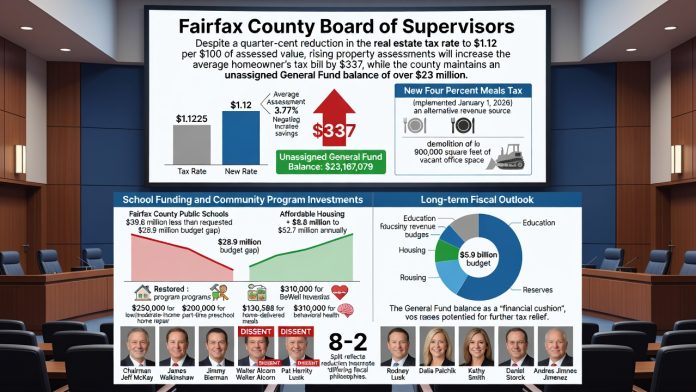
The Fairfax County Board of Supervisors has officially adopted a $5.9 billion budget for the upcoming fiscal year, balancing a slight reduction in the real estate tax rate with rising property assessments. Despite a quarter-cent decrease in the tax rate to $1.12 per $100 of assessed value, the average residential tax bill will increase by $337. This financial dynamic occurs as the county maintains an unassigned General Fund balance of more than $23 million. Officials navigated significant fiscal challenges to finalize the spending plan, which includes new revenue streams and targeted funding restorations for community programs.
The budget decisions were deliberated by the full Fairfax County Board of Supervisors, which includes Chairman Jeff McKay, James Walkinshaw, Jimmy Bierman, Walter Alcorn, Pat Herrity, Rodney Lusk, Dalia Palchik, Kathy Smith, Daniel Storck, and Andres Jimenez. The board ultimately voted 8-2 to set the new tax rate, with dissenting votes reflecting differing fiscal philosophies among the supervisors. Supervisor Alcorn voted against the measure because he opposed any reduction in the tax rate, while Supervisor Herrity dissented on the grounds that the reduction did not go far enough. This split vote underscores the ongoing debate over how best to manage the county’s financial resources amid shifting economic pressures.
Impact on Residential Taxpayers and Assessments
The newly approved real estate tax rate represents a drop from the previous rate of $1.1225 to $1.12 per $100 of assessed value. While this quarter-cent decrease saves the average homeowner approximately $20 compared to keeping the rate flat, the overarching financial burden on residents continues to grow. An average residential assessment increase of 3.77 percent effectively negates the rate reduction, driving the overall average tax bill up by $337. Chairman McKay acknowledged the financial strain on residents, noting that people are suffering right now and expressing hope that future budgets might allow for further reductions.
The board’s ability to lower the real estate tax rate was largely attributed to the alternative revenue stream provided by the county’s new four percent meals tax, which was implemented on January 1, 2026. This newly introduced tax on food and beverages offset the immediate need to hold the real estate tax rate steady to fund essential services. Additionally, County Executive Bryan Hill pointed to the demolition of 900,000 square feet of vacant office space as a necessary step to right-size the commercial market inventory. Hill expressed cautious optimism that a stronger commercial real estate market is beginning to emerge, which could eventually reduce the heavy tax reliance on residential property owners.
School Funding and Community Program Investments
The allocation of the $5.9 billion budget carries significant implications for local education and housing initiatives across Fairfax County. For the second consecutive year, the county transfer to Fairfax County Public Schools came in meaningfully below the school system’s requested amount. The school district received $39.6 million less than initially requested, resulting in a substantial $28.9 million budget gap that administrators must now navigate. Conversely, affordable housing initiatives saw a funding boost, receiving an additional $8.8 million that brings the county’s baseline investment in this sector to approximately $52.7 million annually.
Beyond education and housing, the finalized budget restores partial funding to several critical community support programs that had faced potential cuts. The county directed $250,000 to revive a low and moderate-income home repair pilot program, ensuring vulnerable residents can maintain safe living conditions. Additional restorations include $200,000 for a part-time preschool program, $130,588 for home-delivered meals, and $310,000 for the BeWell behavioral health support initiative. County Executive Hill stated that this budget reflects a full recognition of the fiscal challenges the county faces, while simultaneously continuing to invest in the community and its workforce.
Long-term Fiscal Outlook and General Fund Balance
As Fairfax County moves into the new fiscal year, financial watchdogs are closely monitoring the local government’s reserve funds and long-term spending habits. The county currently holds an unassigned General Fund balance of exactly $23,167,079, a figure that provides a financial cushion but also prompts questions about taxation levels. Taxpayer advocates frequently point to such unassigned balances as evidence that further tax relief could be provided without jeopardizing essential public services. Meanwhile, county administrators maintain that these reserves are crucial for maintaining fiscal stability and addressing long-term infrastructure needs in an unpredictable economic climate.
The implementation of the fiscal year 2027 budget will test the effectiveness of the county’s strategy to balance residential tax relief with the need for robust public services. Residents will begin to see the practical impacts of the $337 average tax bill increase as property tax assessments are finalized and distributed. At the same time, the full-year revenue generated by the new meals tax will be heavily scrutinized to determine if it truly alleviates future tax burdens on homeowners. Local leaders will continue to evaluate commercial real estate trends and revenue collections to guide their fiscal policies in the years ahead.
Email Fairfax County Supervisors At:
Jeff McKay – chairman@fairfaxcounty.gov,
Kathy Smith (Sully District) sully@fairfaxcounty.gov,
Rachna Heizer (Braddock District) braddock@fairfaxcounty.gov,
James Bierman (Dranesville District) dranesville@fairfaxcounty.gov,
Rodney Lusk (Franconia District) franconia@fairfaxcounty.gov,
Walter Alcorn (Hunter Mill District) huntermill@fairfaxcounty.gov,
Andres Jimenez (Mason District) mason@fairfaxcounty.gov,
Daniel Storck (Mount Vernon District) mtvernon@fairfaxcounty.gov,
Dalia Palchik (Providence District) providence@fairfaxcounty.gov,
Pat Herrity (Springfield District) springfield@fairfaxcounty.gov,