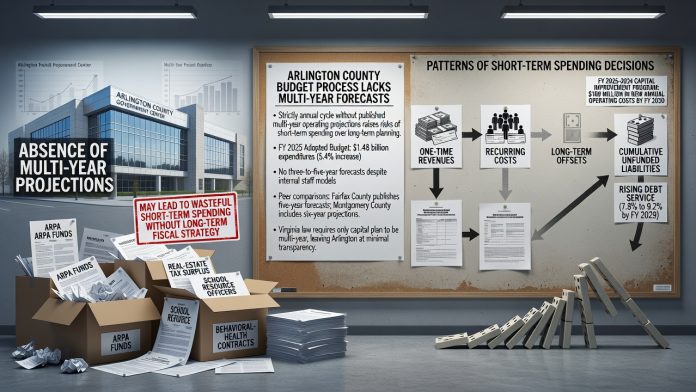
Arlington County operates under an annual budget cycle that requires adoption of the operating budget each year without formal multi-year operating projections. The county charter and code mandate approval of both the operating budget and a separate ten-year capital improvement program. This structure relies on single-year revenue and expenditure snapshots that balance the current fiscal year but leave future obligations unaddressed in public documents.
Annual Budget Cycle Details
Arlington’s fiscal year begins July 1 with the proposed budget typically presented in February or March and adopted in May or June. The most recent document is the FY 2025 Adopted Budget which contains one-year projections only. No three-to-five-year operating forecasts appear in the main budget book or appendices despite internal staff models that include multi-year assumptions for planning purposes.
The capital improvement program covers approximately 2.8 billion dollars in projects over ten years yet excludes most operating cost impacts beyond debt service. Peer jurisdictions such as Fairfax County publish five-year general fund forecasts while Montgomery County Maryland includes six-year out-year projections. Arlington therefore operates at the minimal transparency level among large Northern Virginia localities under Virginia law which requires only the capital plan to be multi-year.
Patterns of Short-Term Spending Decisions
Review of recent budget documents shows repeated allocation of one-time revenues to recurring costs. In FY 2024 and FY 2025 portions of federal ARPA funds and higher real-estate tax collections supported ongoing personnel expansions including additional school resource officers and behavioral-health contracts. These additions balanced the single-year budget without published out-year offsets to cover sustained expenses.
Pension contribution rates and healthcare cost growth receive only the minimum actuarially required funding each year. No published schedule details cumulative unfunded liabilities or the tax-rate effects expected after FY 2027 when debt-service peaks from the capital plan begin. The FY 2025-2034 capital improvement program identifies about 180 million dollars in new annual operating costs by FY 2030 yet these figures remain outside any adopted operating forecast.
FY 2025 Budget Figures and Future Obligations
General Fund expenditures reached 1.48 billion dollars in the FY 2025 adopted budget representing a 5.4 percent increase from the prior year. The real-estate tax rate stayed flat at 0.915 dollars per 100 dollars of assessed value while relying on 4.8 percent assessment growth. Fund balances remained at 5.5 percent of expenditures meeting the policy minimum of 5 percent.
Debt service is projected to rise from 7.8 percent to 9.2 percent of General Fund expenditures by FY 2029 under the current capital plan. Board minutes from May 2024 record questions about future funding for these obligations with staff indicating that subsequent budgets will address them. This approach achieves short-term balance through assessment growth and one-time resources while cumulative impacts stay unquantified for public review.
Comparisons With Other Jurisdictions
Fairfax County explicitly modeled a structural deficit beginning in FY 2027 and adjusted spending and reserves accordingly using its five-year forecast. Arlington documents contain no equivalent analysis. Local reporting from 2023 through 2024 has noted repeated use of one-time money and questioned the sustainability of service expansions without identifying an imminent crisis.
Virginia localities face no state requirement to adopt multi-year operating budgets leaving Arlington legally compliant yet without the earlier visibility provided by peer forecasts. The absence of published multi-year operating projections therefore creates structural conditions that optimize decisions for the current year while deferring recognition of long-term costs.