
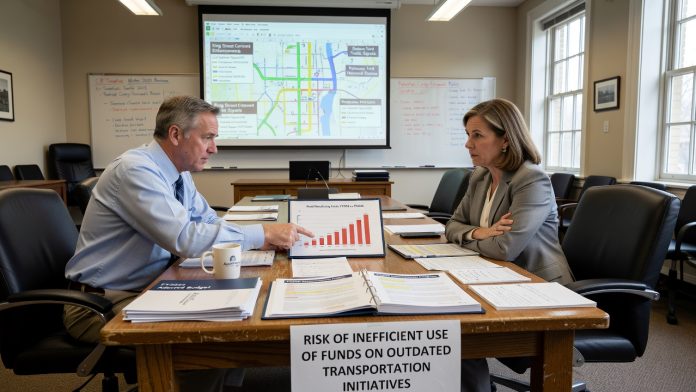
The City of Alexandria operates under a multi-year Capital Improvement Program that receives annual updates alongside the operating budget. Transportation initiatives form a key part of this program and draw funding from general obligation bonds, state and federal grants, Northern Virginia Transportation Authority revenues, and local pay-as-you-go sources. The FY2025 Adopted Budget, approved in spring 2024, serves as the operative document because no FY2026 or FY2027 budgets have been released. This situation leaves open the possibility that some line items could persist without fresh review.
Capital Improvement Program Structure
Alexandria updates its Capital Improvement Program each year through a process that includes staff recommendations presented during winter and spring budget cycles. In the most recent cycle, several transportation projects received adjustments such as revised cost estimates, schedule changes, and funding reallocations tied to grants. These revisions occur within the Transportation and Transit section as well as the Public Works Streets and Traffic categories. The annual refresh provides a formal mechanism to align projects with current traffic data, construction costs, and policy priorities.
Projects that receive no new appropriations or scope modifications can carry forward prior-year allocations. Public records from City Council work sessions and budget hearings in spring 2024 note occasional references to out-year initiatives whose estimates had not been refreshed for two or three years. Such carry-forward practices create a theoretical risk of mismatch between allocated funds and evolving needs. The fiscal year runs from July 1 through June 30, keeping the FY2025 document in force until a successor budget is adopted.
Transportation Categories and Potential Impacts
Common transportation capital categories in recent Alexandria CIP documents include road resurfacing, complete streets improvements, traffic signal modernization, and corridor enhancements along King Street and Duke Street. Additional allocations support regional transit contributions such as the Potomac Yard Metrorail station and WMATA capital needs. Electric vehicle charging infrastructure and fleet electrification also appear among the line items. If a project scope or cost estimate remains static while new traffic counts, ridership figures, or inflation data emerge, the city could face over- or under-funding relative to actual requirements.
The absence of updated line items may also create opportunity costs when compared with higher-priority initiatives identified in updates to the Vision Zero plan. Council has addressed similar situations in prior years through mid-year budget amendments and CIP amendments, which serve as corrective tools. These mechanisms allow adjustments outside the regular annual cycle when conditions warrant. No major news coverage from 2023 through 2024 has identified specific transportation projects as obsolete.
Comparisons Across Recent Budget Cycles
Review of FY2023 through FY2025 CIP documents shows consistent re-appropriation and scope adjustments for major corridors such as Duke Street and Route 1 in the Potomac Yard area. This pattern indicates that the city does not automatically roll every line item forward without examination. The FY2025 baseline will form the starting point for the next review cycle, expected during winter and spring 2025. Until the proposed FY2026 budget and CIP are released, direct comparison of transportation line-item changes cannot occur.
The concern about inefficient use of funds on outdated initiatives represents a generic municipal budgeting issue that arises whenever capital programs are not refreshed. In Alexandria, the annual CIP process combined with public review offers the primary safeguard against such outcomes. City staff presentations and council discussions around the FY2025 budget centered on personnel costs, school funding, WMATA subsidies, and stormwater infrastructure rather than allegations of stale transportation projects. No public records currently document systemic problems with outdated line items.
Future Review Process
Once the FY2026 proposed budget documents become available, analysts will be able to examine whether transportation allocations have been adjusted or left unchanged. The current absence of later-year budgets means the FY2025 Adopted Budget continues to guide all active capital projects. Council retains authority to enact project-specific resolutions or budget amendments if new information surfaces before the next full cycle. This structure maintains oversight while allowing flexibility for emerging needs.
The overall framework underscores the importance of timely data incorporation into capital planning. Alexandria officials have historically used the annual process to address cost and schedule shifts. Continued public access to meeting minutes and budget materials supports transparency around any future adjustments. Until additional documents are released, the existing FY2025 CIP serves as the sole authoritative reference for transportation capital commitments.
Email the City Council at:
Alyia Gaskins (alyia.gaskins@alexandriava.gov),
Sarah Bagley (sarah.bagley@alexandriava.gov),
Canek Aguirre (canek.aguirre@alexandriava.gov),
John Chapman (john.chapman@alexandriava.gov),
Abdel Elnoubi (abdel.elnoubi@alexandriava.gov or abdel-rahman.elnoubi@alexandriava.gov),
Jacinta Greene (jacinta.greene@alexandriava.gov),
Sandy Marks (sandy.marks@alexandriava.gov),