
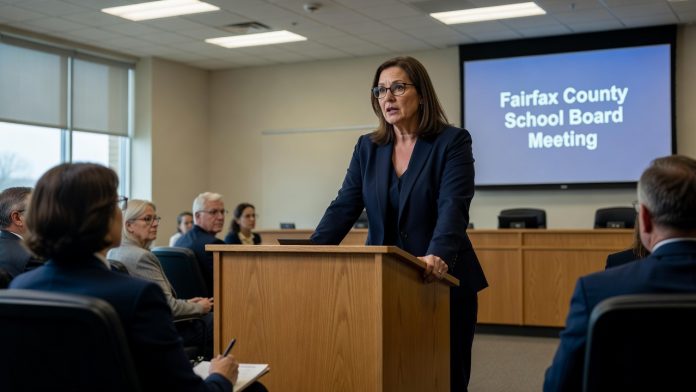
Leslie Borkenhager spoke before the Fairfax County School Board in a community participation segment regarding hybrid telework practices. She described the arrangement as one in which teachers and tech support staff perform nearly all their work on in-office days within a setting free from distractions. Borkenhager added that this environment supports more efficient completion of tasks while work continues uninterrupted overall.
The presentation outlined specific aspects of hybrid schedules that affect daily operations in educational technology support. On designated in-office days, the speaker noted a reduction in conversations that might otherwise interrupt workflow. This setup allows staff to address responsibilities in a concentrated manner according to her account.
Borkenhager conveyed that the hybrid model ensures all required activities, such as reviewing captions and handling calls, remain fully addressed. The testimony focused on the resulting efficiency gains observed in her role. Fairfax County School Board members received this information as part of ongoing discussions about work arrangements.
Details of Hybrid Telework Implementation
Borkenhager explained the mechanics of hybrid telework during her appearance at the Fairfax County School Board. She indicated that in-office periods concentrate the majority of productive effort in a low-distraction space. This division of time supports sustained attention on technical duties essential to school operations.
The account included observations about how remote elements of the schedule integrate with on-site requirements. Borkenhager stated that efficiency improves because staff can manage focused work without competing interruptions. Her description remained centered on practical outcomes for IT personnel within the district.
Board proceedings incorporated the speaker’s points on maintaining service levels across hybrid days. The testimony highlighted the continuity of tasks like communication handling despite the split schedule. Such details provided context for evaluating productivity in Fairfax County educational support functions.
Efficiency Observations from Staff Perspective
During the meeting, Borkenhager shared insights into how hybrid telework affects the pace of work for tech support roles. She noted that the structured in-office time leads to higher efficiency by minimizing external factors. This observation aligned with the need to complete all assigned duties thoroughly.
The speaker connected these practices to broader operational needs at the Fairfax County School Board. Borkenhager described scenarios where focused days enable comprehensive handling of responsibilities without compromising responsiveness. Her comments stayed within the scope of personal experience shared publicly.
The session concluded with emphasis on the overall effectiveness of the hybrid approach as presented. Borkenhager reiterated that work output remains consistent and results-oriented. This information contributes to the board’s consideration of policies affecting staff in the school system.
To Contact Fairfax School Board Members:
All Members – FairfaxCountySchoolBoard@fcps.edu,
Tom Dannan – tfdannan@fcps.edu,
Robyn Lady – ralady1@fcps.edu,
Marcia St. John-Cunning – mstjohncunni@fcps.edu,
Melanie Meren – HunterMillStaff@fcps.edu,
Ricardy Anderson – randerson@fcps.edu,
Mateo Dunne – mdunne@fcps.edu,
Karl Frisch – kfrisch@fcps.edu,
Sandy Anderson – sanderson@fcps.edu,
Seema Dixit – sdixit@fcps.edu,
Kyle McDaniel – kmcdaniel@fcps.edu,
Ryan McElveen – rlmcelveen@fcps.edu,
Ilryong Moon – imoon@fcps.edu,