
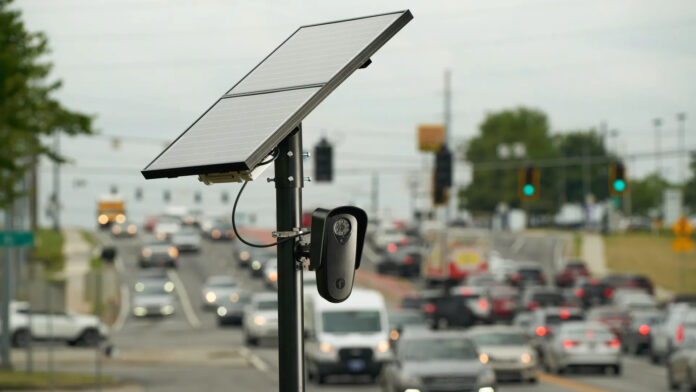
As lawmakers seek to regulate use of automated license plate readers in Virginia, debates continue about how best to do so. Legislation faced a brief defeat in a Senate committee on Monday before being revived for further deliberation.
License plate readers are typically cameras mounted on poles or overpasses (but can also be dashboard cameras) that capture a photograph or video clip of a vehicle and its license plate along with the location, date and time of the capture. The technology has grown in popularity across the country in both public and private sector use — from businesses to homeowner associations to law enforcement agencies. But with no state regulation, the technology’s use exists in a legal gray area.
House Bill 2724 limits how police can use the data it collects with the cameras and restricts how long the information can be stored. The bill by Del. Charniele Herring, D-Alexandria, cleared the House of Delegates last week, but in the Senate some members said allowing the data to be kept for 30 days was too long. They also were concerned that it allowed law enforcement to install cameras along state roads.
Senate Majority Leader and committee chair Scott Surovell, D-Fairfax called it a “tradeoff” and a “balance” to both regulate the usage of license plate readers while granting expanded installation to law enforcement.
Following deliberation in the state’s Crime Commission last year, Herring’s bill landed on a 30-day limit to store data. It’s a sticking point for some advocates however. Several immigrants’ rights groups and the Virginia chapter of the NAACP hope that the lawmakers can reduce data storage to seven days.
It’s something Charlottesville’s police department already does. Chief Michael Kochis, who has repeatedly spoken in support of Herring’s bill, said his department self-regulates seven days based on local community feedback, but he noted that other departments may prefer the 30 days outlined in the bill.
Sen. Jennifer Boysko, D-Fairfax, then proposed an amendment to limit storage to seven days but it didn’t have the votes.
Sens. Lashrecse Aird, D-Petersburg, and Jennifer Carroll Foy, D-Prince William, pushed back hardest from the dais.
“We are authorizing mass surveillance on a massive scale. This is Big Government, ‘Big Brother’ in a big way,” Carroll Foy said, referencing George Orwell’s “1984” novel.
She also echoed concerns from immigrants’ rights groups that license plate reader data could potentially be subpoenaed by Immigration and Customs Enforcement, and added that she’s worried states with abortion bans could also subpoena information to track if someone sought an abortion in Virginia. She and Aird also noted suspicion that the readers may be more likely to be installed in communities of color, which have historically had more negative interactions with law enforcement.
Aird backed law enforcements’ arguments that readers are a useful tool in solving crimes, but suggested tweaking the bill to not allow for highway expansion just yet.
“I think we are doing real harm by expanding this by not allowing additional time to see how these guardrails will work and how they will be applied,” she said. “I don’t think limiting the legislation to existing cameras will be a detriment to law enforcement. This is not the time to expand them — we need to see how this legislation will work with the cameras that are in place.”
But Herring called her bill an “important action in creating a uniform policy across the Commonwealth as we track where those cameras are in use.”
She added that while many existing cameras are mounted around the state on secondary roads and private properties, “interstates become targets for human trafficking.”
After debate and public comment the bill was briefly defeated this session — with Surovell and Sen. Russett Perry, D-Loudoun, the only Democrats to support it advancing. Republicans Sen. Bill Stanley, R-Franklin, and Senate Minority Leader Ryan McDougle, R-Hanover, joined most Democrats in defeating the bill.
However, by the end of the committee meeting, McDougle brought up a reconsideration of the vote to continue debate on the bill — meaning it can come up again when the Courts of Justice committee meets Wednesday. With the 2025 legislative session already past its midpoint, bills that have cleared the House and Senate are now in review in the opposite chamber for a chance to end up on the governor’s desk.