
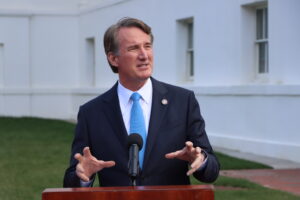
Gov. Glenn Youngkin announced yesterday that he is asking the legislature for an additional $290 million to support school construction and modernization efforts across Virginia. This latest investment would bring the total funding for the current biennium to $700 million and raise the state’s overall contribution under Youngkin’s administration to nearly $2 billion.
Youngkin’s funding request is included in his proposed budget amendments, which he plans to present next week at a joint meeting of the General Assembly’s money committees.
According to the governor’s office, the state’s financial commitments have spurred an estimated $3.4 billion in total funding for school construction. The additional support would be made possible through a combination of local government contributions and federal matching funds.
“Over the last three years, we have invested historic amounts in our education system, including our public-school facilities,” Youngkin said in a statement. “Our record economic growth and the resulting surplus allows us to make this critical investment to ensure every Virginia student has access to high-quality school facilities that support academic success.”

Youngkin plans to use the newly announced $290 million in non-general funds to expand competitive grant opportunities for school divisions, particularly in high-need areas. The money would also address critical infrastructure issues, supporting the construction and renovation of schools in urgent need of repair.
State officials say the increased funding will provide K-12 students with safer, more conducive learning spaces, a move that has been welcomed by educators and community leaders alike. Local school divisions will be able to apply for grant support to fast-track modernization projects that may have been delayed due to funding shortfalls.
The Youngkin administration has framed the initiative as part of a broader effort to support Virginia’s educational system and improve outcomes for students. As schools across the state face aging infrastructure and capacity challenges, this investment aims to reduce disparities in facility quality, especially in underserved areas.
“One of our guiding principles since day one of the Youngkin Administration has been to provide safe, vibrant, and healthy learning environments for all of our students,” said Secretary of Education Aimee Guidera.
“This investment in supporting new and refurbished school buildings makes it possible for every community in the commonwealth to have the means to provide a best-in-class education that prepares every student for success in our increasingly demanding knowledge- and skills-based economy.”
In 2022, Youngkin’s first year in office, the General Assembly in a bipartisan effort approved a historic $1.2 billion investment in school construction, aiming to modernize aging facilities and reduce funding disparities among school divisions. The sweeping plan combined grants and loans to support renovations, new construction, and capacity expansion for K-12 schools across the commonwealth.
Of the $1.2 billion, about $850 million was allocated for grants. This included $400 million in formula-based grants, which provided each of Virginia’s 134 school divisions with a $1 million base allocation. The remaining $266 million was distributed based on the Local Composite Index (LCI) — a state funding formula that considers factors like property values, taxable sales and population data to assess a locality’s financial ability to support its schools.
Another $450 million was funneled into the newly created School Construction Fund and Program, a competitive grant program designed to assist divisions with the most critical infrastructure needs.
School systems with poor building conditions and limited financial capacity could apply for these funds to support construction, renovation, or expansion projects. This program is primarily funded by 98% of gaming revenue from Virginia’s four new casinos in Bristol, Danville, Portsmouth, and Norfolk. The fund is administered by the Virginia Board of Education.
Virginia faces a mounting crisis with school infrastructure. Data released by the Virginia Department of Education in 2022 revealed that nearly 1,000 school buildings across the state are at least 50 years old. Replacing these facilities would cost more than $25 billion — a figure far beyond the capacity of most localities.
Traditionally, local governments have shouldered the financial burden of school construction, relying on local tax revenue. But for economically distressed areas, particularly in Southwest Virginia and Southside, this has become an increasingly difficult challenge due to population decline and economic hardship.
But in April, Youngkin vetoed a bill lawmakers sent to his desk that would have allowed localities to implement a 1% sales tax to help cover the costs of school construction and modernization.
The proposal required voter approval through a referendum before the tax could be enacted by local governments.
Youngkin acknowledged that school construction is a “worthy cause” but argued that Virginia has already taken substantial steps to address those costs. He contended that citizens should not face additional taxes, particularly the $1.5 billion annually that would have been raised by the 1% sales tax.
“The commonwealth should pursue a tax policy that unleashes economic development and prioritizes job and wage growth through innovative reforms,” Youngkin said in his veto. “These reforms must allow hardworking Virginians to keep more of their money, not less; any proposal that increases the cost of living and the cost of business is not a policy we should pursue.”
Prior to 2022, Democrat state assistance for school construction was limited, with much of it coming from the Literary Fund, a state-managed pool of money established in Virginia’s Constitution. Funded by sources such as unclaimed lottery winnings, criminal fines, and unclaimed property, the Literary Fund historically provided low-interest loans to support school construction and debt service for technology.
However, in recent years, much of the fund’s revenue was redirected to cover teacher retirement costs, leaving fewer resources for school building projects.
The 2022 legislative session retooled the Literary Fund’s loan program, significantly increasing its impact. Lawmakers raised the maximum loan amount from $7.5 million to $25 million and capped the interest rate at 2%. These changes made it more feasible for school divisions to finance major construction projects at a lower cost.
With the state’s total contribution now approaching $2 billion, education advocates are hopeful the increased funding will lead to long-term improvements in school facilities and better learning conditions for students throughout the commonwealth.
Virginia Board of Education President Grace Creasey said Tuesday that the panel will prioritize “those school divisions in greatest need that have missed out on prior grant opportunities,” especially rural divisions.
“We also know that school divisions are eager to adopt seat time flexibility and competency-based models which requires us to design learning environments and spaces differently. This new investment will make this possible,” Creasey said.
This article was reprinted from the Virginia Mercury under the Creative Commons project.