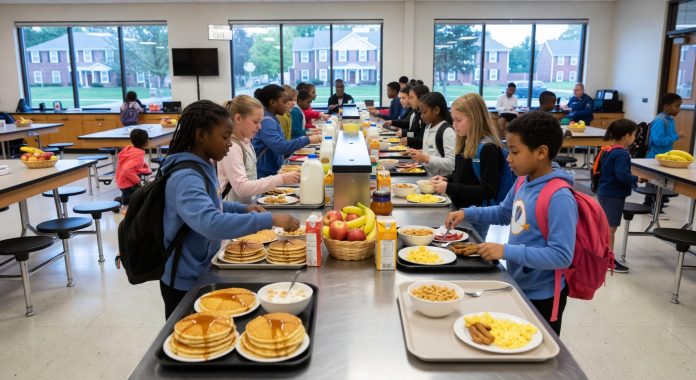
The Virginia House of Delegates considered legislation during the 2026 regular session aimed at making school breakfast available at no cost to all students in public elementary and secondary schools. House Bill 96 proposes changes to the Code of Virginia to achieve this goal through amendments and repeals of specific sections.
Specifically, the bill would amend and reenact section 22.1-79.7:1, which deals with school meals and their availability to students. The current language in this section requires school boards to ensure that meals are available to students who qualify for free or reduced price meals under federal programs. The proposed amendment would extend this to require that school breakfast be provided at no cost to all students, regardless of eligibility status.
In addition, House Bill 96 would repeal section 22.1-207.3 of the Code of Virginia. This section previously outlined the framework for school breakfast programs, including provisions related to federal funding appropriations and authorizations for reimbursement.
The core requirement of the bill is that the Department of Education must reimburse each public elementary and secondary school for every eligible school breakfast served to a student. This reimbursement would cover the costs associated with providing the meals, allowing schools to offer them without charging students or their families.
The legislation was introduced on January 2, 2026. Delegate Elizabeth Bennett-Parker sponsored the bill in the House of Delegates. After introduction, it was referred to the House Committee on Education. The bill advanced from that committee and was then sent to the House Committee on Appropriations for further consideration of its budgetary implications.
On February 6, 2026, the House Committee on Appropriations continued House Bill 96 to the 2027 regular session by voice vote. This continuation means that the bill will not receive final action during the 2026 session and will be eligible for consideration again next year.
A budget amendment associated with the bill has been proposed to allocate forty point three million dollars from the general fund for each of fiscal year 2027 and fiscal year 2028. This funding would support the implementation of the no-cost school breakfast program across the state by covering the reimbursement costs to schools.
By establishing a state reimbursement system, the bill seeks to ensure consistent availability of breakfast in all public schools without reliance on local funds or variable federal support. The repeal of the previous statute removes the condition that programs could only operate when federal funds were available.
The changes would apply to every public school division in Virginia, requiring them to make breakfast available at no cost to students. This universal provision aims to eliminate any financial barriers that might prevent students from participating in the breakfast program.
As the bill stands continued to the next session, members of the House of Delegates will have additional time to review the details, including the exact administrative requirements for schools and the Department of Education. The fiscal impact of providing reimbursements for all served breakfasts will also be subject to further analysis during the 2027 session.
The legislative history of House Bill 96 includes its prefiling and formal introduction in the new year. The referral to both education and appropriations committees underscores the dual focus on policy and funding for the proposal.
Under the amended section 22.1-79.7:1, school boards would have an expanded obligation to ensure that breakfast is provided without charge. This differs from the prior emphasis on targeted availability based on federal eligibility criteria.
The Department of Education would oversee the reimbursement process, distributing state funds to schools based on the number of breakfasts served. This centralized approach could streamline operations for local school divisions.
With the bill’s continuation, no changes to current practices regarding school breakfast will take effect from this legislation in the immediate term. Schools will continue to operate under the existing provisions of the Code of Virginia until further action in 2027.
The proposal in House Bill 96 highlights the ongoing discussion in the House of Delegates about supporting student nutrition through state resources. The specific funding request of over forty million dollars annually illustrates the scale of the commitment involved in expanding the program to all students.
Lawmakers in the House have the chance to propose modifications or gather more data on participation rates and costs when the bill is taken up again. The voice vote for continuation reflects a collective decision to pause for additional examination.
Overall, House Bill 96 introduces a new model for school breakfast in Virginia by mandating no-cost availability and state reimbursement while repealing the prior conditional statute.