
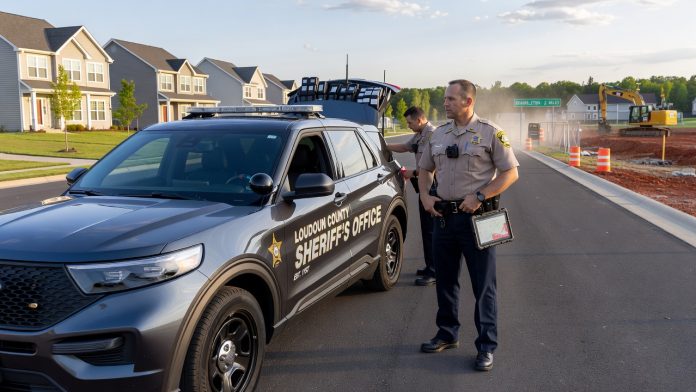
Loudoun County has approved increased funding for the Sheriff’s Office overtime and equipment upgrades as part of its FY2026 budget. The allocations respond to ongoing population growth and rising demands for law enforcement services in expanding suburban areas. County officials have tied these increases to measurable trends in call volume and staffing requirements.
Population Growth Pressures Public Safety Resources
Loudoun County’s population has risen from approximately 312,000 in 2010 to an estimated 440,000 in 2024. This growth of roughly 2 to 3 percent annually has occurred primarily in new subdivisions around Brambleton, Aldie, and the fringes of Leesburg. The expansion has led to higher numbers of 911 calls, traffic incidents, and property-related incidents that require additional law enforcement response.
Budget documents note that response-time metrics and staffing ratios are tracked closely during annual work sessions. These figures show the need for sustained resources to maintain service levels across a larger geographic area. County reports indicate that per-capita crime rates have remained stable or declined in many categories despite the population increase.
FY2026 Budget Allocations for the Sheriff’s Office
The FY2026 Adopted Budget covers the period from July 1, 2025, through June 30, 2026, and forms part of the county’s overall operating budget that exceeds 1.8 billion dollars. Public safety functions, including the Loudoun County Sheriff’s Office, typically account for 12 to 15 percent of general-fund expenditures. Recent budgets have shown year-over-year increases for the Sheriff’s Office in both personnel and capital categories.
The Loudoun County Sheriff’s Office manages patrol, investigations, corrections, court security, and emergency response duties. Funding supports salaries, benefits, and overtime along with vehicles, body-worn cameras, radios, and forensic equipment. These line items appear in both the operating budget and the capital improvement program.
Drivers of Overtime and Equipment Needs
Overtime expenditures have risen in line with population-driven call volumes, recruitment challenges, and special-event coverage. County analyses describe overtime as a short-term measure that helps bridge staffing gaps while full-time hiring processes continue. Equipment upgrades are funded to replace aging assets and improve interoperability with neighboring agencies.
Modern communications systems and updated vehicles are cited as ways to enhance officer safety and evidence collection. Budget materials emphasize that these investments help the department keep pace with development in new residential areas. Officials have noted that such upgrades also support compliance with court mandates and regional coordination requirements.
Outcomes and Regional Comparisons
County reports indicate that public-safety spending has correlated with maintained service levels even as the population grows. Per-capita crime statistics have not shown widespread increases, and performance metrics are reviewed regularly in public meetings. Similar funding patterns appear in neighboring jurisdictions such as Fairfax and Prince William counties.
These peer localities also allocate rising shares of their budgets to overtime and technology upgrades amid comparable housing growth. Loudoun’s per-capita public-safety expenditures remain competitive with these jurisdictions. Budget discussions have included consideration of hiring bonuses and civilian support roles as potential alternatives to sustained overtime use.
Public Record Sources and Ongoing Monitoring
Official budget documents are available on the county website and contain line-item justifications for Sheriff’s Office expenditures. Work-session minutes from the spring adoption cycle reference growth-related pressures on response capabilities. Local news coverage has reported on these budget adjustments during the annual review period.
The adopted figures reflect incremental increases that mirror population gains recorded over the past decade. Continued monitoring of vacancy rates and response times will inform future budget cycles. County staff have stated that the current allocations aim to sustain existing service standards in expanding communities.
Email the Board of Supervisors at:
Phyllis J. Randall (Chair, At-Large) – Phyllis.Randall@loudoun.gov,
Michael R. Turner (Vice Chair, Ashburn District) – Mike.Turner@loudoun.gov,
Juli E. Briskman (Algonkian District) – Juli.Briskman@loudoun.gov,
Sylvia R. Glass (Broad Run District) – Sylvia.Glass@loudoun.gov,
Caleb Kershner (Catoctin District) – caleb.kershner@loudoun.gov,
Matthew F. Letourneau (Dulles District) – Matt.Letourneau@loudoun.gov,
Kristen C. Umstattd (Leesburg District) – Kristen.Umstattd@loudoun.gov,
Laura A. TeKrony (Little River District) – Laura.TeKrony@loudoun.gov,
Koran Saines (Sterling District) – Koran.Saines@loudoun.gov,