
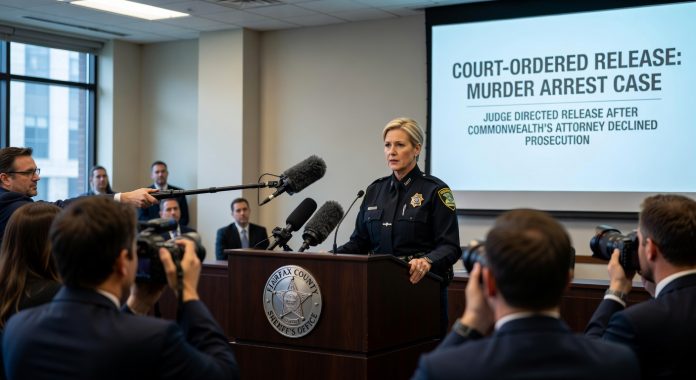
Sheriff Stacey Kincaid addressed questions regarding the release of an individual arrested on murder charges in Fairfax County. The release occurred after Commonwealth’s Attorney Steve Descano declined to prosecute the case. A judge issued the order that required the sheriff’s office to free the suspect.
Congressman Jim Jordan inquired about the circumstances leading to the release of the violent offender. Kincaid explained that her department follows directives from the court when prosecution does not proceed. She stated that the decision rested with the judge following the prosecutor’s choice not to file charges.
The case involved an arrest for murder along with aggravated elements. Jordan highlighted the seriousness of the allegations during the exchange. Kincaid confirmed that the individual was released pursuant to the judicial order.
Kincaid noted that the arrest took place on March 11, 2016. After Descano’s office declined to move forward with prosecution, the court directed the release. She described the process as one where the sheriff executes court orders without discretion in such matters.
Jordan sought further details on why prosecution was not pursued despite the nature of the charges. Kincaid responded that the Commonwealth’s Attorney holds responsibility for those decisions. She emphasized that once charges are not filed, judicial release follows as a legal requirement.
The discussion examined the broader effects on public safety when violent offenders are released. Kincaid reiterated that her office does not independently decide releases in these situations. The judge’s order serves as the binding authority according to her statements.
Jordan continued to ask about accountability measures for cases involving serious crimes. Kincaid provided responses focused on the legal framework governing releases. She explained that compliance with court directives is mandatory for the sheriff’s department.
The exchange clarified the roles of the prosecutor and the judiciary in determining outcomes. Descano’s decision not to prosecute directly led to the court order for release. Kincaid outlined how her office carried out that order without additional authority to detain the suspect.
Jordan raised points about patterns of violent offenders returning to communities. Kincaid addressed the specific instance by confirming the sequence of arrest, non-prosecution, and judicial release. She avoided speculating on prosecutorial motivations.
The sheriff described the release as a direct result of the judge’s ruling. Kincaid stated that without prosecution moving forward, holding the individual became untenable under the law. Jordan listened to these explanations during the course of the questioning.
Further clarification came on the date and details of the arrest. Kincaid confirmed the March 11, 2016, timeline in relation to the events. She noted that the aggravated aspects of the charges were part of the original arrest.
Jordan pressed for understanding of how such decisions impact ongoing public safety efforts. Kincaid maintained that the sheriff’s role is limited to enforcing court orders. She stated that the prosecutor determines whether cases advance to trial.
The dialogue remained centered on the factual sequence in the referenced case. Kincaid provided consistent answers about following judicial instructions. Jordan sought additional context on the decision-making process.
Public records and statements indicate that the release was executed as ordered by the court. Kincaid affirmed this during the exchange without adding personal commentary. The focus stayed on procedural compliance rather than policy critique.
Jordan concluded segments of the inquiry by noting the need for clarity on violent crime handling. Kincaid responded by reiterating the mandatory nature of court-ordered releases. She described the process as standard when prosecutors elect not to proceed.
The case served to illustrate the operational realities faced by the sheriff’s office. Kincaid explained that releases occur only after judicial review and directive. Jordan used the example to explore implications for community protection.
Overall the exchange provided insight into the interplay between local prosecution and judicial authority. Kincaid’s responses highlighted the sheriff’s obligation to adhere to court rulings. Jordan continued to seek comprehensive explanations throughout the discussion.
Email At:
Steve Descano – stephen.descano@fairfaxcounty.gov,
Stacey Kincaid – sheriff@fairfaxcounty.gov,