
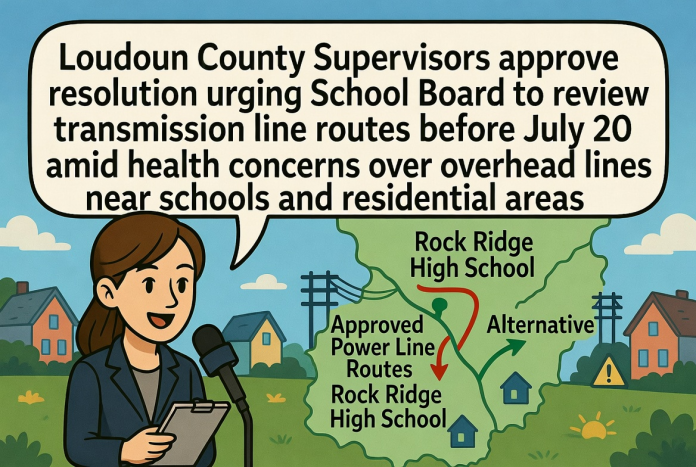
The Loudoun County Board of Supervisors approved a resolution on June 30, 2026, during a special joint meeting with the Planning Commission that asks the Loudoun County School Board to schedule an emergency meeting before July 20, 2026. The request asks the School Board to consider authorizing the use of Loudoun County Public Schools property for alternative routes of Dominion Energy’s Golden to Mars transmission line project. The move follows the Virginia State Corporation Commission’s June 29, 2026, final order approving Route 3A, which runs between Rock Ridge High School and the Loudoun Valley Estates residential community northwest of Dulles International Airport.
The Loudoun County Board of Supervisors comprises Chair Phyllis Randall, Vice Chair Michael Turner, and Supervisors Juli Briskman of the Algonkian District, Sylvia Glass of the Broad Run District, Caleb Kershner of the Catoctin District, Matthew Letourneau of the Dulles District, Kristen Umstattd of the Leesburg District, Laura TeKrony of the Little River District, and Koran Saines of the Sterling District. A majority of members present supported the resolution after extended review of route options with county staff, school officials, Dominion Energy, and other parties before the State Corporation Commission.
Context of the Golden to Mars Project and Regulatory Process
Dominion Energy proposed the Golden to Mars project, including 500-kilovolt and 230-kilovolt transmission lines plus related facilities, to support electric reliability in a region experiencing substantial growth in electricity demand. The county and school system participated in the State Corporation Commission proceedings and initially supported underground construction for portions of the line to limit effects on residents. An April 2026 commission order concluded that undergrounding was not practical at the needed locations. The June 29 final order therefore selected Route 3A as the path forward in the absence of school board approval for other alignments.
Route 3A does not require school property under the configuration reviewed in the April order. Routes 3B and 4 would involve or border Rock Ridge High School property but maintain greater distance from surrounding homes. The commission indicated that Route 3A serves the overall public interest if school land remains unavailable. Dominion Energy must submit a precise alignment map within 30 days of the order. The Board of Supervisors resolution serves as a formal request rather than a directive, giving the School Board an opportunity to reconsider property use that could allow the commission to amend its decision.
Health Considerations with Overhead Transmission Infrastructure
Scientific literature documents potential health effects associated with electromagnetic fields generated by high-voltage overhead power lines. The International Agency for Research on Cancer has classified extremely low-frequency magnetic fields as possibly carcinogenic to humans, citing limited but consistent evidence of an association with childhood leukemia in epidemiological research. Other investigations have explored links to additional health outcomes, including certain neurological conditions. Exposure levels decrease with distance, making proximity to schools and residential areas a particular point of attention for public health officials and families.
Overhead lines create electric fields that extend outward and magnetic fields that vary with load and configuration. Underground cables shield electric fields completely at the surface and produce magnetic fields that are strongest directly above the line but diminish more quickly with lateral distance than those from overhead structures. Design features such as conductor arrangement and burial depth can further manage magnetic field levels. These technical differences have led some jurisdictions to favor underground construction near sensitive land uses when feasible, even when initial cost estimates are higher.
The proximity of Route 3A to Rock Ridge High School and Loudoun Valley Estates places students and families in closer range of overhead infrastructure than alternative paths. While the State Corporation Commission determined undergrounding impractical for this project, the body of research on electromagnetic field exposure supports careful evaluation of all options that could reduce or eliminate surface-level fields near occupied areas. Distance from homes and schools, combined with burial where lines must pass through developed zones, offers measurable advantages in limiting potential exposure.
Implications for Local Decision-Making and Next Steps
The Board of Supervisors resolution keeps open the possibility that the School Board could enable Routes 3B or 4 by authorizing necessary easements on school property. Those routes have been viewed by multiple stakeholders as preferable because they maintain greater separation from residential neighborhoods. If the School Board does not act by July 20, 2026, the commission’s Route 3A approval stands and construction planning would proceed on that alignment.
The situation illustrates the balance between regional infrastructure requirements and localized effects on schools and neighborhoods. Economic activity tied to data centers and other development has increased electricity needs, yet residents and officials continue to emphasize routes and construction methods that respect community character and health priorities. The resolution provides one additional avenue for input before final engineering and permitting advance.
Public health considerations, including the body of research on electromagnetic fields, favor approaches that maximize distance from homes and schools or place lines underground where they must traverse populated areas. The coming weeks will determine whether Loudoun County can secure a route or construction standard that better aligns with these priorities while still delivering needed grid improvements.