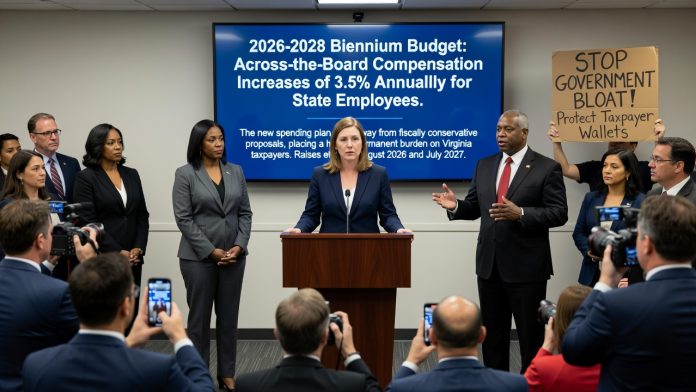
The 2026-2028 biennium budget finalized by Governor Abigail Spanberger and Democratic lawmakers features massive 3.5% annual across-the-board pay raises for state employees. This sweeping compensation package shifts away from previous fiscally conservative proposals and places a heavier, permanent financial burden on Virginia taxpayers. The aggressive spending plan impacts all state agencies and state-supported local employees, with raises taking effect in August 2026 and July 2027. The sheer scale of these permanent baseline increases raises serious questions about the long-term fiscal health of the Commonwealth.
This new spending contrasts sharply with the original budget introduced by outgoing Governor Glenn Youngkin in December 2025. Youngkin had proposed a much more modest, taxpayer-friendly 2% annual raise combined with a 2% one-time bonus for state workers. The new administration’s decision to scrap the one-time bonus in favor of compounding 3.5% base salary increases creates permanent financial obligations that cannot easily be undone. Fiscal conservatives argue that one-time bonuses are far more responsible, as they reward employees without artificially inflating the government’s baseline operating costs forever.
Expanding the Bureaucracy and Government Bloat
The spending spree extends far beyond basic state workers, funneling millions of additional dollars into specific departments like the Office of the Attorney General. Attorney General Jay Jones recently praised the inclusion of more than $15 million in new investments for his office over the upcoming biennium. While Jones claims these funds will address compensation disparities and create brand new government positions, fiscal watchdogs view this as unnecessary bureaucratic bloat. Expanding the payroll of the Attorney General’s office during a time when taxpayers are struggling with inflation represents a gross misallocation of state resources.
Public education and healthcare sectors are also receiving massive injections of taxpayer funds under the newly finalized budget agreement. Teachers and public education support staff are slated to receive a hefty 4% salary increase in each of the next two fiscal years, significantly outpacing the general state employee raises. Additionally, home care workers funded through Medicaid and the Department of Aging and Rehabilitative Services will see a 4% reimbursement rate increase on January 1, 2027. This initial bump will be followed by another 3.9% rate increase on January 1, 2028, further straining the state’s already heavily burdened Medicaid resources.
Questioning Fiscal Sustainability and Merit
Democratic leaders have heavily defended the ballooning budget as a necessary step for affordability and economic security within the state. Governor Abigail Spanberger stated that the finalized budget charts a path toward a stronger and more affordable future for families residing in the Commonwealth. State Senator Mamie Locke echoed these progressive sentiments, claiming the Senate Democrats remain focused on lowering costs for working families while strengthening public education through these historic pay raises. However, these officials fail to acknowledge that increasing government spending inevitably drives up the cost of living and the tax burden for the very citizens they claim to be helping.
Furthermore, these sweeping across-the-board compensation hikes completely ignore the fundamental principles of merit-based pay and fiscal restraint. By guaranteeing a 3.5% raise to all state employees regardless of their individual performance or efficiency, the government is effectively rewarding mediocrity and perpetuating waste. In the private sector, employees must consistently demonstrate exceptional value and productivity to earn compounding annual raises of this magnitude. Taxpayers are ultimately left footing the bill for a growing administrative state that refuses to tighten its own belt or hold its workforce accountable to standard performance metrics.
The Long-Term Taxpayer Burden
The structural design of these base salary increases guarantees that the financial burden on Virginia residents will multiply aggressively year after year. Because the 3.5% raises for state employees and 4% raises for teachers are permanently baked into the baseline budget, future administrations will struggle immensely to balance the books during economic downturns. This compounding effect builds dangerously upon the previous 2024-2026 budget, which already provided a 3% base salary increase and a 1.5% one-time bonus for state employees. Creating such massive unfunded liabilities severely limits the state’s ability to provide future tax relief to hard-working citizens who desperately need it.
If Virginia is to maintain its reputation for strong economic management and fiscal responsibility, lawmakers must prioritize protecting the taxpayer over expanding the government payroll. Relying on continuous, uninterrupted tax revenue growth to fund permanent, across-the-board salary hikes is a dangerous gamble that invites future budget deficits. Fiscal conservatives strongly urge a return to targeted, performance-based compensation models that eliminate government waste and respect the citizens funding these initiatives. True affordability in the Commonwealth will only be achieved when the state government learns to live within its means and stops treating taxpayer wallets as an endless source of revenue.