
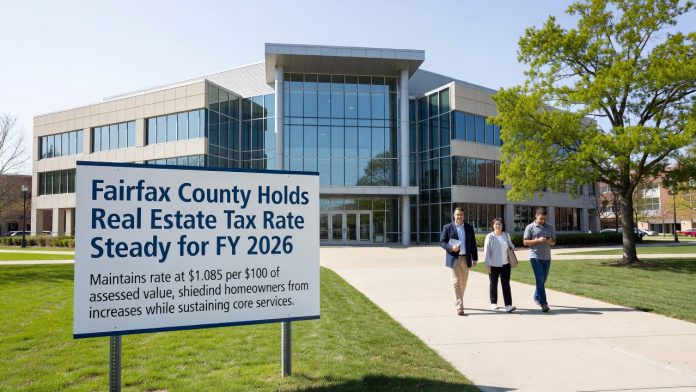
Fairfax County has maintained its real estate tax rate at $1.085 per $100 of assessed value in the fiscal year 2026 adopted budget plan. This action continues the rate level that has remained unchanged since fiscal year 2022. The decision supports homeowner stability amid rising property assessments while funding essential county operations. Revenue projections estimate approximately $3.3 billion from real estate taxes in the general fund due to assessment growth rather than any rate adjustment.
The overall general fund budget totals about $5.1 billion with combined county and schools operating funds exceeding $8.2 billion. Average residential assessed values increased by roughly 4 to 6 percent across the county. This growth produces an estimated annual tax bill rise of $400 to $700 for a typical single-family home. The increase stems entirely from higher assessments instead of any change in the tax rate.
Tax Rate Decision and Historical Context
County budget documents indicate that holding the rate steady relies on strong tax base expansion from new construction and reassessments. Efficiencies in operations along with targeted use of reserves and other revenue sources also contribute to this approach. The rate has now stayed constant for five consecutive years from fiscal year 2022 through 2026. The previous rate adjustment occurred in fiscal year 2021.
This steady rate positions Fairfax County in the middle range compared with neighboring jurisdictions for fiscal year 2026. Arlington County lists a rate of $0.978 per $100 while Loudoun County sets $0.895. Prince William County adopts $1.098 and Alexandria uses $1.11. Effective tax burdens can vary based on how quickly assessments rise in each locality.
Impacts on Homeowners and Relief Options
Homeowners with flat or declining assessed values face no tax increase or may see reductions under the unchanged rate. Most properties still experience higher bills because of assessment growth tied to housing market trends. The county provides an annual tax calculator to help residents determine exact effects on individual parcels. Lower-value or slower-appreciating properties tend to see smaller dollar increases than high-value homes in rapidly appreciating areas.
Existing relief programs remain available to qualifying households. These include the senior and disabled tax relief program based on income and asset criteria along with a real estate tax deferral option. Such measures help mitigate impacts for eligible residents. Equity considerations receive attention in budget materials that note varied effects across different property types and locations.
Sustaining Core Services and Budget Allocations
Major funding supports Fairfax County Public Schools through a county transfer of approximately $2.8 billion. This allocation reflects a 3 to 4 percent increase over the prior year. Public safety departments receive modest enhancements for staffing and equipment. Human services and infrastructure programs continue with existing levels plus limited expansions achieved through reallocation of resources.
Budget materials state that core service levels are maintained or modestly expanded without requiring a rate increase. Position reductions in some administrative areas and continued operational efficiencies contribute to this outcome. Revenue from sources such as certain fees and state aid further supports the adopted plan. The county notes that growth from the existing rate funds the majority of budget increases.
Limitations and Forward Outlook
Holding the tax rate steady does not prevent individual tax bills from rising when assessments increase. County documents acknowledge this dynamic and its role in revenue growth. No proposal for fiscal year 2027 has been developed yet as that process begins later in 2025. All figures originate from the official fiscal year 2026 adopted budget plan documents available on the county website.
Actual tax bills for specific properties depend on final assessed values determined by the Department of Tax Administration. Residents are encouraged to review personalized calculations through county resources. The approach balances stability for homeowners against ongoing demands for public services across the jurisdiction.
Email At:
Jeff McKay → chairman@fairfaxcounty.gov,
Kathy Smith (Sully District) sully@fairfaxcounty.gov,
James Walkinshaw (Braddock District) braddock@fairfaxcounty.gov,
James Bierman (Dranesville District) dranesville@fairfaxcounty.gov,
Rodney Lusk (Franconia District) franconia@fairfaxcounty.gov,
Walter Alcorn (Hunter Mill District) huntermill@fairfaxcounty.gov,
Andres Jimenez (Mason District) mason@fairfaxcounty.gov,
Daniel Storck (Mount Vernon District) mtvernon@fairfaxcounty.gov,
Dalia Palchik (Providence District) providence@fairfaxcounty.gov,
Pat Herrity (Springfield District) springfield@fairfaxcounty.gov,