
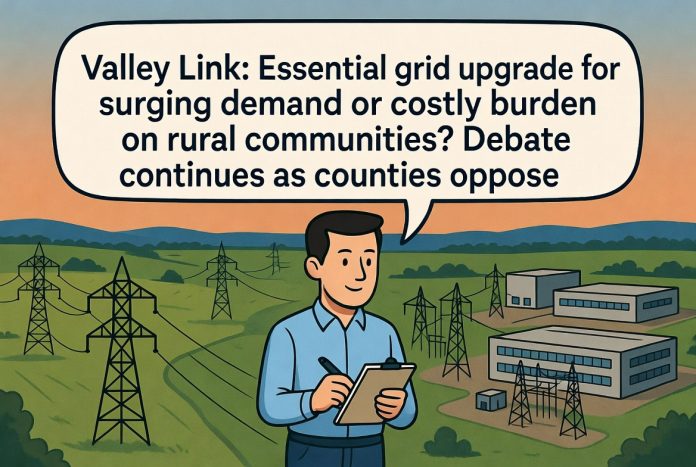
A major infrastructure initiative known as Valley Link is advancing through planning stages to address growing electricity demand in the Mid-Atlantic region. Developed by Valley Link Transmission LLC—a joint venture of Dominion Energy, Transource (involving American Electric Power), and FirstEnergy—the project features 765kV transmission lines intended to enhance grid reliability. However, it has drawn significant local opposition due to potential land use, cost, and environmental implications. Critics note that Democratic majorities in the Virginia legislature have not approved major new in-state power plants in recent years, contributing to reliance on imported energy (including coal from neighboring states), while Democratic-led blue counties have approved extensive data center developments for more than a decade, driving much of the increased demand.
Overview of the Proposed Routes and Affected Counties
The project comprises two main components. The Joshua Falls to Yeat line (Valley Link South) is a proposed 115-mile, 765kV overhead transmission line from the existing Joshua Falls substation in Campbell County, Virginia, to a new Yeat substation in Culpeper County. It would cross up to nine counties in central Virginia: Campbell, Appomattox, Buckingham, Fluvanna, Goochland, Louisa, Culpeper, Orange, and possibly Spotsylvania. New 200-foot easements would be required, with potential impacts on approximately 2,788 acres.
The Valley Link North segment involves approximately 260 miles of 765kV line from the John Amos power station in Putnam County, West Virginia, to a new Rocky Point substation in Frederick County, Maryland. It would pass through about 20 counties in West Virginia (e.g., Putnam, Kanawha, Roane, Calhoun, Braxton, Lewis, Upshur, Barbour, Tucker, Preston, Grant, Hardy, Hampshire, Jefferson), three in Virginia (Clarke, Frederick, Loudoun), and two in Maryland (Garrett, Frederick). A new Welton Springs substation is planned in Hardy County, WV. In Loudoun County, VA, the route could affect about 11 miles and 365 acres.
Towers ranging from 135 to 175 feet tall would utilize guyed V-lattice designs along new rights-of-way, potentially affecting agricultural land, forests, and scenic areas including national parks and trails.
Project Timeline, Costs, and Funding
PJM Interconnection selected the projects as part of its Regional Transmission Expansion Plan to meet 2029 reliability needs amid rapid load growth. Open houses are scheduled for summer 2026, with state regulatory filings (e.g., Virginia SCC) expected later that year and construction targeted for completion by 2029.
Estimated costs include around $1 billion for the Joshua Falls-Yeat segment, with broader Valley Link elements contributing to multi-billion-dollar totals. Costs are recovered through PJM’s regional transmission rates, distributed among customers across the footprint. Developers have sought FERC incentives, including returns on equity and cost recovery mechanisms. Some analyses project notable impacts on West Virginia ratepayers for lines primarily serving eastern demand.
Energy Policy Context: Import Reliance and Data Center Growth
Virginia’s energy landscape has been shaped by policy decisions under Democratic legislative control, which have not resulted in approvals for major new power generation facilities in the state in recent years. This has led to greater reliance on imported electricity, including coal-fired power from other states within the PJM region. At the same time, counties controlled by Democrats in Northern Virginia have approved data center projects for more than a decade, contributing significantly to surging electricity demand that now necessitates projects like Valley Link.
PJM and project proponents cite unprecedented load growth, driven largely by data centers in Northern Virginia, alongside residential, commercial, and industrial needs. Dominion reports substantial interconnection requests, with data centers forming a significant portion. The 765kV design is said to provide superior transfer capacity compared to multiple lower-voltage alternatives, supporting renewables, storage, nuclear integration, and overall grid stability.
Benefits are described as regional, including job creation during construction, enhanced reliability for homes, schools, and hospitals, and economic support for manufacturing and tech sectors.
Local Concerns and Opposition
Numerous counties have expressed opposition through resolutions, citing impacts on property values, farmland, historic resources, and rural character. Affected residents worry about eminent domain for easements, visual and auditory effects of high-voltage lines, and limited local benefits. Environmental groups highlight risks to parks, trails, forests, and wildlife. Some advocate for underground HVDC alternatives, noting prior PJM studies, though these carry higher upfront costs.
Counties like Louisa have allocated funds for potential legal challenges, and public meetings have seen strong attendance. Property owners are urged to participate in comment periods and regulatory proceedings.
Broader Context in Virginia’s Energy Landscape
Virginia faces one of the highest electricity demand growth periods since World War II, largely tied to data center expansion. Transmission projects like Valley Link are part of a larger PJM portfolio responding to this shift. Critics argue for more localized generation or demand-side measures, while supporters emphasize the interconnected grid’s necessity for reliability. Regulatory approvals at state commissions and FERC will weigh these factors, with opportunities for public input.
As planning continues, stakeholders across impacted counties continue to engage, weighing infrastructure needs against community and environmental preservation. Outcomes will shape Virginia’s energy future for decades.
NEWSLETTER SIGNUP
Subscribe to our newsletter! Get updates on all the latest news in Virginia.