
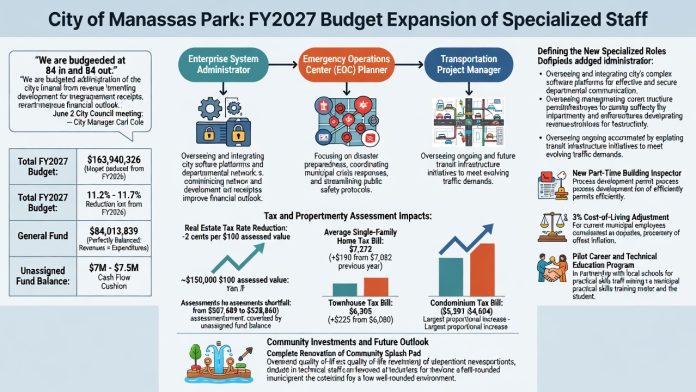
The City of Manassas Park has officially outlined its fiscal priorities for the upcoming year, placing a distinct focus on expanding specialized municipal staff. Within the newly structured FY2027 budget, local officials have secured funding for three new full-time positions aimed at modernizing city operations. These roles include an Enterprise System Administrator, an Emergency Operations Center Planner, and a Transportation Project Manager. The strategic staffing expansion represents a targeted effort to improve digital infrastructure, emergency readiness, and transit planning for the growing municipality.
This expansion of specialized city staff is situated within a broader FY2027 overall budget totaling $163,940,326. Despite the addition of these highly technical full-time roles, the total fiscal package actually represents an 11.2 percent to 11.7 percent reduction compared to the previous FY2026 budget. The general fund, which serves as the primary operating account for the city, is perfectly balanced at $84,013,839 in both expected revenues and planned expenditures. City administrators maintain that this careful financial balancing allows for critical personnel growth without overextending municipal resources.
Defining the New Specialized Roles
Each of the three newly funded positions is designed to address specific operational vulnerabilities within the municipal government framework. The Enterprise System Administrator will be tasked with overseeing and integrating the city’s complex software platforms, ensuring that various departmental networks communicate effectively and securely. Meanwhile, the Emergency Operations Center Planner will focus on disaster preparedness, coordinating municipal responses to potential crises and streamlining public safety protocols. Finally, the Transportation Project Manager will oversee ongoing and future transit infrastructure initiatives, ensuring that local road networks can accommodate the region’s evolving traffic demands.
Beyond these three primary full-time additions, the FY2027 budget also accommodates other essential personnel and programmatic expansions. The city plans to hire a new part-time building inspector to help process local development and construction permits more efficiently. Additionally, current municipal employees will receive a three percent cost-of-living adjustment to help offset regional inflation and retain experienced staff members. The budget also allocates resources for a pilot Career and Technical Education program, which will be operated in direct partnership with the local school system to provide students with practical workforce skills.
Financial Management and Cash Flow
During the June 2 City Council meeting, City Manager Carl Cole provided extensive details regarding the financial mechanics that made these new hires possible. Cole emphasized the municipality’s strong fiscal position and strict adherence to balanced ledgers, stating directly to the council, “We are budgeted at 84 in and 84 out.” He further justified the overall budget structure by noting that revenue timing shifts from development receipts helped improve the city’s financial outlook for the coming year. This strategic timing of incoming development funds provided the necessary capital to expand the specialized workforce without generating a deficit.
Maintaining a secure financial safety net was another major priority highlighted by city leadership during the budget presentation. Cole pointed to a healthy unassigned fund balance that maintains the required $7 million to $7.5 million cash flow cushion for the municipality. According to the city manager, preserving this substantial reserve allows the local government the flexibility needed to address other emerging needs throughout the fiscal year. City officials have consistently described the FY2027 plan as fiscally conservative, balancing affordability for residents with key investments in infrastructure, public safety, and staff support.
Tax Rates and Property Assessments
While the budget funds new administrative and planning positions, the local government also implemented measures to alter the property tax rate. The real estate tax rate was officially reduced by two cents per one hundred dollars of assessed property value. This specific rate reduction reduces overall city revenue by approximately $150,000, a shortfall that will be exclusively covered by drawing from the unassigned fund balance. Furthermore, administrators ensured that no increases are planned for municipal utility rates or other enterprise funds during the FY2027 cycle.
Despite the lowered tax rate, many residents will still experience an increase in their annual tax obligations due to rising property values. Average single-family home tax bills are projected to rise to $7,272, representing a $190 increase from the $7,082 average recorded the previous year. This discrepancy is entirely driven by average property assessments for single-family homes increasing significantly from $507,689 to $528,860 across the city. The combination of a lower rate and higher assessments ultimately results in a net increase in out-of-pocket expenses for these homeowners.
Owners of other property types within Manassas Park will also see their annual tax bills adjust upward under the new budget. Townhouse tax bills will average approximately $6,305, which constitutes a $225 increase from the previous average of $6,080. Condominium owners will actually experience the largest proportional jump in their annual tax burden during the FY2027 fiscal year. Condominium tax bills are expected to average $5,201, representing a substantial $597 increase from the $4,604 average seen in the prior budget cycle.
Community Investments and Future Outlook
In addition to the personnel expansions and tax adjustments, the FY2027 budget outlines funding for specific community enhancement projects. One notable capital improvement included in the final document is the complete renovation of the community splash pad. This recreational upgrade aligns with the council’s stated goal of maintaining public amenities while simultaneously investing in specialized administrative roles like the Emergency Operations Center Planner. By balancing these quality-of-life improvements with technical staff additions, the city aims to foster a well-rounded and highly functional municipal environment.
The addition of an Enterprise System Administrator, an Emergency Operations Center Planner, and a Transportation Project Manager marks a distinct shift toward highly specialized municipal governance in Manassas Park. By maintaining a balanced $84 million general fund and utilizing strategic development revenues, the city has managed to modernize its workforce while preserving its required financial reserves. As the FY2027 budget goes into effect, local administrators will be tasked with integrating these new professionals into the existing government structure. The ultimate success of this fiscally conservative budget will depend on how effectively these new roles enhance the city’s infrastructure, safety protocols, and daily operations.
Email the Manassas Park City Council at:
Alanna Mensing (Mayor): a.mensing@manassasparkva.gov,
Darryl Moore (Vice Mayor): d.moore@manassasparkva.gov,
Haseeb Javed: h.javed@manassasparkva.gov,
Yesy Amaya: y.amaya@manassasparkva.gov,
Michael Carrera: m.carrera@manassasparkva.gov,
Stacy Seiberling: s.seiberling@manassasparkva.gov,
Kevin Moreau: k.moreau@manassasparkva.gov,