
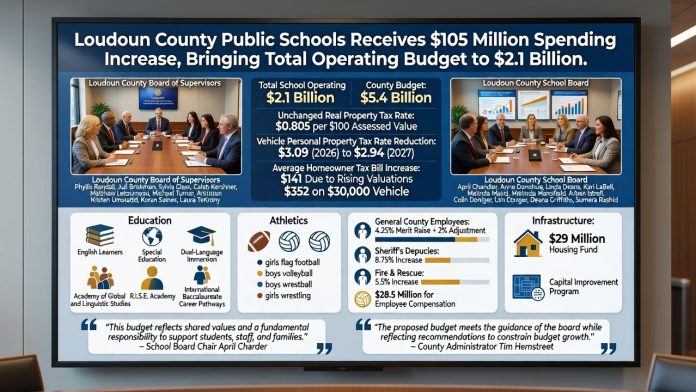
Loudoun County officials have officially adopted a comprehensive financial plan that includes a massive funding boost for local education. The newly approved budget allocates a $105 million spending increase for Loudoun County Public Schools, fully funding the request made by educational leaders. This significant transfer brings the total school operating budget to an unprecedented $2.1 billion for the upcoming fiscal year. Furthermore, the overall county budget reaches $5.4 billion, which includes a county operating budget of $1.1 billion.
The budget approval process involved extensive collaboration and review by the primary governing bodies of the region. The Loudoun County Board of Supervisors, which includes Phyllis Randall, Juli Briskman, Sylvia Glass, Caleb Kershner, Matthew Letourneau, Michael Turner, Kristen Umstattd, Koran Saines, and Laura TeKrony, finalized the appropriations. They worked in tandem with the Loudoun County School Board, consisting of April Chandler, Anne Donohue, Linda Deans, Kari LaBell, Melinda Mansfield, Arben Istrefi, Colin Doniger, Deana Griffiths, and Sumera Rashid. Together, these elected officials navigated complex financial constraints to deliver a balanced fiscal strategy.
Tax Rates and Homeowner Impact
Despite the substantial increases in departmental spending, the real property tax rate will remain unchanged at $0.805 per $100 of assessed value. However, the average homeowner can still expect their tax bill to increase by approximately $141 due to rising property valuations across the county. In a move to provide some financial relief to residents, the vehicle personal property tax rate will be reduced to $3.09 per $100 in 2026, before dropping further to $2.94 in 2027. This vehicle tax reduction is projected to save taxpayers an average of $352 on a vehicle valued at $30,000 compared to the previous year.
County leadership emphasized the importance of fiscal responsibility alongside these major investments in community services. County Administrator Tim Hemstreet noted that the proposed budget meets the guidance of the board while reflecting recommendations to constrain budget growth. Hemstreet explained that this cautious approach is necessary in anticipation of a plateauing of county revenues projected for the early 2030s. To enforce this fiscal discipline, the budget implements strict growth caps, limiting school division budget growth to eight percent and county operating budget growth to nine percent.
Historic Investments in Public Education
The centerpiece of the newly adopted budget is the historic financial commitment to the local public school system. School Board Chair April Chandler stated that the approval of this budget reflects shared values and a fundamental responsibility to support students, staff, and families. She emphasized that the financial plan invests in critical programs, expands opportunities for students, and honors commitments to employees. Ultimately, Chandler believes these targeted financial allocations will position the entire school division for continued long-term success.
A substantial portion of the $2.1 billion school operating budget will be directed toward specialized academic programs designed to serve a diverse student population. Funding will bolster support for English Learners, Special Education, and the expanding Dual-Language Immersion initiatives across the district. Additional investments are earmarked for the Academy of Global and Linguistic Studies, the R.I.S.E. Academy, and the International Baccalaureate Career Pathways program. Superintendent Aaron Spence remarked that the budget prioritizes strong instructional support, inclusive programs, access to opportunity, and competitive compensation for educators.
Beyond the traditional classroom setting, the budget also delivers significant enhancements to extracurricular activities and athletic programs. The school division will introduce several new sports offerings, including girls flag football, boys volleyball, and girls wrestling. These additions aim to increase student participation in athletics while promoting gender equity across the county’s high schools. Educational leaders view these expanded athletic opportunities as a vital component of fostering a well-rounded student experience.
County Employee Compensation and Department Upgrades
The $5.4 billion county budget also places a heavy emphasis on retaining and attracting quality public servants through enhanced compensation packages. Officials allocated $28.5 million specifically for employee compensation increases across various county departments. General county employees will benefit from a comprehensive pay raise structure, which includes a 4.25 percent merit raise combined with a two percent salary adjustment. This competitive compensation strategy is designed to keep the local government workforce stable amidst regional economic pressures.
Public safety personnel will see targeted salary adjustments reflecting the critical nature of their roles within the community. Deputies within the Sheriff’s Office are slated to receive an average pay increase of 8.75 percent under the new budget framework. Meanwhile, personnel in the Fire and Rescue department will benefit from a 5.5 percent average increase in their compensation. These public safety investments are intended to ensure the county can maintain high emergency response standards as the local population continues to grow.
In addition to education and public safety, the budget addresses broader community infrastructure and housing needs. A notable $29 million has been allocated to the Housing Fund to support various affordable housing initiatives throughout the region. The broader Capital Improvement Program will also receive necessary funding to advance long-term infrastructure projects over the coming decade. By balancing immediate departmental needs with future revenue projections, local officials aim to maintain economic stability while delivering essential services to all residents.
Email the Loudoun County Board of Supervisors at:
Phyllis J. Randall (Chair, At-Large) – Phyllis.Randall@loudoun.gov,
Michael R. Turner (Vice Chair, Ashburn District) – Mike.Turner@loudoun.gov,
Juli E. Briskman (Algonkian District) – Juli.Briskman@loudoun.gov,
Sylvia R. Glass (Broad Run District) – Sylvia.Glass@loudoun.gov,
Caleb Kershner (Catoctin District) – caleb.kershner@loudoun.gov,
Matthew F. Letourneau (Dulles District) – Matt.Letourneau@loudoun.gov,
Kristen C. Umstattd (Leesburg District) – Kristen.Umstattd@loudoun.gov,
Laura A. TeKrony (Little River District) – Laura.TeKrony@loudoun.gov,
Koran Saines (Sterling District) – Koran.Saines@loudoun.gov