
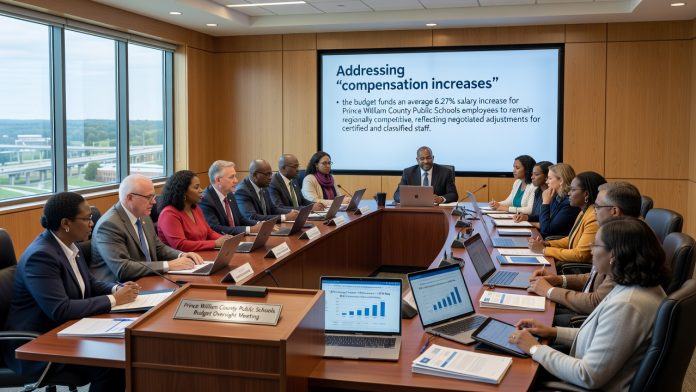
The Prince William County Public Schools system is set to operate under a comprehensive total budget of $2.9 billion for the upcoming fiscal year. A central component of this expansive financial plan is a substantial $1.1 billion transfer directly from the county government to the educational sector. This specific transfer reflects an increase of $123.8 million, representing a 12.5 percent rise over the previous fiscal year’s allocation. Administrators designed this funding structure to ensure the district remains regionally competitive by heavily investing in employee compensation, classroom support, and advanced academic programming.
Approving and managing these massive financial allocations requires constant coordination between the Prince William County Board of County Supervisors and the local school board. The Board of County Supervisors includes Deshundra Jefferson, Tom Gordy, Yesli Vega, Bob Weir, Victor Angry, Kenny Boddye, Andrea Bailey, and Margaret Franklin. Meanwhile, the Prince William County School Board consists of Babur Lateef, Erica Tredinnick, Lisa Zargarpur, Tracy Hardter, Shantell Rock, Richard Jessie, Justin Wilk, and Loree Williams. Together, these elected officials oversee the strategic distribution of taxpayer funds to support extensive educational mandates, infrastructure improvements, and staffing requirements across the rapidly growing region.
Compensation Adjustments and Collective Bargaining
To attract and retain highly qualified educators, the newly approved budget funds an average 6.27 percent salary increase for all public school employees. This substantial compensation adjustment is part of a broader two-year collective bargaining agreement recently negotiated between the school district and staff representatives. Under the specific terms outlined in the new budget, certified staff members will receive a 6.5 percent increase in their base salaries. Classified staff members will simultaneously see a 6.2 percent pay bump, which builds upon a previous 7 percent pay raise implemented for teachers during the prior fiscal cycle.
Strategic Plan Transition
The current financial blueprint serves as a critical bridge between the concluding Vision 2025 strategic plan and the newly developed PWCS Elevate 2030 framework. Official budget documents highlight that strengthening the educational workforce remains a primary priority for administrators during this transitional period. School Board Chairman At-Large Babur Lateef expressed enthusiasm that the budget successfully initiates the funding required for this ambitious long-term strategic vision. Lateef emphasized that the financial commitments will directly sustain the ongoing efforts to provide essential operational support to both students and teachers inside the classroom.
Expanded Educational Initiatives
Beyond direct compensation increases, the $123.8 million boost in county funding facilitates several major educational program expansions across the school division. The budget officially launches the initial Phase I rollout of a highly anticipated Universal Pre-K initiative aimed at improving early childhood development. Special education departments will also receive targeted financial support to hire 59 new full-time teaching assistants to manage growing enrollment needs and individualized education plans. Furthermore, the district plans to direct additional resources toward robust summer school support programs and a comprehensive Student and Family Workforce Readiness Initiative.
Community and Health Support
The substantial county transfer also addresses holistic student well-being through expanded community health and critical nutrition programs. Dedicated funding will establish and maintain school-based food pantries to assist vulnerable families facing food insecurity within the district. The budget also allocates necessary resources for mobile health clinics designed to provide accessible medical care directly to students on various school campuses. Occoquan District Supervisor Kenny Boddye noted that these comprehensive community investments are vital for maintaining the impressive 95 percent graduation rate currently held by the school system.
Long-Term Financial Outlook
Managing a massive $2.9 billion total budget requires strict oversight to ensure all negotiated adjustments for certified and classified staff are met sustainably. The historic $1.1 billion county transfer represents a significant, long-term commitment from local government officials to prioritize public education over competing regional interests. By fully funding the collective bargaining agreement, Prince William County aims to stabilize its workforce amid widespread national teacher shortages and economic fluctuations. Local leaders anticipate that these targeted financial strategies will secure the district’s reputation as a premier educational institution in Northern Virginia for many years to come.































