
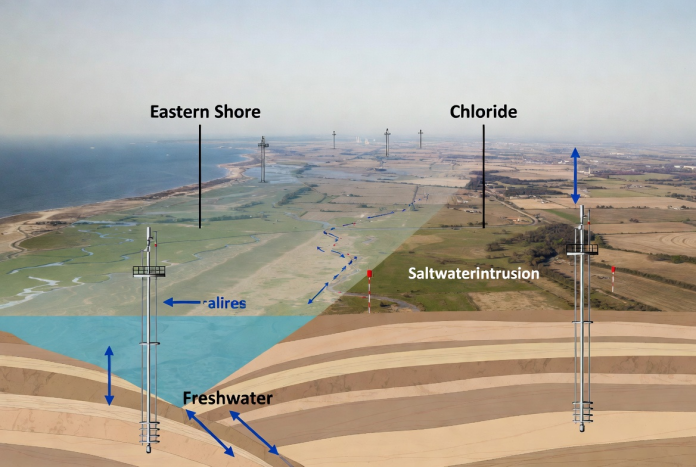
A 2026 report from the Virginia Department of Environmental Quality finds that chloride concentrations are increasing locally in parts of Eastern Virginia and on the Eastern Shore. These trends raise the potential for regional saltwater intrusion into freshwater portions of the Coastal Plain aquifer system east of Interstate 95. The analysis forms part of a broader examination of groundwater supply and quality directed by Senate Joint Resolution 25 from the 2024 General Assembly session.
Researchers compiled and evaluated groundwater-quality data collected in the Virginia Coastal Plain since 2007 and compared the results with earlier records. Regional-scale chloride concentrations, the overall position of the saltwater-transition zone, and the sequence of hydrochemical facies have remained generally consistent with patterns observed since the early twentieth century. However, trend analysis applied to individual wells with suitable data sets identified localized increases in chloride at multiple locations.
Hydraulic Conditions Favoring Saline Movement
Decades of heavy pumping, particularly from paper mills near Franklin and West Point, lowered inland groundwater levels below sea level and reversed predevelopment flow patterns. Groundwater now tends to move inward from the margins toward major industrial withdrawal centers and downward from higher to lower units within the aquifer system. These altered gradients create conditions that can favor the lateral migration of saline water from coastal and deeper zones into freshwater aquifers.
The confined Potomac aquifer accounts for approximately 70 percent of total reported and estimated withdrawals in the Eastern Virginia Groundwater Management Area. On the Eastern Shore, the Yorktown-Eastover system supplies about 95 percent of withdrawals. Combined use across both management areas shows industrial demand at 35 percent, private domestic at 34 percent, and public water supply at 26 percent. Private domestic withdrawals remain largely unpermitted and are estimated from census and water-use data.
Monitoring Networks and Quality Trends
The statewide groundwater observation well network, a cooperative effort between the Department of Environmental Quality and the U.S. Geological Survey, includes more than 440 wells. Dedicated subsets of the network monitor chloride concentrations as an indicator of salinity. Expansion of the network continues in both the Coastal Plain and areas west of Interstate 95. These data supported the identification of localized chloride increases and the broader assessment of saltwater-transition zone stability.
Most of the observed chloride increases were attributed to the influence of specific nearby withdrawals. The report notes that declining water levels create hydraulic conditions that would favor lateral saltwater intrusion. Even under these conditions, the overall regional position of the saltwater-transition zone has not shown large-scale shifts in the available data. Continued monitoring is identified as essential for detecting any broader changes over time.
Regulatory Context and Capacity Findings
The Ground Water Management Act of 1992 requires permits for withdrawals of 300,000 gallons or more in any month within designated management areas. The report characterizes the act’s results as mixed. Following the 2010 closure of the Franklin Mill and subsequent management actions, the annual overall groundwater deficit in the Potomac aquifer was reduced to nearly zero for about a decade. Regional levels rose and broadly stabilized until approximately 2021, after which rising trends stalled and signs of renewed decline appeared.
Modeling of future capacity shows limited remaining ability to accommodate significant new withdrawals. Hypothetical industrial demands of three million gallons per day failed to meet permit criteria at every tested location. Maximum allowable new volumes ranged from 360,000 gallons per day in Northumberland County to less than 30,000 gallons per day in several western regions near the Interstate 95 corridor.
Policy Recommendations
The Department of Environmental Quality offers recommendations that include clarifying statutory authority to deny or reduce permits when alternative sources such as surface water or reuse are reasonably available, requiring local comprehensive plans in management areas to reflect groundwater constraints, and addressing scientific and legal questions before any groundwater trading program is considered. Managed aquifer recharge projects are noted as potential tools for future capacity enhancement and possible mitigation of salinity risks.
The documented local increases in chloride concentrations and the associated potential for regional saltwater intrusion provide a technical foundation for decisions by the General Assembly, the State Water Control Board, and local governments. The findings confirm that altered hydraulic conditions linked to long-term withdrawals have created pathways that can allow saline water to advance into freshwater aquifers, with implications for water quality and long-term resource management across the Coastal Plain east of Interstate 95.
Email the House of Delegates at:
Jessica Anderson: DelJAnderson@house.virginia.gov,
Bonita Anthony: DelBAnthony@house.virginia.gov,
Alex Askew: DelAAskew@house.virginia.gov,
Terry Austin: DelTAustin@house.virginia.gov,
Jason Ballard: DelJBallard@house.virginia.gov,
Robert Bloxom, Jr.: DelRBloxom@house.virginia.gov,
Gretchen Bulova: DelGBulova@house.virginia.gov,
Katrina Callsen: DelKCallsen@house.virginia.gov,
Karen Carnegie: DelKCarnegie@house.virginia.gov,
Betsy Carr: DelBCarr@house.virginia.gov,
Stacey Carroll: DelSCarroll@house.virginia.gov,
Mike Cherry: DelMCherry@house.virginia.gov,
Nadarius Clark: DelNClark@house.virginia.gov,
Laura Cohen: DelLJCohen@house.virginia.gov,
Joshua Cole: DelJCole@house.virginia.gov,
Nicole Cole: DelNCole@house.virginia.gov,
Kelly Convirs-Fowler: DelKConvirs-Fowler@house.virginia.gov,
Mitchell Cornett: DelMCornett@house.virginia.gov,
Rae Cousins: DelRCousins@house.virginia.gov,
Will Davis: DelWDavis@house.virginia.gov,
Karrie Delaney: DelKDelaney@house.virginia.gov,
Lindsey Dougherty: DelLDougherty@house.virginia.gov,
Mark Downey: DelMDowney@house.virginia.gov,
Michael Feggans: DelMFeggans@house.virginia.gov,
Hyland Fowler, Jr.: DelBFowler@house.virginia.gov,
Lily Franklin: DelLFranklin@house.virginia.gov,
Margaret Franklin: DelMFranklin@house.virginia.gov,
Debra Gardner: DelDGardner@house.virginia.gov,
Thomas Garrett, Jr.: DelTGarrett@house.virginia.gov,
Jackie Glass: DelJGlass@house.virginia.gov,
Timothy Griffin: DelTGriffin@house.virginia.gov,
Elizabeth Guzman: DelEGuzman@house.virginia.gov,
Karen Hamilton: DelKHamilton@house.virginia.gov,
Cliff Hayes, Jr.: DelCHayes@house.virginia.gov,
Dan Helmer: DelDHelmer@house.virginia.gov,
Rozia Henson, Jr.: DelRHenson@house.virginia.gov,
Phil Hernandez: DelPHernandez@house.virginia.gov,
Charniele Herring: DelCHerring@house.virginia.gov,
Keith Hodges: DelKHodges@house.virginia.gov,
Patrick Hope: DelPHope@house.virginia.gov,
Hillary Kent: DelHKent@house.virginia.gov,
Karen Keys-Gamarra: DelKKeys-Gamarra@house.virginia.gov,
Terry Kilgore: DelTKilgore@house.virginia.gov,
Paul Krizek: DelPKrizek@house.virginia.gov,
Amy Laufer: DelALaufer@house.virginia.gov,
Destiny LeVere Bolling: DelDLeVereBolling@house.virginia.gov,
Jay Leftwich, Jr.: DelJLeftwich@house.virginia.gov,
Alfonso Lopez: DelALopez@house.virginia.gov,
Fernando Martinez: DelMMartinez@house.virginia.gov,
John McAuliff: DelJMcAuliff@house.virginia.gov,
Adele McClure: DelAMcClure@house.virginia.gov,
Garrett McGuire: DelGMcGuire@house.virginia.gov,
Ellen McLaughlin: DelEMcLaughlin@house.virginia.gov,
Joseph McNamara: DelJMcNamara@house.virginia.gov,
Kirk McPike: DelKMcPike@house.virginia.gov,
Delores McQuinn: DelDMcQuinn@house.virginia.gov,
Leslie Mehta: DelLMehta@house.virginia.gov,
Will Morefield: DelJMorefield@house.virginia.gov,
May Nivar: DelMNivar@house.virginia.gov,
Israel O’Quinn: DeliOquinn@house.virginia.gov,
Delores Oates: DelDOates@house.virginia.gov,
Justin Pence: DelJPence@house.virginia.gov,
Eric Phillips: DelEPhillips@house.virginia.gov,
Kimberly Pope Adams: DelKPopeAdams@house.virginia.gov,
Cia Price: DelMPrice@house.virginia.gov,
Sam Rasoul: DelSRasoul@house.virginia.gov,
Atoosa Reaser: DelAReaser@house.virginia.gov,
David Reid: DelDReid@house.virginia.gov,
Andrew Rice: DelARice@house.virginia.gov,
Chris Runion: DelCRunion@house.virginia.gov,
Charles Schmidt, Jr.: DelCSchmidt@house.virginia.gov,
Don Scott: DelDScott@house.virginia.gov,
Phillip Scott: DelPScott@house.virginia.gov,
Holly Seibold: DelHSeibold@house.virginia.gov,
Briana Sewell: DelBSewell@house.virginia.gov,
Irene Shin: DelIShin@house.virginia.gov,
Marcus Simon: DelMSimon@house.virginia.gov,
Shelly Simonds: DelSSimonds@house.virginia.gov,
JJ Singh: DelJSingh@house.virginia.gov,
Rip Sullivan, Jr.: DelRSullivan@house.virginia.gov,
Anne Tata: DelAFTata@house.virginia.gov,
Josh Thomas: DelJThomas@house.virginia.gov,
Virgil Thornton, Sr.: DelVThornton@house.virginia.gov,
Luke Torian: DelLTorian@house.virginia.gov,
Kathy Tran: DelKTran@house.virginia.gov,
Howard Wachsmann, Jr.: DelOWachsmann@house.virginia.gov,
Wendell Walker: DelWWalker@house.virginia.gov,
Jeion Ward: DelJWard@house.virginia.gov,
Lee Ware: DelLWare@house.virginia.gov,
Vivian Watts: DelVWatts@house.virginia.gov,
Michael Webert: DelMWebert@house.virginia.gov,
Madison Whittle: DelMWhittle@house.virginia.gov,
Bill Wiley: DelBWiley@house.virginia.gov,
Rodney Willett: DelRWillett@house.virginia.gov,
Wren Williams: DelWWilliams@house.virginia.gov,
Tony Wilt: DelTWilt@house.virginia.gov,
Thomas Wright, Jr.: DelTWright@house.virginia.gov,
Scott Wyatt: DelSWyatt@house.virginia.gov,
Eric Zehr: DelEZehr@house.virginia.gov,