
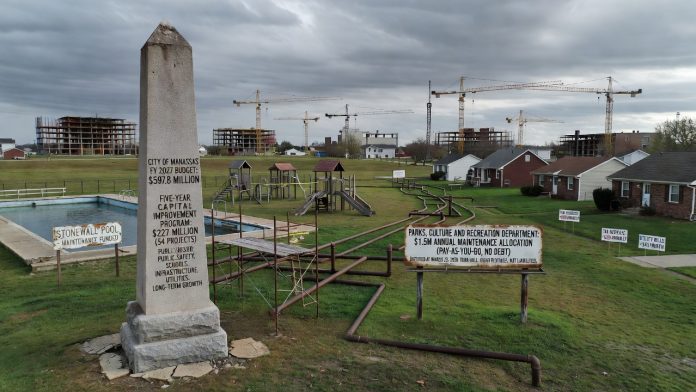
The City of Manassas has officially adopted a massive $597.8 million budget for the fiscal year 2027, raising questions about how potential fiscal planning gaps could affect the efficient use of taxpayer funds. Local officials have emphasized a commitment to infrastructure and community resources, but the sheer scale of the financial plan requires meticulous oversight. A significant portion of this fiscal strategy hinges on a $227 million allocation spread across the FY 2027 to FY 2031 Five-Year Capital Improvement Program. This extensive program encompasses 54 distinct projects designed to modernize the city and maintain essential public services.
Despite efforts to manage the financial burden on residents, the new budget introduces a complex mix of tax adjustments and fee changes. The real estate tax rate was actually reduced by two cents, bringing the new rate to $1.24 per $100 of assessed property value. However, rising property assessments, combined with heavy infrastructure investments and operational costs, mean residents will still see an average residential tax increase of approximately $289 annually. Furthermore, local households are expected to face utility bill increases amounting to roughly $45 per month under the new fiscal framework.
Parks and Recreation Maintenance Funding
A major focal point of the FY 2027 budget involves the Parks, Culture and Recreation Department, which relies heavily on consistent funding to serve the community. To address ongoing needs, the city has allocated $1.5 million annually in the General Fund specifically for Pay-As-You-Go maintenance projects. This dedicated funding stream is intended to support critical areas such as general parks maintenance and the upkeep of the popular Stonewall Pool. Additionally, these funds will be directed toward historic site maintenance and the necessary replacement of aging school playground equipment across the municipality.
City officials have strongly defended this funding approach, framing it as a highly responsible method for managing public assets without incurring long-term liabilities. During a March 25, 2026, Town Hall meeting, administrators justified the strategy by describing it as paying for capital improvements using revenues other than debt. They further clarified that these specific funds are strictly used for the maintenance of existing infrastructure rather than the construction of new facilities. This approach is intended to ensure efficient fiscal planning and the careful use of taxpayer funds in preserving community recreation spaces.
Capital Improvement Program and Fiscal Planning
The broader FY 2027 to FY 2031 Five-Year Capital Improvement Program represents a monumental financial commitment for the City of Manassas. With 54 individual projects totaling $227 million, the city must navigate complex logistical and financial challenges to prevent budgetary shortfalls. Any fiscal planning gaps within this massive framework could easily disrupt the scheduled maintenance of parks, pools, and recreational centers. Consequently, financial analysts and municipal watchdogs are closely monitoring how these capital projects are prioritized and executed over the next five years.
The municipal government has clearly outlined its overarching priorities for this substantial financial package in recent public communications. According to the June 2026 City Connection newsletter, the City Council approved a nearly $597.8 million budget focused on public safety, schools, infrastructure, utilities, and long-term growth. Balancing these massive priorities means that departments handling culture and recreation must constantly advocate for their share of the general fund. Without strict adherence to the established fiscal plan, funds originally intended for playground replacements or historic sites could be inadvertently absorbed by larger infrastructure demands.
Balancing Taxpayer Burden and City Growth
Navigating the financial realities of city growth requires a delicate balance between funding essential services and managing the direct burden placed on local taxpayers. While the two-cent reduction in the real estate tax rate from the FY 2026 approved rate appears beneficial, the actual out-of-pocket expenses for residents continue to climb. The $289 average annual tax increase reflects the inescapable reality of rising operational costs and the necessity of funding a $227 million capital improvement slate. Municipal leaders must continually justify these rising costs by demonstrating tangible improvements in public amenities and efficient service delivery.
In an effort to offset some of these rising costs and streamline revenue collection, the city has altered its traditional fee structures. The FY 2027 budget officially eliminates the annual $25 vehicle decal fee that had been collected from residents in all previous years. While this provides a minor financial reprieve for vehicle owners, it simultaneously removes a predictable revenue stream from the municipal coffers. Such shifts in revenue collection further underscore the need for flawless fiscal planning to ensure departments like Parks and Recreation remain fully funded.
Long-Term Outlook for Manassas Infrastructure
The long-term outlook for Manassas infrastructure depends entirely on the city’s ability to stick to its ambitious five-year financial roadmap. Maintaining vital community assets like the Stonewall Pool and various historic sites requires predictable, uninterrupted funding that spans multiple budget cycles. If economic conditions shift or utility revenues fall short of projections, the city may be forced to reevaluate its Pay-As-You-Go maintenance allocations. Protecting these recreational investments will require continuous oversight and a steadfast commitment to the fiscal principles outlined during the recent budget hearings.
Ultimately, the successful execution of the FY 2027 budget will serve as a critical test of the city’s financial management capabilities. The allocation of $1.5 million annually for parks and recreation maintenance is a positive step, but it remains vulnerable to broader economic pressures. Residents facing higher annual taxes and increased monthly utility bills will undoubtedly expect a high return on their financial contributions to the city. Ensuring that taxpayer funds are used efficiently will remain the paramount challenge for Manassas leadership as they implement this $597.8 million fiscal plan.
Email the Manassas Park City Council at:
Alanna Mensing (Mayor): a.mensing@manassasparkva.gov,
Darryl Moore (Vice Mayor): d.moore@manassasparkva.gov,
Haseeb Javed: h.javed@manassasparkva.gov,
Yesy Amaya: y.amaya@manassasparkva.gov,
Michael Carrera: m.carrera@manassasparkva.gov,
Stacy Seiberling: s.seiberling@manassasparkva.gov,
Kevin Moreau: k.moreau@manassasparkva.gov,