The financial landscape of Fairfax County, Virginia, is facing significant adjustments as local leaders direct a massive increase in department spending toward public education. Officials have projected a transfer increase of $148.44 million to Fairfax County Public Schools, representing a 5.06 percent jump in funding compared to previous allocations. This substantial financial injection is primarily designed to support essential school operations, comprehensive employee compensation packages, and newly established collective bargaining agreements. These funding priorities highlight the ongoing commitment to maintaining high educational standards amidst a challenging and evolving economic environment.
The Fairfax County Board of Supervisors holds the ultimate responsibility of reviewing and authorizing these massive budgetary transfers. The current board consists of Chairman Jeffrey McKay, James Walkinshaw, Jimmy Bierman, Rodney Lusk, Walter Alcorn, Andres Jimenez, Daniel Storck, Dalia Palchik, Pat Herrity, and Kathy Smith. These elected officials must carefully balance the pressing financial demands of the school system with the overall fiscal health of the municipality. Their upcoming budget deliberations will require navigating complex revenue projections and competing departmental needs to ensure long-term community stability.
Breakdown of Educational Funding
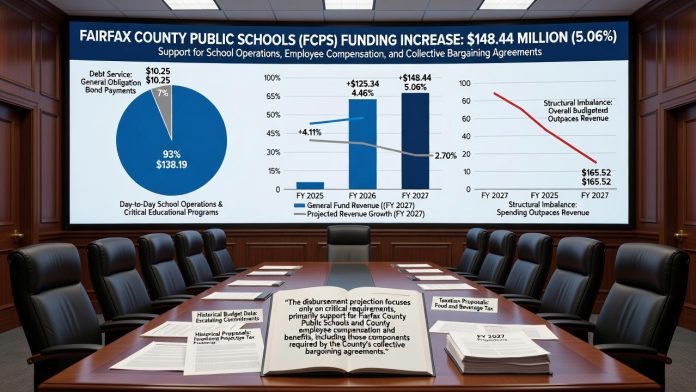
The projected $148.44 million increase is categorized into specific operational and structural needs within the extensive school system. Approximately $138.19 million of this total is strictly allocated for day-to-day school operations and critical educational programs required by the district. The remaining $10.25 million is dedicated exclusively to debt service, specifically targeting programmed general obligation bond payments. Financial documents indicate that every single percent increase in this educational transfer costs the county government an estimated $27 million in localized funding.
Historical budget data reveals a clear and consistent trend of escalating financial commitments toward the local public school system. During the previous fiscal cycle, the FY 2026 transfer to the school system saw an increase of $125.34 million, which constituted a 4.46 percent rise over the FY 2025 budget. The projected FY 2027 increase of 5.06 percent demonstrates a steeper upward trajectory in educational spending that outpaces previous estimates. In contrast, the FY 2026 general fund revenue only experienced a 4.11 percent increase compared to the revised budget plan, signaling a growing gap between income and expenditures.
Addressing Employee Compensation and Deficits
Official budget documents explicitly outline the rationale behind these massive spending increases and the intense focus on essential municipal obligations. According to the financial report, “The disbursement projection focuses only on critical requirements, primarily support for Fairfax County Public Schools and County employee compensation and benefits, including those components required by the County’s collective bargaining agreements.” These newly negotiated bargaining agreements have placed mandatory structural demands on the county budget that cannot be easily deferred or ignored. Fulfilling these contractual obligations is deemed absolutely necessary to retain qualified educators and staff within a highly competitive regional job market.
Despite the clear need for ongoing educational funding, the county is facing a stark reality regarding its internal revenue generation capabilities. Projected county revenue growth is currently stalling at a mere 2.70 percent, which falls significantly short of the 5.06 percent increase in anticipated school spending. Because of this structural imbalance, financial analysts have projected an overall budget shortfall of $165.52 million for the upcoming fiscal year. Furthermore, budget planners have explicitly assumed that county disbursements and the overall support for the school system will increase at the exact same rate in FY 2027.
Taxation Proposals and Future Fiscal Outlook
To mitigate the looming financial deficit, local leaders have actively explored alternative revenue streams, including the implementation of a new local consumer tax. The proposed Food and Beverage Tax has been highlighted as a primary mechanism to generate additional municipal funds without directly taxing residential properties. However, official projections caution that, “While adoption of the Food and Beverage Tax is anticipated to increase revenues and reduce the burden on the County’s homeowners, it is not anticipated to eliminate the County’s estimated shortfall in FY 2027.” Consequently, the local government remains in a precarious position as it attempts to fund essential services while simultaneously managing a severe budget deficit.
The ongoing fiscal challenges in Fairfax County accurately illustrate the complex dynamics of funding a premier public school district. As the $148.44 million transfer moves forward, it unequivocally demonstrates the region’s prioritization of public education and fair employee compensation. Nevertheless, the looming $165.52 million shortfall will force local administrators to make incredibly difficult financial decisions in the near future. The community will be watching closely as municipal leaders attempt to bridge the widening gap between educational aspirations and stark economic realities.
Email Fairfax County Supervisors At:
Jeff McKay – chairman@fairfaxcounty.gov,
Kathy Smith (Sully District) sully@fairfaxcounty.gov,
Rachna Heizer (Braddock District) braddock@fairfaxcounty.gov,
James Bierman (Dranesville District) dranesville@fairfaxcounty.gov,
Rodney Lusk (Franconia District) franconia@fairfaxcounty.gov,
Walter Alcorn (Hunter Mill District) huntermill@fairfaxcounty.gov,
Andres Jimenez (Mason District) mason@fairfaxcounty.gov,
Daniel Storck (Mount Vernon District) mtvernon@fairfaxcounty.gov,
Dalia Palchik (Providence District) providence@fairfaxcounty.gov,
Pat Herrity (Springfield District) springfield@fairfaxcounty.gov,