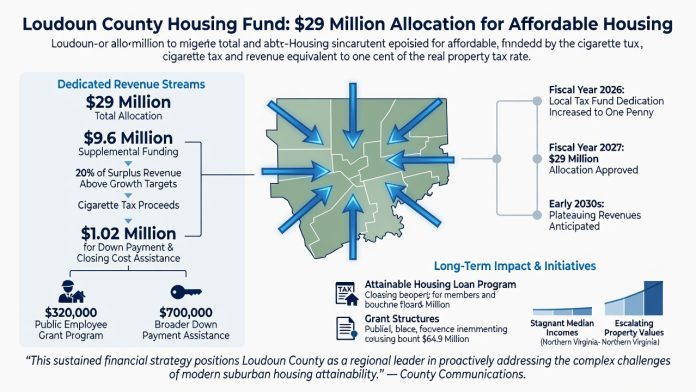
Loudoun County has officially allocated $29 million to its Housing Fund in a sweeping effort to support affordable and attainable housing initiatives across the region. This substantial financial commitment relies on multiple revenue streams, including proceeds from the local cigarette tax and revenue equivalent to one cent of the real property tax rate. According to county records, this latest injection of capital brings the total dedicated funding for affordable housing to $64.9 million since the tax rate dedication policy was first implemented. Local officials emphasize that these targeted investments are designed to address the growing cost of living and provide accessible homeownership pathways for residents.
The Loudoun County Board of Supervisors unanimously advanced these fiscal priorities during recent budget deliberations to ensure long-term community stability. The current board consists of Chair Phyllis Randall, Juli Briskman, Sylvia Glass, Laura TeKrony, Matthew Letourneau, Michael Turner, Caleb Kershner, Koran Saines, and Kristen Umstattd. These local leaders have consistently directed staff to identify sustainable funding mechanisms that do not place undue burdens on standard operational budgets. By institutionalizing these revenue streams, the board aims to create a permanent financial foundation for critical housing assistance programs well into the next decade.
Breakdown of Dedicated Revenue Streams
The newly approved $29 million allocation is constructed from a complex formula of dedicated taxes and strategic budget surpluses. Beyond the baseline revenue equivalent to one cent of the real property tax rate, the plan includes an additional $9.6 million in supplemental funding. Furthermore, the board established a policy dictating that twenty percent of any county revenue exceeding established growth targets must be automatically dedicated to the Housing Fund. This multi-tiered funding approach ensures that the housing budget scales proportionally with the county’s broader economic expansion and commercial success.
A significant portion of this fiscal strategy relies on the strategic redirection of the local cigarette tax to directly benefit prospective homeowners. Specifically, $1.02 million of the dedicated cigarette tax funding is strictly allocated to down payment and closing cost assistance programs. Within this specific allocation, $320,000 is reserved for the Public Employee Grant program, which assists local government workers in securing housing. The remaining $700,000 is distributed through the broader Down Payment and Closing Cost assistance initiative, offering crucial financial leverage to first-time homebuyers navigating a highly competitive real estate market.
Strategic Budget Management and Future Planning
County Administrator Tim Hemstreet outlined the fiscal philosophy driving these allocations during the presentation of the upcoming budget framework. Hemstreet stated that the proposed budget meets the guidance provided by the board while reflecting his recommendations on constraining budget growth. He explicitly noted that this careful financial management is necessary in anticipation of a projected plateauing of county revenues in the early 2030s. By securing these dedicated housing funds now, the county administration seeks to insulate critical social programs from future economic downturns or periods of stagnant tax revenue.
The official budget message for fiscal year 2027 further clarifies the legislative intent behind these targeted financial maneuvers. The document notes that, as directed by the board, the cigarette tax has been fully dedicated to the Housing Fund to support down payment and closing cost assistance programs. It also reiterates the board’s directive for staff to mandate the twenty percent dedication of surplus revenue above the growth target. This clear legislative framework prevents these designated housing funds from being absorbed into the general fund for unrelated municipal expenditures.
Long-Term Impact on Local Housing Initiatives
The infusion of $29 million will directly empower several specific municipal initiatives, notably the Attainable Housing Loan Program and various grant structures. These programs are designed to bridge the widening gap between stagnant median incomes and escalating property values in Northern Virginia. The groundwork for this massive investment was laid during the fiscal year 2026 budget cycle, which previously increased the Local Tax Fund dedication from half a penny to one full penny of the real property tax rate. That foundational policy shift essentially doubled the baseline revenue stream, enabling the subsequent expansion of these vital community support systems.
Local government communications have actively highlighted this ongoing commitment to transparency and community welfare regarding the housing crisis. A recent county newsletter proudly announced that the $29 million set aside for affordable housing this year represents a monumental milestone for the region. The publication explicitly noted that this specific allocation brings the county’s total historical investment to $64.9 million since the tax rate dedication began. Ultimately, this sustained financial strategy positions Loudoun County as a regional leader in proactively addressing the complex challenges of modern suburban housing attainability.
Email the Loudoun County Board of Supervisors at:
Phyllis J. Randall (Chair, At-Large) – Phyllis.Randall@loudoun.gov,
Michael R. Turner (Vice Chair, Ashburn District) – Mike.Turner@loudoun.gov,
Juli E. Briskman (Algonkian District) – Juli.Briskman@loudoun.gov,
Sylvia R. Glass (Broad Run District) – Sylvia.Glass@loudoun.gov,
Caleb Kershner (Catoctin District) – caleb.kershner@loudoun.gov,
Matthew F. Letourneau (Dulles District) – Matt.Letourneau@loudoun.gov,
Kristen C. Umstattd (Leesburg District) – Kristen.Umstattd@loudoun.gov,
Laura A. TeKrony (Little River District) – Laura.TeKrony@loudoun.gov,
Koran Saines (Sterling District) – Koran.Saines@loudoun.gov