
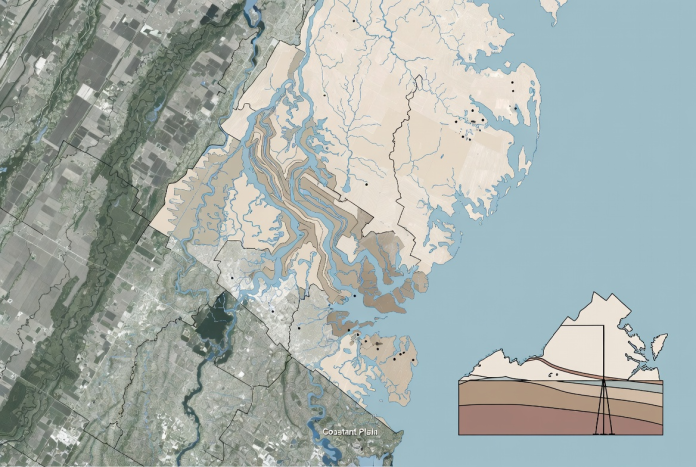
A detailed report from the Virginia Department of Environmental Quality, released in 2026 as Senate Document No. 6, concludes that the groundwater supply in the Coastal Plain east of Interstate 95 has limited capacity for significant new withdrawals. Modeling of the Virginia Coastal Plain aquifer system indicates that most evaluated locations can support only small additional permitted volumes, with some areas near the I-95 corridor restricted to less than 30,000 gallons per day.
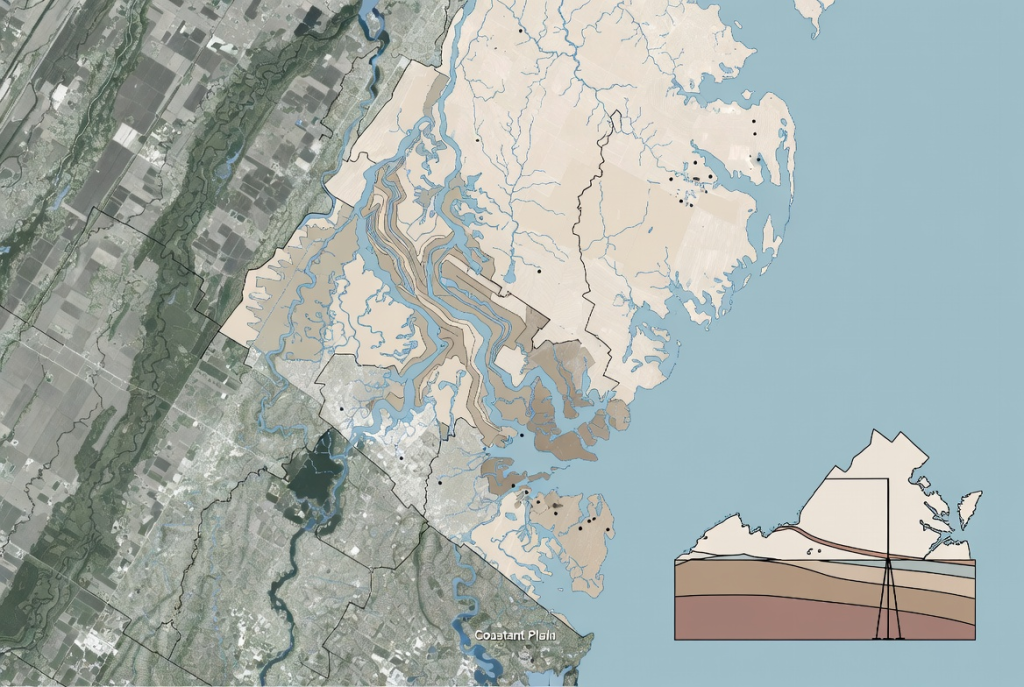
The study was directed by Senate Joint Resolution 25, approved during the 2024 legislative session. It examined the Eastern Virginia Groundwater Management Area and the Eastern Shore Groundwater Management Area, which together cover most of the region east of Interstate 95. The confined Potomac aquifer accounts for approximately 70 percent of total reported and estimated withdrawals in the Eastern Virginia area. On the Eastern Shore, the Yorktown-Eastover aquifer system supplies about 95 percent of withdrawals.
Current Use Patterns and Growth Pressures
Combined across the two management areas, major categories of use are industrial at 35 percent, private domestic at 34 percent, and public water supply at 26 percent. Private domestic withdrawals remain largely unpermitted and unreported. The report projects that growth in these household wells will increase total annual withdrawal rates by an average of 200,000 to 300,000 gallons per day each year through 2050, based on census and water-use data.
Historical withdrawals, particularly from paper mills near Franklin and West Point, have lowered inland groundwater levels below sea level. Multiple lines of evidence show that flow patterns have shifted from predevelopment conditions. Groundwater now generally moves inward from the margins toward major withdrawal centers and downward from higher to lower units within the aquifer system. These changes contribute to land subsidence and create conditions favorable for saltwater intrusion. Chloride concentrations have increased locally in parts of Eastern Virginia and on the Eastern Shore.
Assessment of New Withdrawal Capacity
To evaluate future industrial demand, the department modeled a hypothetical withdrawal of three million gallons per day at the centroid of each groundwater budget region, plus one additional site in Northumberland County selected for favorable hydrogeologic conditions. None of the tested locations met the technical criteria for a permit under existing Groundwater Withdrawal Regulations. Calculated maximum passing withdrawals ranged from 360,000 gallons per day in Northumberland County to less than 30,000 gallons per day in Henrico and Sussex counties.
The report states that under current conditions the aquifer system has limited capacity for significant new withdrawals. Only the upper end of the estimated range would support a typical hyperscale data center using evaporative cooling, and that location lies far from existing concentrations of data-center infrastructure near the I-95 corridor.
Regulatory History and Recent Trends
The Ground Water Management Act of 1992 established the current framework requiring permits for withdrawals of 300,000 gallons or more in any month within designated management areas. The report characterizes the act’s results as mixed. Following the 2010 closure of the Franklin Mill and a subsequent period of reduced withdrawals, regional groundwater levels in the Potomac aquifer rebounded and broadly stabilized for about a decade. Those rising trends stalled around 2021, and more recent observations indicate the onset of renewed declines. The annual overall groundwater deficit in the Potomac aquifer was reduced to nearly zero for a period after management actions between 2014 and 2017, but conditions have since shifted.
The statewide groundwater observation well network, a cooperative effort between the Department of Environmental Quality and the U.S. Geological Survey, includes more than 440 wells. Many provide continuous water-level data, and subsets monitor climate response, drought, and chloride. Expansion of the network is in progress in both the Coastal Plain and areas west of Interstate 95.
Quality and Long-Term Considerations
Analysis of groundwater-quality data collected since 2007, compared with earlier records, found that regional-scale chloride concentrations and the position of the saltwater-transition zone have remained generally consistent. Localized increases in chloride were identified and linked in most cases to nearby withdrawals. The report notes that declining water levels create conditions that could favor lateral saltwater intrusion over longer timeframes.
The Department of Environmental Quality offers several recommendations for legislative consideration. These include clarifying statutory authority to deny or reduce permits when alternative water sources are reasonably available, requiring local comprehensive plans in management areas to account for groundwater limits when no other supply is feasible, and addressing scientific and legal questions before any groundwater trading program is authorized. The report also references managed aquifer recharge projects, including the Hampton Roads Sanitation District’s Sustainable Water Initiative for Tomorrow, as potential tools for future capacity enhancement.
The findings provide a technical baseline for decisions by the General Assembly, the State Water Control Board, and local governments regarding water allocation, economic development, and long-term resource management in the Coastal Plain.
Email the Senate At:
Lashrecse Aird – senatoraird@senate.virginia.gov,
Lamont Bagby – senatorbagby@senate.virginia.gov,
Elizabeth Bennett-Parker – senatorbennett-parker@senate.virginia.gov,
Jennifer Boysko – senatorboysko@senate.virginia.gov,
Jennifer Carroll Foy – senatorcarrollfoy@senate.virginia.gov,
Luther Cifers – senatorcifers@senate.virginia.gov,
Christie Craig – senatorcraig@senate.virginia.gov,
Creigh Deeds – senatordeeds@senate.virginia.gov,
Bill DeSteph – senatordesteph@senate.virginia.gov,
Danny Diggs – senatordiggs@senate.virginia.gov,
Tara Durant – senatordurant@senate.virginia.gov,
Barbara Favola – senatorfavola@senate.virginia.gov,
Timmy French – senatorfrench@senate.virginia.gov,
Travis Hackworth – senatorhackworth@senate.virginia.gov,
Christopher Head – senatorhead@senate.virginia.gov,
Michael Jones – senatorjones@senate.virginia.gov,
Emily Jordan – senatorjordan@senate.virginia.gov,
Mamie Locke – senatorlocke@senate.virginia.gov,
Louise Lucas – senatorlucas@senate.virginia.gov,
David Marsden – senatormarsden@senate.virginia.gov,
Ryan McDougle – senatormcdougle@senate.virginia.gov,
Jeremy McPike – senatormcpike@senate.virginia.gov,
Tammy Mulchi – senatormulchi@senate.virginia.gov,
Mark Obenshain – senatorobenshain@senate.virginia.gov,
Mark Peake – senatorpeake@senate.virginia.gov,
Stella Pekarsky – senatorpekarsky@senate.virginia.gov,
Russet Perry – senatorperry@senate.virginia.gov,
Todd Pillion – senatorpillion@senate.virginia.gov,
Bryce Reeves – senatorreeves@senate.virginia.gov,
Danica Roem – senatorroem@senate.virginia.gov,
Aaron Rouse – senatorrouse@senate.virginia.gov,
Saddam Salim – senatorsalim@senate.virginia.gov,
Kannan Srinivasan – senatorsrinivasan@senate.virginia.gov,
William Stanley – senatorstanley@senate.virginia.gov,
Richard Stuart – senatorstuart@senate.virginia.gov,
Glen Sturtevant – senatorsturtevant@senate.virginia.gov,
David Suetterlein – senatorsuetterlein@senate.virginia.gov,
Scott Surovell – senatorsurovell@senate.virginia.gov,
Schuyler VanValkenburg – senatorvanvalkenburg@senate.virginia.gov,
Angelia Williams Graves – senatorwilliamsgraves@senate.virginia.gov,