
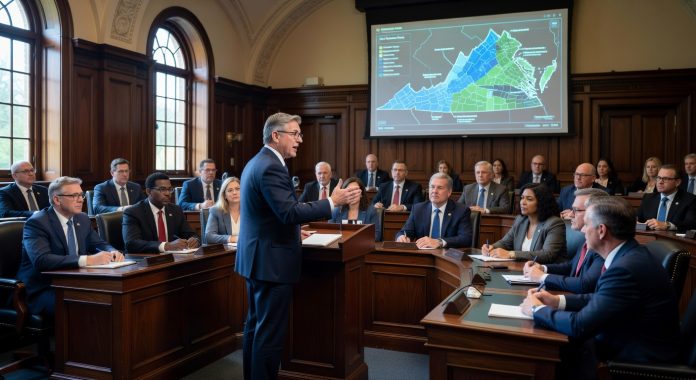
Helmer’s comments focused on Recommendation 3 within the bill, arguing that board-chosen leadership aligns with standard practices for such advisory groups. The exchange highlighted procedural nuances in establishing the task force, which would include representatives from utilities like Dominion Energy, environmental organizations, local governments, and industry experts. These entities are pivotal as Virginia navigates mandates for long-duration energy storage—4 gigawatts for Dominion—and broader clean energy goals amid PJM Interconnection challenges.
Responding was Delegate Michael Webert of the 61st District, representing Fauquier County and serving as Republican Whip. Webert addressed Helmer’s proposal, noting Virginia’s experience with numerous boards where appointed chairs provide necessary direction. ‘As the bill, we prefer because we set up boards a lot,’ Webert stated, raising practical concerns such as determining chair selection in boards with odd numbers of members. He questioned potential inefficiencies, asking, ‘Who’s going to chair it?’ and defended the executive appointment as a means to ensure focused leadership.
The discussion unfolded in the context of Virginia’s evolving energy sector. Distributed energy resources are increasingly relevant, with Dominion implementing comprehensive management systems and state policies promoting solar and storage to enhance grid resiliency and reduce household costs. Recent laws require diverse technologies for storage, while debates persist over utility-scale solar’s rural impacts and the need for baseload capacity like natural gas. The task force aims to provide recommendations on policy, incentives, and infrastructure to balance these priorities.
Presiding officers facilitated the back-and-forth, recognizing speakers and clarifying points. A female delegate was referenced in procedural remarks, with corrections noted on the energy officer’s role. The floor debate underscored competing views: Helmer’s push for member-driven governance versus Webert’s preference for structured appointments to avoid paralysis.
HB285 represents part of a larger legislative push on energy reliability. With data centers proliferating and electrification accelerating, distributed resources offer local solutions, but their scaling requires coordinated study. The task force’s composition and leadership will influence outcomes on topics from net metering to virtual power plants.
As the bill progresses through committees and potentially to the Senate, the House exchange illustrates legislative deliberation at work. Lawmakers weighed autonomy against efficiency, reflecting diverse district interests from urban Fairfax to rural Fauquier. The final structure will shape how Virginia advances distributed energy amid national trends in decarbonization and grid modernization.
This debate exemplifies the House’s role in refining policy details, ensuring the task force serves the Commonwealth’s energy needs effectively.
Source: Field reports and eyewitness accounts.