
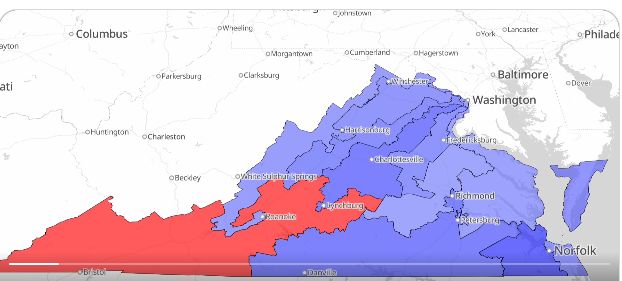
RICHMOND, Va. — On May 8, 2026, the Virginia Supreme Court ruled that a Democrat-backed constitutional amendment authorizing temporary partisan redistricting of congressional districts violated the state constitution’s procedural requirements. The decision nullifies the results of the April 21 special election referendum, in which voters narrowly approved the measure by approximately 51.7% to 48.3%, with roughly 3.1 million ballots cast.
The ruling, authored in part by Justice D. Arthur Kelsey, upholds existing congressional maps drawn through Virginia’s independent redistricting commission process. Those maps currently yield a 6 Democratic to 5 Republican delegation. The proposed amendment would have enabled the General Assembly to implement new maps projected to favor Democrats significantly, potentially shifting the balance toward 10-1 or similar.
Critics of the court’s decision argue that it undermines core democratic principles by disregarding the expressed will of Virginia voters. Supporters of the amendment, including Democratic leaders and voting rights advocates, contend that the referendum represented a legitimate response to perceived national partisan redistricting efforts in Republican-led states. They view the court’s intervention as an overreach that prioritizes technical procedural disputes over the substantive outcome of a free and fair election.
Background on the Amendment and Referendum
The 2026 Virginia redistricting amendment emerged from a special session of the Democrat-controlled General Assembly. It sought to amend the state constitution to allow the legislature to adopt new congressional districts temporarily before the 2030 census, framed as a measure to “restore fairness” amid what proponents described as aggressive mid-decade map-drawing in other states. The ballot language emphasized that the standard nonpartisan commission process would resume afterward.
Voters approved the measure despite a series of legal challenges. A Tazewell County Circuit Court judge had previously blocked aspects of the process on procedural grounds, but the Virginia Supreme Court allowed the April 21 vote to proceed, deferring full resolution until after the election. Turnout reached about 48.6% of registered voters, lower than recent statewide contests, with stronger relative participation in some Republican-leaning areas yet sufficient support in Northern Virginia to secure a narrow “Yes” victory.
Core Arguments Against the Court’s Ruling
Opponents of the decision highlight several key concerns. First, they argue that invalidating a voter-approved constitutional amendment sets a dangerous precedent. In a representative democracy, courts traditionally show deference to the electorate’s judgment on ballot measures, especially when procedural objections were litigated and the election was permitted to occur. Nullifying over 1.6 million “Yes” votes, they say, effectively disenfranchises participants who cast ballots in good faith.
Second, the procedural violations cited—related to the timing of legislative sessions, public notice requirements, the definition of an “election” (including early voting periods), and compliance with constitutional amendment processes—are characterized by critics as overly formalistic. Democrats maintained throughout litigation that the General Assembly substantially complied with requirements and that minor technicalities should not override voter sovereignty. Some legal observers noted that the Virginia Supreme Court had twice declined to halt the referendum pre-election, which some interpreted as an implicit signal of viability.
Third, the ruling occurs against a backdrop of intense national partisan redistricting battles ahead of the 2026 midterms. Proponents of the Virginia amendment portrayed it as a necessary counter to maps drawn in states like Texas. Striking it down, critics argue, leaves Virginia at a competitive disadvantage and entrenches existing maps that some view as outdated or unreflective of current political realities. This decision could influence House control dynamics, maintaining a narrower Republican edge or competitive balance in Virginia’s delegation.
Additionally, questions have arisen about the court’s composition and potential institutional pressures. Several justices, including Kelsey, were appointed or elected under prior Republican legislative majorities, with terms expiring in coming years under Democratic legislative control. While no evidence of direct impropriety exists, some commentators suggest the decision reflects a stricter interpretive approach to constitutional procedures that could be seen as favoring the status quo.
Counterarguments and the Court’s Likely Rationale
The court’s opinion centered on strict adherence to Virginia’s constitutional framework for amendments. The state requires proposed amendments to pass the General Assembly in two sessions separated by an intervening election, with specific notice and timing rules designed to ensure public deliberation. Challengers successfully argued that the special session and ballot placement failed these standards, rendering the referendum invalid from inception.
Supporters of the ruling emphasize the rule of law: constitutional processes exist to protect against hasty or self-serving changes to fundamental governance structures like redistricting. Allowing procedural shortcuts, they contend, could invite future abuses regardless of party. Virginia’s shift to an independent commission was itself a voter-approved reform intended to reduce partisanship in map-drawing; bypassing it mid-decade raises consistency concerns.
Broader Implications
The decision preserves Virginia’s current 6-5 split for the immediate future but intensifies debates over gerrymandering nationwide. It highlights tensions between state sovereignty in elections, judicial review, and direct democracy. Legal analysts expect potential appeals or further legislative attempts, though the immediate path for new maps appears closed.
Voter reactions have been mixed. Proponents of the struck-down measure decry it as thwarting majority will in a low-turnout but legitimate election. Defenders praise the court for upholding procedural integrity. Political scientists note that such controversies often energize future turnout, particularly in a battleground state like Virginia.
As Virginia and the nation prepare for 2026 midterms, this ruling underscores ongoing challenges in balancing fair representation, legal compliance, and partisan competition. Whether it represents a principled defense of constitutional norms or an undue judicial override of voter preferences will likely remain a point of contention in legal, academic, and political circles for years to come.