
RICHMOND, Va. — Virginia Democrats have asked the U.S. Supreme Court to intervene in a high-stakes redistricting dispute after the Virginia Supreme Court nullified a voter-approved constitutional amendment on procedural grounds, a development that preserves the state’s current congressional maps for the 2026 midterm elections.
The Virginia Supreme Court ruled 4-3 on May 8, 2026, that the Democratic-led General Assembly violated state constitutional and statutory procedures when it placed the redistricting amendment on the April 21 special election ballot. Justice D. Arthur Kelsey wrote for the majority that the rushed process “incurably taints” the referendum, rendering its narrow approval by voters legally ineffective.
Voters had approved the measure by a slim margin—approximately 51.7% to 48.3%—which would have allowed the legislature to redraw congressional districts mid-decade. Proponents argued the change was needed to counter perceived partisan map-drawing in other states and restore fairness. Opponents, including Republicans, called it an attempt at gerrymandering that could have shifted the state’s delegation from a current 6-5 Democratic advantage to as much as 10-1 in favor of Democrats.
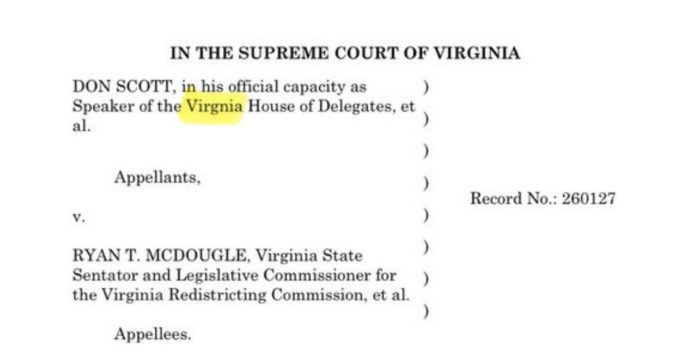
In response to the ruling, House Speaker Don Scott (D) and Attorney General Jay Jones (D) filed a “Joint Motion to Delay Issuing Mandate” with the state court, signaling plans for an emergency appeal to the U.S. Supreme Court. The filing has drawn attention for containing notable typographical errors, including “Virgnia” in place of “Virginia” in the caption and “Sentator” instead of “Senator” when referring to a lawmaker. Former Attorney General Jason Miyares (R) highlighted the mistakes on social media, describing the appeal effort as a low-probability “Hail Mary.”
Legal experts note that the appeal faces significant hurdles under the adequate and independent state grounds doctrine. This principle of federalism generally prevents the U.S. Supreme Court from reviewing state court decisions that rest primarily on interpretations of state law, as appears to be the case here. The Virginia ruling focused on compliance with the state’s own constitutional amendment process rather than federal constitutional questions.
Background and Context
The controversy stems from efforts by Virginia Democrats to respond to redistricting actions in other states ahead of the 2026 midterms. After the amendment passed the legislature in the required two sessions, it advanced to voters despite legal challenges. A lower court had initially questioned the process, but the state Supreme Court allowed the April 21 vote to proceed before ultimately invalidating the results post-election.
The existing congressional maps, drawn by courts following previous disputes, have produced a 6-5 split favoring Democrats. The proposed changes would have empowered the General Assembly to adopt new districts temporarily, with a return to the standard process involving the Virginia Redistricting Commission after the 2030 census.
Democrats framed the amendment as a defensive measure to protect democratic principles amid national map battles. Republicans countered that it represented an improper power grab that bypassed normal timelines and violated procedural safeguards intended to ensure deliberate constitutional changes.
The special election itself cost taxpayers an estimated $10 million, while political spending on both sides reached tens of millions of dollars. The outcome leaves current maps in place for 2026, potentially aiding Republican efforts to maintain or expand their position in the U.S. House.
Reactions
Republican leaders, including Miyares, welcomed the state court decision as a defense of the rule of law and constitutional process. Miyares had previously issued an opinion questioning the amendment’s legality.
Democratic officials expressed disappointment, arguing the ruling overrides the expressed will of the voters who participated in the special election. They maintain that the procedural issues cited do not justify nullifying a ratified amendment and have proceeded with the federal appeal to seek a stay and further review.
The 4-3 split on the Virginia Supreme Court broke largely along ideological lines, with the majority emphasizing strict adherence to procedural requirements for amending the state constitution. The dissenters reportedly viewed the process as sufficiently compliant or the remedy as overly harsh.
Potential Implications
The episode highlights ongoing national tensions over redistricting. Both parties have engaged in map-drawing strategies to gain electoral advantages, with courts frequently called upon to referee disputes. Virginia’s case is notable for involving a voter-approved measure that was later overturned on process grounds rather than substantive gerrymandering claims.
If the U.S. Supreme Court declines to intervene—as many observers expect—the decision will stand, keeping Virginia’s congressional delegation structure intact for the upcoming cycle. Should it grant review, it could set precedents on state court authority over election-related constitutional matters.
The typographical errors in the emergency filing have added an element of embarrassment to an already contentious legal battle, drawing commentary across the political spectrum about the professionalism of the documents submitted in such a high-profile case.
As the 2026 midterm elections approach, Virginia remains a competitive battleground. The preservation of current maps maintains several closely contested districts, ensuring the state’s delegation will likely continue reflecting the state’s purple political character rather than tilting decisively in one direction.
This case serves as a reminder of the complexities involved when legislatures, voters, and courts intersect on electoral mechanics. Both sides agree on the importance of fair maps but differ sharply on what constitutes fairness and the proper mechanisms to achieve it. Legal proceedings are expected to continue in the short term, with potential ramifications extending beyond Virginia’s borders.