
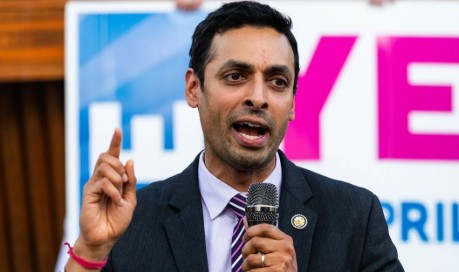
CHANTILLY, Va. — In the wake of a Virginia Supreme Court ruling that invalidated a newly approved congressional redistricting map, some Democrats are exploring aggressive legislative responses, including potential changes to the composition of the state’s highest court. U.S. Rep. Suhas Subramanyam (D-Va.), who represents Loudoun County, has publicly stated his support for taking significant steps — including replacing Supreme Court justices — to uphold the results of last month’s referendum.
The controversy centers on a constitutional amendment approved by Virginia voters in April by a narrow margin. The measure would have allowed the Democrat-controlled General Assembly to suspend the state’s independent redistricting commission for one cycle and enact new congressional district boundaries. Those maps were widely expected to deliver a substantial advantage to Democrats, potentially shifting the state’s 11-member U.S. House delegation from a competitive balance toward a strong Democratic majority.
On May 8, the Virginia Supreme Court ruled 4-3 that the process used to place the amendment on the ballot violated state constitutional requirements, which mandate an intervening general election between certain legislative passages. The decision nullified the referendum outcome and kept in place maps drawn by an independent commission following the 2020 census.
The ruling triggered immediate frustration among Democrats, who viewed the new map as a legitimate exercise of voter will and a counter to Republican gerrymandering efforts in other states. In a private conference call Saturday that included Virginia Democratic House members and House Minority Leader Hakeem Jeffries (D-N.Y.), participants discussed various options for responding, including an “audacious” proposal to replace the entire Virginia Supreme Court in hopes of obtaining a more favorable ruling on the maps.
Rep. Subramanyam addressed the situation in an interview with The New York Times. He expressed support for doing “whatever was necessary” to preserve the map approved by voters, explicitly including the possibility of replacing the state’s Supreme Court justices.
“Everyone has got to have a strong stomach right now; this is a complete disaster waiting to happen if people are timid,” Subramanyam said. He pointed to actions by Republican-led states in other contexts as justification for exploring all available options.
Longstanding Norms at Stake
Virginia’s Supreme Court justices serve 12-year terms, with a mandatory retirement age of 75. Any effort to alter the court’s makeup would likely involve legislation lowering the retirement age or other mechanisms subject to approval by the General Assembly and Gov. Abigail Spanberger (D). Legal experts and some Democrats have described such a move as unprecedented in modern Virginia history and potentially fraught with political and constitutional risks.
The idea has drawn mixed reactions even within Democratic circles. Former Rep. James P. Moran (D-Va.) reportedly called court-stacking efforts “a bridge too far” that could backfire. It remains unclear whether Gov. Spanberger or legislative leaders would support such a plan, and no formal legislation has been introduced as of this writing.
Democrats have also pursued legal avenues, filing an emergency appeal with the U.S. Supreme Court seeking to stay the Virginia ruling and restore the new maps for the 2026 midterm elections. State officials argue the Virginia court overstepped by overturning a direct vote of the people.
Republicans and court defenders counter that the decision upheld the plain text of Virginia’s Constitution and protected the integrity of the amendment process. They argue that bypassing judicial review or retroactively altering the court would undermine separation of powers and set a dangerous precedent after more than 250 years of American judicial tradition emphasizing independence from political branches.
Broader Context of Redistricting Battles
The Virginia dispute is part of a larger national struggle over congressional maps ahead of the 2026 midterms. Both parties have engaged in aggressive redistricting where they hold power, though independent commissions in states like Virginia were intended to reduce partisanship. Democrats contend that the invalidated map represented a voter-endorsed correction to previous imbalances, while critics labeled it a partisan gerrymander designed to maximize Democratic gains.
Rep. Subramanyam, a Democrat elected to represent a competitive Northern Virginia district, has framed the court’s decision as an override of millions of Virginia voters. In public statements, he has criticized the 4-3 ruling as flawed and called for strong action to defend the referendum results.
Political observers note that any attempt to remake the Virginia Supreme Court would likely face significant hurdles, including potential legal challenges, public backlash, and the need for supermajorities or gubernatorial approval depending on the exact mechanism. Virginia’s constitution provides specific procedures for judicial removal, primarily through impeachment, making alternative routes such as age adjustments legally and politically contentious.
As the 2026 election cycle intensifies, the episode highlights ongoing tensions between popular referendums, legislative authority, and judicial review. Democrats maintain they are fighting to honor the will of Virginia voters, while opponents warn that efforts to pressure or reconstitute the judiciary risk eroding public confidence in impartial institutions that have served as a cornerstone of governance since the nation’s founding.
For now, candidates in both parties are preparing to run under the existing court-drawn maps, though the U.S. Supreme Court appeal and potential state legislative maneuvers could still alter the landscape. Rep. Subramanyam’s comments underscore the high stakes and willingness of some Democrats to consider unconventional paths in response to the setback.
This developing story will continue to shape Virginia politics and national redistricting conversations in the months ahead.