
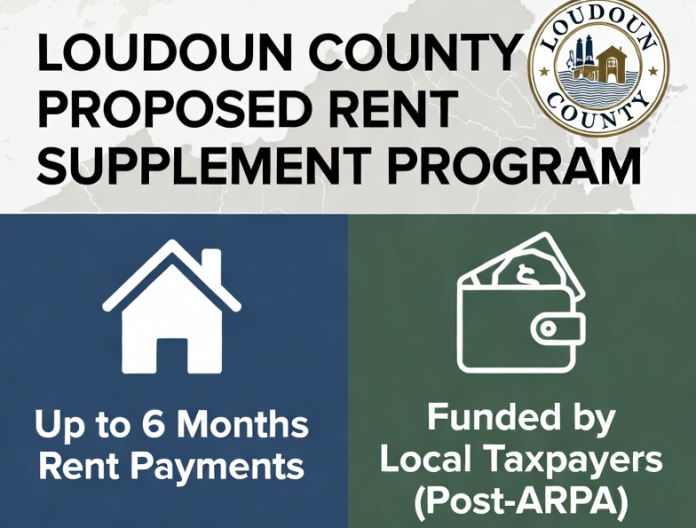
Loudoun County, Virginia—one of the wealthiest counties in the United States—may soon launch a new county-funded “short-term rent supplement program” aimed at promoting housing stability. The initiative, advanced by Supervisors Juli E. Briskman (D-Algonkian) and Koran T. Saines (D-Sterling), has drawn attention for its broad eligibility criteria.
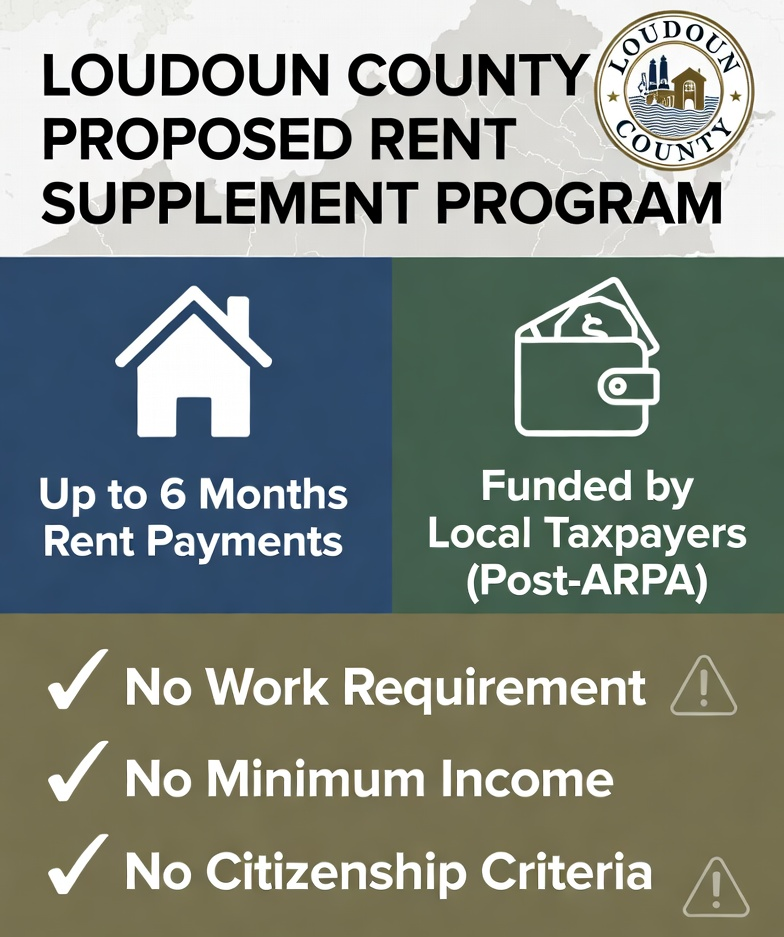
The program would provide up to six months of rent payments to eligible applicants. Key features include no work requirement, no minimum income threshold, and no citizenship criteria. Participants could reportedly reapply as needed, raising questions about the program’s duration and long-term costs to local taxpayers.
Funding Source and Budget Implications
Unlike earlier rental assistance efforts that relied on federal American Rescue Plan Act (ARPA) funds, this appears to be a locally funded initiative. Previous ARPA-supported programs, administered through partners like Loudoun Cares, provided temporary rent and eviction prevention aid and were scheduled to wind down as those federal dollars expired (generally by the end of 2026).
The new short-term rent supplement would shift the financial burden to Loudoun County taxpayers. Fiscal impacts were described as not fully known at the time of the proposal’s advancement, with costs expected to appear in future budgets, potentially the FY 2028 cycle. Loudoun County’s overall budget exceeds $4 billion in recent years, supported primarily by real estate taxes in a high-value housing market. The county maintains a dedicated Housing Fund, which has received appropriations equivalent to a full penny of the real property tax rate in recent budgets to support attainable housing programs.
Exact per-household payment amounts, total program funding, or caps have not been widely detailed in initial public notices. For context, the county’s prior ARPA rental assistance saw an average monthly benefit around $1,500 per household, with hundreds of households served. Annualizing current assistance levels from recent data suggested potential costs in the millions if scaled similarly, though the “limited” nature of the new supplement may constrain scope.
Administration would likely fall under the Department of Housing and Community Development (DHCD) or contracted partners, similar to existing efforts. Payments are typically made directly to landlords to ensure housing stability.
Who Can Apply? Eligibility Details
Specific eligibility guidelines are still emerging, but public descriptions emphasize broad access:
- Loudoun County residents facing housing instability.
- No requirement to demonstrate employment or job-seeking activity.
- No minimum income level specified (potentially open to a wide range of earners).
- No citizenship or immigration status requirements.
- Up to six months of support, with possibility of reapplication.
This contrasts with many traditional rental assistance programs, which often prioritize very low-income households (e.g., below 50% of Area Median Income), require proof of financial hardship tied to specific events (job loss, medical issues), or impose time limits and work incentives. Loudoun’s median household income is significantly above national averages, yet the county faces ongoing challenges with attainable housing, rising rents in certain areas, and demand for support across income brackets.
The program is framed as a “Board Member Initiative: Limited Rent Supplement Program to Promote Housing Stability (Countywide).” It aligns with the Board’s broader strategic focus on meeting diverse housing needs, including loans for attainable multi-family rentals and other affordability measures.
Context and Criticisms
Supporters, presumably including Briskman and Saines, view it as a targeted tool to prevent evictions and homelessness, complementing longer-term housing production efforts. Loudoun has approved millions in loans for new rental units restricted to lower- and moderate-income households (up to 70% AMI). Housing advocates note persistent cost-burden issues where families spend over 30% (or even 50%) of income on housing.
Broader Housing Landscape in Loudoun
Loudoun County continues investing heavily in housing solutions. Recent actions include:
- Loans for hundreds of attainable rental units.
- Partnerships for down-payment assistance and other programs.
- Exploration of policy tools like rent stabilization authority (though not directly tied to this supplement).
The county’s Unmet Housing Needs Strategic Plan guides these efforts. However, transitioning from time-limited federal aid to ongoing local funding marks a policy shift that will require careful oversight.
As the proposal moves forward, residents are encouraged to monitor Board of Supervisors meetings and provide public comment. Key questions remain: How will “short-term” be enforced? What safeguards prevent repeated long-term reliance? How will success be measured (e.g., households stabilized vs. total expenditure)? And what is the projected annual cost once fully implemented?
Loudoun County government websites and DHCD pages will likely post formal application details, guidelines, and contact information once approved. For now, those seeking immediate rent help can explore existing programs through Loudoun Cares, Catholic Charities, or FAITH, though many are time- or fund-limited.
This development underscores ongoing tensions in high-growth suburbs: balancing compassion for housing-vulnerable residents with fiscal responsibility and incentives for self-sufficiency. With Loudoun’s strong tax base, the program could provide a meaningful bridge for some families—but its design, funding sustainability, and outcomes will determine its ultimate value to the community.
This article is based on public statements, Board initiatives, and available budget context as of May 2026. Details may evolve as the program is formalized.