
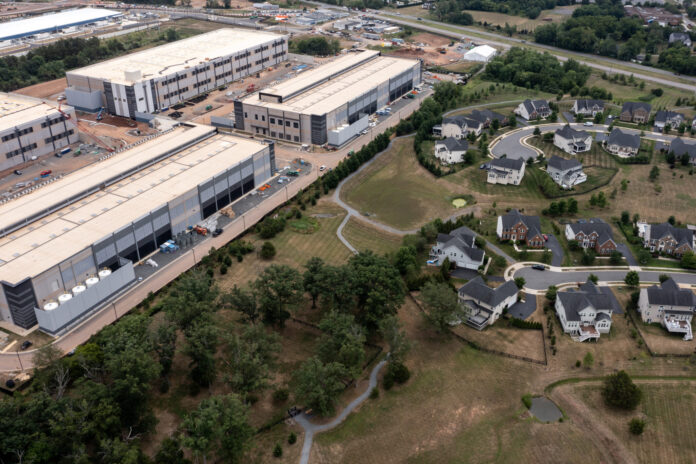
This was supposed to be the year the General Assembly did something about data centers. Two years ago, it crushed the first tentative efforts to regulate construction, choosing instead to goose the pace. Last year it again killed all attempts at regulation, punting in favor of a study by the Joint Legislative Audit and Review Commission (JLARC).
JLARC’s report was released in December to a soundtrack of alarm bells ringing. Unconstrained data center growth is projected to triple electricity demand in Virginia over just the next 15 years, outstripping the state’s ability to build new generation and driving up utility bills for everyone. On top of the energy problem, the industry’s growth is taxing water supplies and spawning billions of dollars worth of transmission infrastructure projects needed to serve the industry.
Yet the most popular strategy for addressing the biggest energy crisis ever to face Virginia is to continue the status quo – that is to say, to keep the data center sprawl sprawling. Of the two dozen or so bills introduced this year that would put restrictions on growth, manage its consequences, or impose transparency requirements, barely a handful have survived to the session’s halfway point this week.
The surviving initiatives do address important aspects of local siting, ratepayer protection and energy, though they will face efforts to further weaken them in the second half of the session. Even if the strongest bills pass, though, they will not rein in the industry, provide comprehensive oversight, require transparency or address serious resource adequacy problems.
HB1601 from Del. Josh Thomas, D-Gainesville, is the most meaningful bill to address the siting of data centers. It requires site assessments for facilities over 100 MW to examine the sound profile of facilities near residential communities and schools. It also allows localities to require site assessments to examine effects on water and agricultural resources, parks, historic sites or forests. In addition, before approving a rezoning, special exception or special use permit, the locality must require the utility that is serving the facility to describe any new electric generating units, substations and transmission voltage that will be required. Existing sites that are seeking to expand by less than 100 MW are excluded. HB1601 passed the House 57-40, with several Republicans joining all Democrats in favor.
SB1449 from Sen. Adam Ebbin, D-Alexandria, is similar to HB1601 but does not include the language on electricity and transmission lines. SB1449 passed the Senate 33-6.
Typically, when the House and the Senate each pass similar but different bills, they each try to make the other chamber’s bill look like theirs, then work out the differences in a conference committee. If that happens here, the House will amend SB1449 to conform it to HB1601 before passing it. The Senate might amend the House bill to match its own or they could recognize that HB1601 is better and pass it as is rather than watering it down to match their own; otherwise, the bills will have to go to conference.
Only two ratepayer protection bills passed. SB960 from Sen. Russet Perry, D-Leesburg, is the better of the two. It requires the SCC to determine if non-data center customers are subsidizing data centers or incurring costs for new infrastructure that is needed only because of data center demand; if so, the SCC is to take steps to eliminate or minimize the cross-subsidy. The bill incorporates a similar measure from Sen. Richard Stuart, R-Westmoreland. It passed the Senate by a healthy 26-13, but leaves the question of why those 13 Republicans voted against a bill designed to protect residential customers from higher rates.
Over in the House, HB2084 from Del. Irene Shin, D-Herndon, started out similar to Perry’s bill but was weakened in committee to the point that its usefulness is questionable. It now merely requires the SCC to use its existing authority during a regular proceeding sometime in the next couple of years to determine whether Dominion and Appalachian Power are using reasonable customer classifications in setting rates, and if not, whether new classifications are reasonable. It passed the House 61-35. Hopefully the House will see the wisdom of adopting the Senate’s bill, but again, these could end up going to conference.
The only data center legislation related to energy use to have made it this far is SB1047 from Sen. Danica Roem, D-Manassas. It requires utilities to implement demand-response programs for customers with a power demand of more than 25 MW, which could help relieve grid constraints. It passed the Senate 21-17.
The data center industry and its labor allies were successful in killing all other data center initiatives, including the only bills that dealt with the energy issues head-on. This included legislation that basically called on the industry to live up to its sustainability claims. SB1196 from Sen. Creigh Deeds, D-Charlottesville, and HB2578, sponsored by Del. Rip Sullivan, D-Fairfax, would have conditioned state tax subsidies on data centers meeting conditions for energy efficiency, zero-carbon energy and cleaner back-up generators. Sullivan’s bill also set up pathways for data center developers to meet the energy requirements and work toward cleaner operations.
None of this mattered. Republicans were united in their determination not to put anything in the way of continued data center sprawl, and they were joined by a number of Democrats who were persuaded that requiring corporations to act responsibly threatens construction jobs. HB2578 died in subcommittee, with Democrats Charniele Herring and Alfonso Lopez joining Republicans in voting to table the bill. SB1196 was never even granted a committee hearing.
Yet the idea of adding conditions to the tax subsidies is not dead. Deeds put in a budget amendment to secure the efficiency requirements that had been in his bill. His amendment takes on a House budget amendment requested by Del. Terry Kilgore, R-Gate City, that extends the tax subsidies out to 2050 from their current sunset date of 2035, with no new conditions whatsoever.
It seems like a reasonable ask for the tech industry to meet some efficiency requirements in exchange for billions of dollars in subsidies and the raiding of Virginia’s water and energy supplies. Indeed, the industry could have had it worse. Stuart had introduced a Senate bill to end the tax subsidies Virginia provides to data centers altogether. Alas, like several other more ambitious bills intended to bring accountability to the data center industry, it failed to even get a hearing in committee.
Now, maybe Virginia will get lucky — or unlucky, depending on how you look at it — and the data center boom will go bust. The flurry of excitement around China’s bid to provide artificial intelligence at a fraction of the cost of American tech joins other news items about efficiency breakthroughs that could mean the tech industry needs far fewer data centers, using far less energy and water. That would be good for the planet, not to mention Virginia ratepayers, but it would leave a lot of empty buildings, upend local budgets, and strand potentially billions of dollars in new generation and transmission infrastructure. A little preparation and contingency planning would seem to have been the wiser course.