
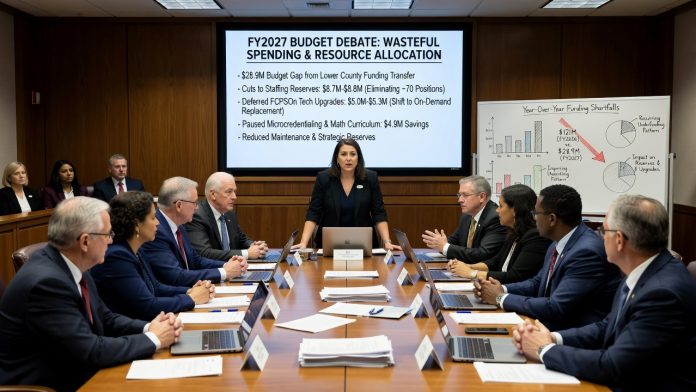
The Fairfax County School Board is currently navigating an intense debate regarding resource allocation and budget reductions for the upcoming fiscal year. District administrators were forced to address a $28.9 million budget gap following a lower-than-expected funding transfer from the local government. To balance the fiscal year 2027 budget, officials have proposed significant cuts to staffing reserves and the deferral of student technology upgrades.
The responsibility of finalizing these complex financial decisions falls directly on the current members of the school board. The board consists of Karl Frisch, Sandy Anderson, Kyle McDaniel, Ryan McElveen, Ilryong Moon, Rachna Sizemore Heizer, Robyn Lady, Marcia St. John-Cunning, Melanie Meren, Ricardy Anderson, Mateo Dunne, and Seema Dixit. These elected officials face mounting pressure from the public to balance fiscal responsibility with the growing educational demands of a large student population.
Closing the Funding Gap
The core of the current fiscal challenge stems from the county funding transfer falling significantly short of the school system’s initial expectations. On May 5, 2026, the Fairfax County Board of Supervisors declined to provide the full requested funding amount for the upcoming academic year. This legislative decision left the school district with an initial funding shortfall estimated between $39.6 million and $39.7 million. Consequently, district leaders had to quickly identify immediate areas for cost savings to produce a legally required balanced budget.
While the resulting $28.9 million final budget gap is substantial, financial records indicate it is considerably smaller than the hurdles faced in the previous cycle. During the fiscal year 2026 budget process, the school system experienced a massive $121 million funding gap that required drastic administrative action. Despite this year-over-year improvement, the current situation marks the second consecutive year that the county’s funding transfer has fallen meaningfully below the school system’s requested amount. This recurring pattern of underfunding has forced administrators to deeply scrutinize resource allocation and identify areas where spending can be paused or reduced.
Impact on Staffing Reserves
To help bridge the multimillion-dollar deficit, district officials specifically targeted the staffing reserve fund for significant financial reductions. This contingency pool is traditionally utilized by human resources to manage unexpected enrollment fluctuations and emergency personnel requirements throughout the academic year. The proposed budget officially cuts between $8.7 million and $8.8 million from this specific administrative reserve account. According to district financial documents, this monetary reduction translates directly to the elimination of approximately seventy staff positions from the contingency pool.
Superintendent Michelle Reid directly addressed the necessity of these difficult financial decisions during recent public budget presentations. She justified the cuts by stating that she had chosen to pause several items in response to the county underfunding the initial budget request. Administrators maintain that tapping into the staffing reserve is a preferable alternative to directly eliminating active classroom teaching positions across the district. However, critics of the reduction worry that a depleted reserve could leave the district highly vulnerable if sudden enrollment spikes occur in the fall.
Deferred Technology and Equipment Upgrades
Another major area impacted by the budget adjustments is the district’s technology infrastructure, specifically concerning the established FCPSOn program. This educational initiative historically operated on a predictable technology device refresh schedule to ensure all students had consistent access to modern computing equipment. Under the newly revised budget plan, the district will defer these automatic hardware upgrades to save between $5.0 million and $5.3 million. The program has now been officially transitioned to an on-demand replacement schedule in an effort to maximize the functional lifespan of existing hardware.
Under this new on-demand framework, students will only receive a new device when their current one is completely unusable or physically broken. District technology officials will no longer replace laptops and tablets simply because the hardware has reached a specific predetermined age milestone. Proponents of this policy change argue it eliminates wasteful spending by preventing the premature disposal of perfectly functional electronic devices. Conversely, some community members have expressed concern that older devices might lack the processing power needed to run modern educational software efficiently.
Additional Program Deferrals
Beyond staffing and technology, the budget shortfall has also prompted immediate delays in several professional development and curriculum initiatives. The district decided to defer its microcredentialing program, which provides specialized professional development certifications for teachers, saving approximately $4.9 million in the process. Additionally, the planned adoption of new math curriculum materials has been temporarily halted to conserve available capital for core operations. These strategic pauses represent a broader administrative strategy of delaying non-essential academic enhancements until local funding levels stabilize in future fiscal years.
Capital maintenance projects and administrative discretionary funds have also faced intense scrutiny during the latest resource allocation debates. The budget outlines notable reductions to the major maintenance fund, which generally covers necessary physical repairs and facility upgrades across the school district. Furthermore, the strategic reserve allocated specifically for the superintendent has been reduced to help offset the massive county funding shortfall. Administrators insist these specific cutbacks will not immediately impact the daily operations or safety of local school buildings.
Long-Term Fiscal Outlook
The ongoing debate over wasteful spending and proper resource allocation highlights the broader, long-term financial challenges facing the entire school system. As administrators successfully navigate the current $28.9 million gap, they must also begin preparing for potential economic headwinds in upcoming budget cycles. The reliance on delaying equipment purchases and shrinking emergency reserves is generally viewed by economists as a short-term solution rather than a sustainable financial strategy. Financial analysts within the district continue to closely monitor local economic indicators to better predict future county revenue transfers and avoid similar shortfalls.
The approved adjustments for the fiscal year 2027 budget reflect a strict prioritization of core instructional needs over auxiliary programs and automatic upgrades. By transitioning to on-demand technology replacements and pausing new curriculum adoptions, the district has managed to balance its immediate financial obligations. Moving forward, the school board will need to carefully evaluate whether these deferred expenses will ultimately create a compounding financial burden in subsequent years. Ultimately, the local community will be watching closely to see exactly how these resource allocation decisions impact the overall quality of education in the region.
Email Fairfax County Supervisors At:
Jeff McKay – chairman@fairfaxcounty.gov,
Kathy Smith (Sully District) sully@fairfaxcounty.gov,
Rachna Heizer (Braddock District) braddock@fairfaxcounty.gov,
James Bierman (Dranesville District) dranesville@fairfaxcounty.gov,
Rodney Lusk (Franconia District) franconia@fairfaxcounty.gov,
Walter Alcorn (Hunter Mill District) huntermill@fairfaxcounty.gov,
Andres Jimenez (Mason District) mason@fairfaxcounty.gov,
Daniel Storck (Mount Vernon District) mtvernon@fairfaxcounty.gov,
Dalia Palchik (Providence District) providence@fairfaxcounty.gov,
Pat Herrity (Springfield District) springfield@fairfaxcounty.gov,
To Contact Fairfax School Board Members:
All Members – FairfaxCountySchoolBoard@fcps.edu,
Tom Dannan – tfdannan@fcps.edu,
Robyn Lady – ralady1@fcps.edu,
Marcia St. John-Cunning – mstjohncunni@fcps.edu,
Melanie Meren – HunterMillStaff@fcps.edu,
Ricardy Anderson – randerson@fcps.edu,
Mateo Dunne – mdunne@fcps.edu,
Karl Frisch – kfrisch@fcps.edu,
Sandy Anderson – sanderson@fcps.edu,
Seema Dixit – sdixit@fcps.edu,
Kyle McDaniel – kmcdaniel@fcps.edu,
Ryan McElveen – rlmcelveen@fcps.edu,
Ilryong Moon – imoon@fcps.edu,































