
This post was originally published on this site.
This post was originally published on this site.
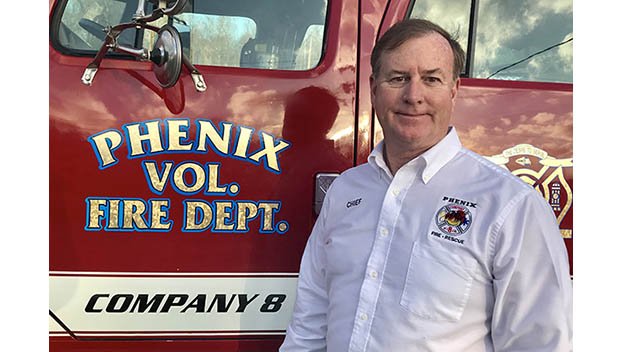
Walt Bailey, Phenix Fire chief, is encouraging residents to volunteer with their local fire departments and EMS services. Rural communities in the region are struggling to keep enough personnel on hand to respond to emergency situations.
Bailey, who has more than 50 years of experience in firefighting and emergency medical services, is calling on residents to volunteer.
A report requested by Virginia’s General Assembly regarding the state’s funding needs for fire and EMS noted that Virginia has no definition of a firefighter and does not have minimum training requirements. This makes it difficult to estimate the number active firefighters in the state.
The report cited data from the Federal Emergency Management Agency for 2023, which showed that 70.7% Virginia fire departments are volunteer departments. Rural communities may struggle to attract younger volunteers. This can lead to gaps in coverage for fire and EMS.
Bailey says the problem is widespread in the region.
Bailey stated that being a volunteer rescuer and firefighter is the most rewarding thing you can do. It’s amazing when you are there and you help someone with a positive result in their life following an accident.
Bailey described helping people through an emergency as “just incredibly rewarding,” especially when it results in a positive outcome.
But times have changed.
Bailey stated that Virginia’s history is built on the idea that neighbors help neighbors.
He said that “farmers used to move from farm to farm and get their crops,” in the old days. Everyone pitched in when they built a house or a barn. We don’t see that much anymore, except in the Amish community.”
Bailey said that volunteer fire departments were among the last remaining organizations to rely on neighbor-to-neighbor assistance.
He said, “Sadly, the volunteerism in fire and rescue is decreasing, as are other volunteer positions.” “There are a lot of distractions in our society today compared to 30 years ago. This is taking a toll on rural communities, particularly.”
Bailey noted that neighbors have always helped each other in times of need.
He said that when he started in 1973 it was unheard-of for a fire department to ask for help from another. “Even though we did not have the latest technology and our equipment was older, we still had people who were able to think outside of the box.”
Bailey explained that over time, equipment has improved while the number has decreased.
He said that in 2010, Virginia had over 100,000 volunteers who answered calls and served on fire and EMS. “Today sadly, this number is under 15,000 – an 85% drop.”
Bailey called it the perfect storm.
He said that the workload is growing as departments struggle with training needs and financial demands.
Bailey stated that a new pumper vehicle cost around $200,000. The same truck is now worth more than $1,000,000.
Bailey continued, “There’s already fewer of you to run your business and do the fundraising for the equipment.” “This perfect storm will lead to the extinction of volunteer firefighters and rescue workers.”
Bailey said that three departments were dispatched for structure fires within the county, not because their equipment was needed but because they had to add more personnel.
He said: “It’s sad that a county with 470 square kilometers would have to send all of its fire departments to the area to achieve the goal of putting out the flames.” Everyone is at risk of losing homes or businesses. This puts everyone at risk.
Bailey explained that fire departments used to be able to operate within a range of five or six miles. Currently, departments respond to calls from more than 20 miles.
“This creates a hazard.” He said that the second danger is if another incident occurs in the county, while everyone is still occupied with one incident. “We often don’t have enough depth to handle multiple incidents at once.”
Bailey’s message to volunteers is simple. Don’t hesitate to get involved.
Bailey replied, “We need your help.” You may not be in a position to enter a burning building but you might be able drive the truck. You might not be able drive the truck but you can help raise money. You could cook meals or lend a hand in other ways. You’ll need to provide us with the necessary tools to help save our volunteer firefighters and rescuers.
Bailey stated that it costs $10,000 for one firefighter to be outfitted with equipment and receive training. He and other chiefs have to come up with $200,000 every 10 years for turnout equipment, he said.
He thinks that the burden of fundraising should be reduced to allow first responders to focus on responding to emergencies and training.
Bailey, who is a volunteer chief, said that he and many others worry about whether there will be enough people available to respond when a call comes in.
He asks himself, “Am I going have enough people?” Is someone going to lose property because there aren’t enough people to handle the emergency? The biggest worry I have is the possibility of saving someone’s life.
Bailey often wonders whether someone might die because of a lack of resources, regardless if it is a medical crisis, car accident, or trying to save someone from a house on fire.
Bailey said, “I lose sleep constantly thinking about that.” Bailey said, “I lose sleep thinking about it constantly.”
He said that for years when his pager or siren went off, he felt confident the call was answered.
He said, “I’m not sure that this call will be answered today.” “And, you know, it’s 24 hours a day,” he said.
Bailey claimed that he had the idea for the letter at night.
He said, “I am on the road all the time and often run into situations of emergency and offer help.” In some cases, the help offered was accepted. In some cases I believe they were apprehensive about not knowing me. I can see why. “But the volunteer community has a wonderful group of people with their hearts in the correct place.”
Bailey called on volunteers to assist wherever needed, including outside their own communities.
He said, “If you are in my city and hear the alarm sounding, please come to our aid.”
Bailey was surprised when other departments informed him that the staffing issues went beyond their local communities. Two people from two different fire departments in the state asked Bailey how they could help.
He said that the response he has received so far was “pretty overwhelming”. “There are a few church groups who have contacted me and asked, hey, how can we help?”
Bailey claimed that he worked as a paid firefighter for 32 years at the Lynchburg Fire Department.
He said, “There are many great paid people in the world — there’s no doubt about that.” “But, if my house is on fire or I need medical attention at 3 am, and I see a volunteer, I know that they are not there to earn a paycheck. They care about me, and they want to help. “I will continue to do that as long as I can.”
Speaking from Experience
Walt Bailey, at the age of 14, began answering calls for the Phenix Volunteer Fire Department with his father and uncle who were founding members. He was promoted to captain in 1978, then assistant chief in 1980, and finally chief in 1983. This is the position he still holds. He was the founding member of Charlotte County Fire and Rescue Association, in 1980. From 1983 to 1990, he served as the association’s president. He joined the Charlotte County Volunteer Rescue Squad (CRS) in 1978.
Bailey retired as deputy chief operations from the Lynchburg Fire Department in 2012 after serving there since 1981. He was president of the Virginia Fire Chiefs Association and appointed by Governor in 2012. Bob McDonnell was appointed to the Virginia Fire Services Board by Gov. He served as chairman of the board for seven-years before his second term in office ended in 2021. Gov. Glenn Youngkin nominated Bailey for a third term by 2022.
He has served on study committees that examine fire and EMS issues, and he has helped localities to address the challenges of emergency services. He was elected as president of the Virginia State Firefighters Association and served until 2025. He is a Virginia Fire Services Council member since 2014, and vice chair since 2010. He is the president of the Old Dominion Emergency Medical Services Council and has served as vice chair since 2020. Youngkin appointed him to the Virginia Emergency Medical Services Advisory Board 2023.
Bailey has been the chairman of Charlotte County Board of Supervisors since 2024. He was elected in 2022. He is also a member of the local government committee of the Virginia Association of Counties.