
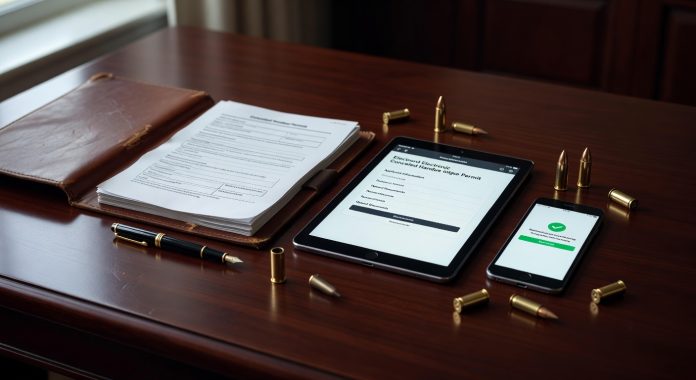
Virginia has taken a step to update its concealed handgun permitting process with the enactment of House Bill 101. Sponsored by Delegate Jason Ballard of the 42nd District, the bill modifies section 18.2-308.02 of the Code of Virginia to allow alternate methods for submitting applications for permits to carry concealed handguns. The law was approved by the governor on April 22, 2026, and becomes effective July 1, 2026, as Chapter 1034 of the 2026 Acts of Assembly.
The primary change introduced by the legislation is the removal of the exclusive requirement for written applications. Under the new provisions, individuals applying for concealed handgun permits may now submit their applications, required supporting documentation, and fees using electronic methods. These methods include online portals, email submissions, or other digital formats that the Department of State Police will establish and regulate. This modernization ensures that the process accommodates contemporary practices for handling official state documents and transactions.
Importantly, the bill does not alter any of the substantive requirements for eligibility. Applicants must still undergo comprehensive background checks, complete an approved course in firearms training, provide evidence of residency, and satisfy all other criteria outlined in state law for receiving a permit. The focus remains on maintaining high standards for who may lawfully carry a concealed handgun in Virginia.
The legislative journey of House Bill 101 demonstrated broad consensus. It passed the House of Delegates on January 29, 2026, by a vote of 98 to 1. The Senate followed with approval on February 25, 2026, passing the bill unanimously with a 40 to 0 vote. The bill advanced through key committees, including a recommendation from the Firearms Subcommittee on January 22, 2026, by a 10 to 0 vote. It then moved to the Public Safety Committee, where it was reported on January 23, 2026, with a 21 to 1 vote. The Courts of Justice Committee reported it favorably on February 23, 2026, in a 14 to 0 decision. After enrollment and communication to the governor, the bill received approval, with the governor’s recommendations adopted unanimously in both the House and Senate on April 22, 2026.
This update to the application process is expected to make it more user-friendly for qualified residents. By enabling electronic submissions, the Department of State Police can implement secure systems that verify applicant information efficiently. The agency is responsible for developing the necessary protocols to handle digital applications while ensuring the same level of scrutiny applied to paper submissions.
Analyses of the bill’s fiscal impact suggest that any costs associated with setting up electronic systems will be minimal. This practical change aligns with the goal of improving government efficiency in processing requests for concealed handgun permits. Residents across Virginia, from urban centers to rural communities, will have the option to apply using methods that fit their individual circumstances, potentially expediting the overall timeline from submission to approval or denial.
The bill’s provisions empower the Department of State Police to create rules for electronic submissions that guarantee security and compliance with all legal standards. This includes measures to confirm the identity of applicants and the authenticity of submitted materials. Such rules will help prevent fraud and maintain the reliability of the permitting process.
Furthermore, the legislation recognizes that many official interactions with government now occur digitally. Allowing electronic applications for concealed handgun permits brings this important function in line with other areas of state administration, such as tax filings or license renewals. This consistency can improve overall citizen satisfaction with government services related to firearms ownership and use.
Law-abiding Virginians who qualify for concealed carry permits can now pursue their applications with greater ease. The option for online submission may particularly assist those who live far from regional offices or prefer to handle paperwork from home. Despite the convenience, the requirement for in-person training and other verifications ensures that the process remains thorough.
The unanimous or near-unanimous votes in the Senate and strong majority in the House reflect the recognition that updating application methods does not compromise the intent of the original statutes governing concealed handguns. Instead, it modernizes them for current realities.
As this law takes hold, it is anticipated that the number of applications processed could increase due to the reduced barriers in submission, though eligibility remains strict. The Department of State Police will monitor the implementation to ensure smooth operation.
This development comes at a time when many states are reviewing their permitting procedures for concealed firearms. Virginia’s approach through House Bill 101 provides a model for balancing tradition with innovation in public policy.































