
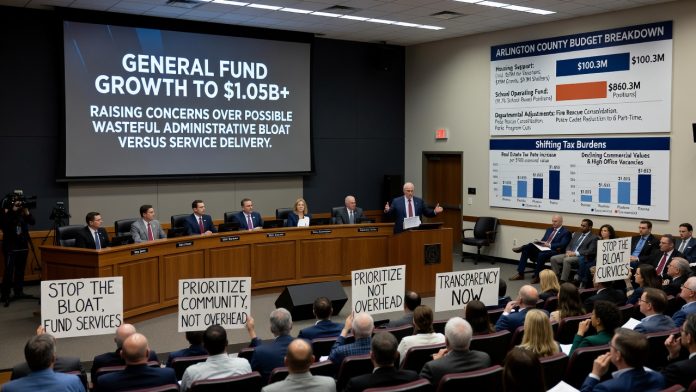
Arlington County officials have officially adopted a comprehensive $1.7 billion budget that navigates significant fiscal challenges while sparking intense debate over administrative spending. The financial plan represents a minimal 0.7 percent increase over the previous fiscal year, marking a rare period of constrained growth for the municipality. At the heart of the budget discussions is a growing public concern regarding potential administrative bloat and the critical need to preserve direct service delivery. Residents and watchdog groups are closely monitoring how the county balances its operational overhead against the funding required for essential community programs. Local leaders face mounting pressure to justify every dollar spent on internal management structures during this period of economic transition.
The current Arlington County Board consists of Libby Garvey, Matt de Ferranti, Takis Karantonis, Susan Cunningham, and Maureen Coffey. During the budgetary process, County Manager Mark Schwartz was directed to provide proposals for program and service reductions if a balanced budget could not be achieved under existing tax rates. Schwartz identified potential cuts totaling $14 million that would have significantly reduced service delivery and negatively affected priority programs across multiple departments. Ultimately, Schwartz explicitly stated he did not recommend implementing these reductions, prompting the board to seek alternative revenue sources. The board agreed that preserving core services was paramount, even if it required asking residents to shoulder a heavier financial burden.
Shifting Tax Burdens and Fiscal Constraints
To bridge the funding gap without slashing essential services, the board approved a real estate tax rate increase of two cents. This adjustment raises the rate from $1.033 to $1.053 per $100 of assessed property value, directly impacting local homeowners. The necessity for this tax hike stems from a sharp decline in commercial real estate values and persistently high office vacancy rates throughout the region. Consequently, the local tax burden has shifted heavily onto residential property owners, creating friction among taxpayers who demand greater efficiency in local government operations. Financial analysts note that until the commercial sector recovers, residential taxpayers will likely continue to bear the brunt of local government funding requirements.
Housing support remains a substantial component of the newly adopted budget, with $100.3 million allocated to assist vulnerable populations. This funding includes $29 million designated for Housing Choice Vouchers, $19 million for housing grants, and $9.1 million to sustain local homeless shelters. Despite these significant investments, financial constraints have forced the implementation of a waitlist for the locally funded housing grant program, alongside new spending caps. These limitations highlight the ongoing struggle to meet increasing community needs while operating under strict fiscal limitations and a heavily scrutinized revenue stream. Advocates for the homeless have expressed concern that these new caps could leave some of the county’s most at-risk residents without adequate support.
Departmental Impacts and Public Backlash
Various county departments are experiencing operational shifts and service reductions as a direct result of this constrained fiscal environment. The Fire Department is currently consolidating two specialized rescue units into a single operational team to maximize resource efficiency. Similarly, the Police Department has reduced its Cadet Program from ten available positions down to just six part-time roles. Meanwhile, the Department of Parks and Recreation faced severe public backlash after proposing the elimination of local gymnastics programs, illustrating the community’s strong attachment to direct recreational services. These departmental adjustments underscore the difficult choices municipal leaders must make when balancing a tight budget against high public expectations.
Arlington Public Schools also faced intense scrutiny regarding the balance between classroom resources and administrative overhead. The adopted school budget stands at $860.3 million, which represents an increase of $15.7 million over the previous fiscal year. In a clear effort to prioritize direct educational services, school-based positions now account for 91.7 percent of the total School Operating Fund workforce. This slight increase from 91.3 percent the previous year reflects a deliberate administrative strategy to shield classrooms from the broader financial constraints impacting the county. Parents and educators alike have praised this shift, arguing that keeping funds concentrated at the building level is essential for student success.
Transparency and Administrative Overhead
To address ongoing concerns about wasteful spending, local government watchdogs have emphasized the need for comprehensive workforce restructuring. The newly adopted budget eliminated 8.25 filled positions and 11.5 unfilled positions while freezing an additional 15.5 roles to control administrative costs. The Fiscal Affairs Advisory Commission specifically recommended that the county enhance transparency by including detailed information on administrative staffing and overhead in future budget documents. The commission views this tracking effort as a vital opportunity to improve cost-effectiveness, strengthen public trust, and ensure resources flow toward direct service delivery. Interestingly, the commission also recommended increased funding for administrative staff support within the Community Oversight Board to ensure proper operational accountability.
Public commentary surrounding the budget frequently highlighted the disparity between highly compensated managers and lower-paid front-line workers. Local media outlets and residents have described the current workforce reductions as a small step in the right direction, though many continue to demand a more holistic review of executive compensation. County Board Chair Matt de Ferranti acknowledged these complex dynamics, stating that the board ultimately decided to focus on public safety and ensuring vulnerable populations have necessary resources. Following months of deliberation and thousands of public comments, the final budget attempts to walk a delicate line between fiscal responsibility and compassionate community support. As the new fiscal year approaches, county officials will remain under strict observation to see if these budgetary compromises effectively serve the broader community.
Email the Arlington County School Board Members:
Bethany Zecher Sutton – bethany.zechersutton@apsva.us,
Miranda Turner – miranda.turner@apsva.us,
Monique Bryant – monique.bryant@apsva.us,
Kathleen Clark – kathleen.clark2@apsva.us,
Zuraya Tapia-Hadley – zuraya.tapiahadley@apsva.us,