
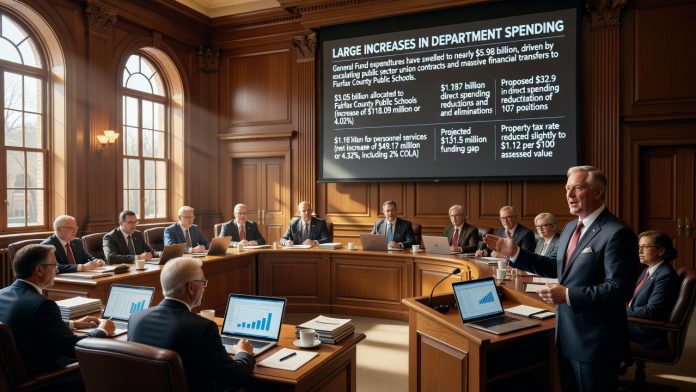
The Fairfax County government has unveiled its advertised budget for the upcoming fiscal year, featuring General Fund expenditures that have swelled to nearly $5.98 billion. This substantial increase in department spending is primarily driven by escalating public sector union contracts and massive financial transfers to local schools. Despite these soaring costs, the proposal includes a slight reduction in the property tax rate, dropping it from $1.1225 to $1.12 per $100 of assessed value. County officials are now tasked with balancing these expansive financial commitments against a projected funding gap of $131.5 million.
The Fairfax County Board of Supervisors will be responsible for reviewing, adjusting, and ultimately approving this complex financial blueprint. The current board includes Chairman Jeffrey McKay, James Walkinshaw, Jimmy Bierman, Walter Alcorn, Rodney Lusk, Dan Storck, Dalia Palchik, Pat Herrity, Kathy Smith, and Andres Jimenez. These elected officials must navigate the competing demands of various county departments while ensuring fiscal responsibility. Their upcoming deliberations will determine how the county addresses the remaining funding gap without compromising essential public services.
Education Funding and Financial Transfers
A significant portion of the proposed budget is dedicated to massive financial transfers directed toward Fairfax County Public Schools. The advertised plan allocates $3.05 billion to the school system, representing an increase of $118.09 million or 4.02 percent over the previous fiscal year. Over the past three years, the total financial transfer to the educational system has increased by an average of nearly six percent annually. Even with this massive allocation of local tax dollars, the proposed educational funding still falls short of the school system’s initial financial requests.
The school superintendent originally requested a $138.4 million increase, which would have represented a 5.1 percent jump over the prior year’s budget. However, the current advertised county budget leaves a shortfall of between $36 million and $44 million compared to that ambitious request. To streamline some youth operations, funding for programs like the Middle School After School program and transition services is being transferred from the Department of Neighborhood and Community Services and the Community Services Board directly to the school district. This administrative restructuring aims to consolidate educational and youth support services under a single organizational umbrella. Officials hope this consolidation will create operational efficiencies moving forward.
Personnel Costs and Union Contracts
Escalating public sector union contracts represent another major driver behind the swelling general fund expenditures. Personnel services now account for $1.187 billion of the budget, marking a net increase of $49.17 million or 4.32 percent over the revised budget plan for the previous year. This massive personnel figure includes a two percent cost of living adjustment for eligible employees to meet recently negotiated collective bargaining agreements. County officials emphasize that maintaining competitive compensation packages is absolutely necessary to attract and retain qualified staff in the region.
County Executive Bryan Hill highlighted the ongoing external pressures affecting the county workforce and overall operational costs during his budget presentation. He stated that the county continues to face a highly competitive labor market alongside cost increases stemming from recent federal legislation. Hill also pointed to the growing financial demands associated with aging government facilities and the urgent need for a resilient, modern information technology infrastructure. Addressing these overlapping pressures requires careful allocation of increasingly strained municipal resources across all departments.
Budget Cuts and Departmental Reinvestments
To accommodate these large spending increases in education and personnel, the county administration has proposed significant reductions elsewhere in the budget. The advertised plan includes $32.9 million in direct spending reductions and the elimination of 107 existing county positions. These proposed cuts bring the total amount of budget reductions since the 2024 fiscal year up to a staggering $124.5 million. Last year alone, the county proposed $59.8 million in reductions, marking the most substantial cuts since the local government slashed $90 million following the 2008 economic recession.
Despite the widespread cuts, certain critical areas are slated for financial reinvestment to address long-deferred maintenance and technological upgrades. Following the Great Recession, baseline funding for capital renewal and information technology was largely eliminated, forcing the county to rely heavily on one-time funding at quarterly reviews. Hill noted that while this reactive approach allowed the county to manage for many years, it is no longer a sustainable financial strategy. The new budget proposal deliberately begins rebuilding baseline funding for these essential infrastructure needs to prevent future systemic failures.
Navigating Future Fiscal Challenges
While overall expenditures are rising rapidly, the county is simultaneously expanding targeted community programs like affordable housing development. The new budget includes the addition of three full-time staff members dedicated exclusively to supporting affordable housing activities across the jurisdiction. Balancing these new community initiatives with the reduced property tax rate contributes directly to the current structural funding gap. Administrators must carefully monitor these specialized investments to ensure they deliver measurable results for local residents.
The formal presentation of the budget sets the stage for complex public deliberations in the coming months as officials work to finalize the fiscal plan. Hill presented the advertised budget plan stating he did so with a sense of pride, a renewed optimism, and a clear recognition that significant fiscal challenges remain. Local leaders must now weigh the inflexible demands of collective bargaining agreements and school funding against the realities of a constrained revenue environment. The final budget adoption will dictate the county’s financial trajectory and operational priorities for the foreseeable future.
Email Fairfax County Supervisors At:
Jeff McKay – chairman@fairfaxcounty.gov,
Kathy Smith (Sully District) sully@fairfaxcounty.gov,
Rachna Heizer (Braddock District) braddock@fairfaxcounty.gov,
James Bierman (Dranesville District) dranesville@fairfaxcounty.gov,
Rodney Lusk (Franconia District) franconia@fairfaxcounty.gov,
Walter Alcorn (Hunter Mill District) huntermill@fairfaxcounty.gov,
Andres Jimenez (Mason District) mason@fairfaxcounty.gov,
Daniel Storck (Mount Vernon District) mtvernon@fairfaxcounty.gov,
Dalia Palchik (Providence District) providence@fairfaxcounty.gov,
Pat Herrity (Springfield District) springfield@fairfaxcounty.gov,