
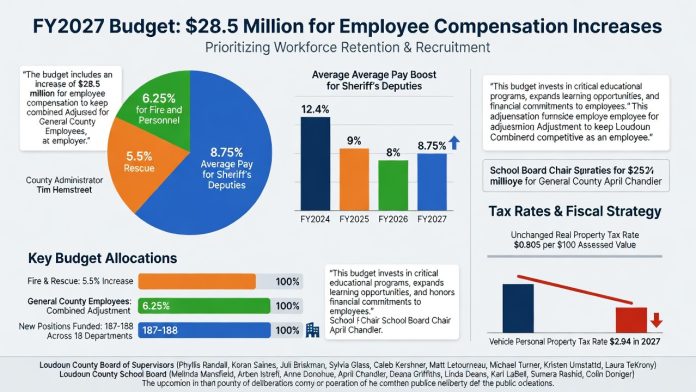
Loudoun County officials have officially unveiled the proposed fiscal year 2027 budget, which heavily prioritizes long-term workforce retention and recruitment through substantial compensation enhancements. At the center of this comprehensive financial plan is a $28.5 million allocation specifically designated for employee pay increases across multiple municipal departments. County Administrator Tim Hemstreet emphasized the absolute necessity of these funds, stating the budget includes an increase of $28.5 million for employee compensation to keep Loudoun competitive as an employer. By targeting key public safety and administrative sectors, the county aims to stabilize its workforce amid regional economic pressures and a highly competitive job market.
The budget requires comprehensive review and final approval from the Loudoun County Board of Supervisors, which currently includes Phyllis Randall, Koran Saines, Juli Briskman, Sylvia Glass, Caleb Kershner, Matt Letourneau, Michael Turner, Kristen Umstattd, and Laura TeKrony. Educational appropriations within the financial plan also involve close coordination with the Loudoun County School Board, comprising Melinda Mansfield, Arben Istrefi, Anne Donohue, April Chandler, Deana Griffiths, Linda Deans, Kari LaBell, Sumera Rashid, and Colin Doniger. These elected officials face the complex task of balancing competitive employee compensation with strict fiscal responsibility to local taxpayers. Their upcoming public deliberations and final voting sessions will ultimately determine the exact distribution of these proposed municipal funds.
A significant portion of the proposed compensation package is directed toward local law enforcement, with Loudoun County Sheriff deputies slated to receive an average pay boost of 8.75 percent. This specific adjustment consists of a 5.75 percent salary scale increase combined with a standard step increase for all eligible personnel. Historical budget data reveals that this FY2027 proposal is slightly higher than the 8 percent increase adopted in FY2026, though it remains lower than the 12.4 percent and 9 percent boosts approved in FY2025 and FY2024 respectively. This carefully tiered approach to law enforcement compensation is specifically designed to reduce departmental turnover and attract highly experienced officers to the rapidly growing jurisdiction.
EXPANDING COUNTY SERVICES AND EDUCATIONAL SUPPORT
Beyond law enforcement, the proposed financial plan ensures that other critical public safety and administrative personnel receive necessary and timely salary adjustments. Fire and Rescue department employees are scheduled to receive a 5.5 percent compensation increase to maintain strict parity with other regional emergency service agencies. Meanwhile, general county employees will see a combined 6.25 percent adjustment, which helps directly address ongoing cost-of-living concerns and regional inflation. To support the successful opening of newly constructed county facilities, the budget also fully funds between 187 and 188 new positions spread across eighteen different municipal departments.
SUPPORTING PUBLIC SCHOOLS AND AFFORDABLE HOUSING
Education remains a highly prominent pillar of the county’s financial strategy, with substantial resources directed toward Loudoun County Public Schools to heavily support both staff and students. School Board Chair April Chandler noted that the board’s approval of this budget reflects deeply shared community values and a fundamental responsibility to support students, staff, and families. Chandler further stated that the budget invests in critical educational programs, expands learning opportunities for students, and honors financial commitments to employees, all while positioning the school system for continued future success.
In direct addition to employee compensation and educational funding, the FY2027 budget places a remarkably strong emphasis on addressing regional affordability challenges. County officials have deliberately allocated $29 million directly to the local Housing Fund to support various affordable housing initiatives throughout the sprawling jurisdiction. This targeted financial investment aims to provide viable, long-term living options for essential workers, including the very teachers, deputies, and firefighters receiving the proposed salary increases. By strategically coupling wage enhancements with robust housing support, local leaders hope to create a much more sustainable economic environment for the entire municipal workforce.
TAX RATES AND LONG-TERM FISCAL STRATEGY
Despite the highly significant investments in personnel and affordable housing, the county intends to maintain strict stability in its primary revenue collection mechanisms. The real property tax rate is projected to remain entirely unchanged from the previous calendar year, holding steady at $0.805 per $100 of assessed real estate value. However, to help directly offset the financial burden of rising property assessments on local residents, the vehicle personal property tax rate is scheduled to drop to $2.94 in 2027. This strategic adjustment in vehicle taxation provides highly targeted relief to taxpayers while simultaneously preserving the revenue streams strictly necessary to fund the $28.5 million compensation package.
The comprehensive FY2027 budget ultimately reflects a delicate balancing act between aggressive workforce investment and measured, long-term fiscal restraint. By prioritizing consistent and competitive wage growth, local administrators clearly acknowledge that retaining experienced public servants is ultimately far more cost-effective than constantly recruiting and training brand new personnel. The combined, collaborative efforts of the Board of Supervisors and the School Board highlight a highly unified approach to managing the rapid population growth that has defined the region for decades. As the final budget adoption phase rapidly approaches, local residents will watch closely to see exactly how these strategic financial commitments shape the future of local government services.
Email the Board of Supervisors at:
Phyllis J. Randall (Chair, At-Large) – Phyllis.Randall@loudoun.gov,
Michael R. Turner (Vice Chair, Ashburn District) – Mike.Turner@loudoun.gov,
Juli E. Briskman (Algonkian District) – Juli.Briskman@loudoun.gov,
Sylvia R. Glass (Broad Run District) – Sylvia.Glass@loudoun.gov,
Caleb Kershner (Catoctin District) – caleb.kershner@loudoun.gov,
Matthew F. Letourneau (Dulles District) – Matt.Letourneau@loudoun.gov,
Kristen C. Umstattd (Leesburg District) – Kristen.Umstattd@loudoun.gov,
Laura A. TeKrony (Little River District) – Laura.TeKrony@loudoun.gov,
Koran Saines (Sterling District) – Koran.Saines@loudoun.gov